
There are increasing reports that the US is reaching out to Kurdish Iranian opposition groups. This comes four days after the US and Israel began airstrikes on Iran. Five Kurdish Iranian groups formed a coalition on February 22, in which they agreed to work together against the regime. T
This is important because these groups don’t always agree on policy, and they have different ideologies. CNN reported on March 3 that “also on Tuesday, President Donald Trump spoke with the president of the Democratic Party of Iranian Kurdistan (KDPI), Mustafa Hijri, according to a senior Iranian Kurdish official. KDPI was one of the groups targeted by the IRGC.”
Iran has been increasingly targeting the Kurdish Iranian opposition groups, which have bases in the Kurdistan Region of Northern Iraq. Iranian attacks have targeted sites of the Kurdistan Freedom Party (PAK), the Democratic Party of Iran, and also Komala in the last several days. Iran appears to have increased attacks, as reports indicated that US President Donald Trump was reaching out to Kurdish leaders in the Kurdistan Region of Northern Iraq, as well as to Kurdish Iranian opposition groups.
When the Kurdish groups announced a coalition on February 22, they said, “We, the political parties signing the Political Forces Alliance of Kurdistan–Iran, have formed this alliance to continue our work and struggle in response to the current stage and political situation in the country. We have unified our forces and activities in Kurdistan and announced a political alliance. This alliance was reached after a period of opinion exchange and fieldwork under the framework of the ‘Center for Dialogue and Cooperation.’ The aim is to give greater importance to Kurdish political work in Iran and to strengthen the struggle of political parties against the Iranian Republic, as well as to secure the rights and freedom of the Kurdish people and to discuss building a new Iran.”
Which are the groups the US might be working with?
Democratic Party of Iranian Kurdistan (PDKI)
Founded in 1945 and now led by Mustafa Hijri, the PDKI is a historic Kurdish Iranian party. It has this long historic pedigree that also means it has historically had a close relationship with the Kurdistan Democratic Party in Iraq. Founded by Qazi Muhammad, the party has roots in the quest for an independent Kurdish state in 1945. A short-lived Kurdish state was declared in 1946. Muhammad was hanged in 1947 when the state collapsed under Iranian attacks. After the rise of the Islamic Republic in 1971, the PDKI was subjected to more attacks by the new regime. Its leadership was targeted for assassination. Its leader, Abdulrahman Ghassemlou, was murdered in 1989 by the Iranian regime.
Since 2004, Mustafa Hijri has led the group. He was born in 1945 and has long experience as a Kurdish leader. He is respected by Kurds in Iran and Iraq as well as around the world. When five Kurdish Iranian groups agreed to work as a coalition on February 22, Hijri sat at the center of the groups, announcing the coalition.
The PDKI works with Kurds from Iran, both inside Kurdish areas in western Iran and also in the Kurdistan Regional Government in Iraq. The Kurdish region of Iran is known as Rojhelat among Kurds. This means Eastern Kurdistan. Its bases have been targeted over the years. The PDKI is politically a centrist and nationalist group.
There was a period of time when PDKI had different branches with confusingly similar names. These included one branch of PDKI led by Khalid Azizi, sometimes also called KDP-I. Then there was the larger PKDI part led by Hijri, which was sometimes confusingly referred to as KDPI. They unified in 2022, ending the confusion.
The Kurdistan Freedom Party (PAK)
This group was founded in the 1990s. It is currently led by Hussein Yazdanpanah. It is a nationalist Kurdish group, and politically centrist. Yazdanpanah is well known among Kurds because he played a role in the war on ISIS alongside Kurdish Peshmerga of the KRG. The PAK members served alongside Peshmerga in many positions along the frontline from 2014 to 2017. They fought on the line of hills between Kirkuk and Hawija, and also above Bashiqa. In the Nawaran offensive to retake areas in the Nineveh plains, the PAK played a key role.
PAK fighters and Yazdanpanah became well known for heroism and willingness to always be at exposed frontline positions. After the KRG’s independence referendum, the group again came under attack by Iranian-backed militias during fighting in 2017 at Altun Kupri. Their service alongside the KRG’s Peshmerga means the PAK has warm relations with the KDP and other Kurdish groups.
Over the last few years, the PAK have continued to train for action in Rojhelat in Iran. Iran has also increased attacks on them since February 28. The PAK said on March 4 that one of its fighters was killed. “Martyr Jalal Rashidi, nom de guerre Kawan, as a result of a drone attack and shelling by the occupying and terrorist state of Tehran a short while ago, sacrificed his life for the freedom and independence of Kurdistan and joined the ranks of the martyrs,” the note. The PAK has women and male fighters, like other Kurdish groups that incorporate women in their ranks.
Kurdistan Free Life Party (PJAK)
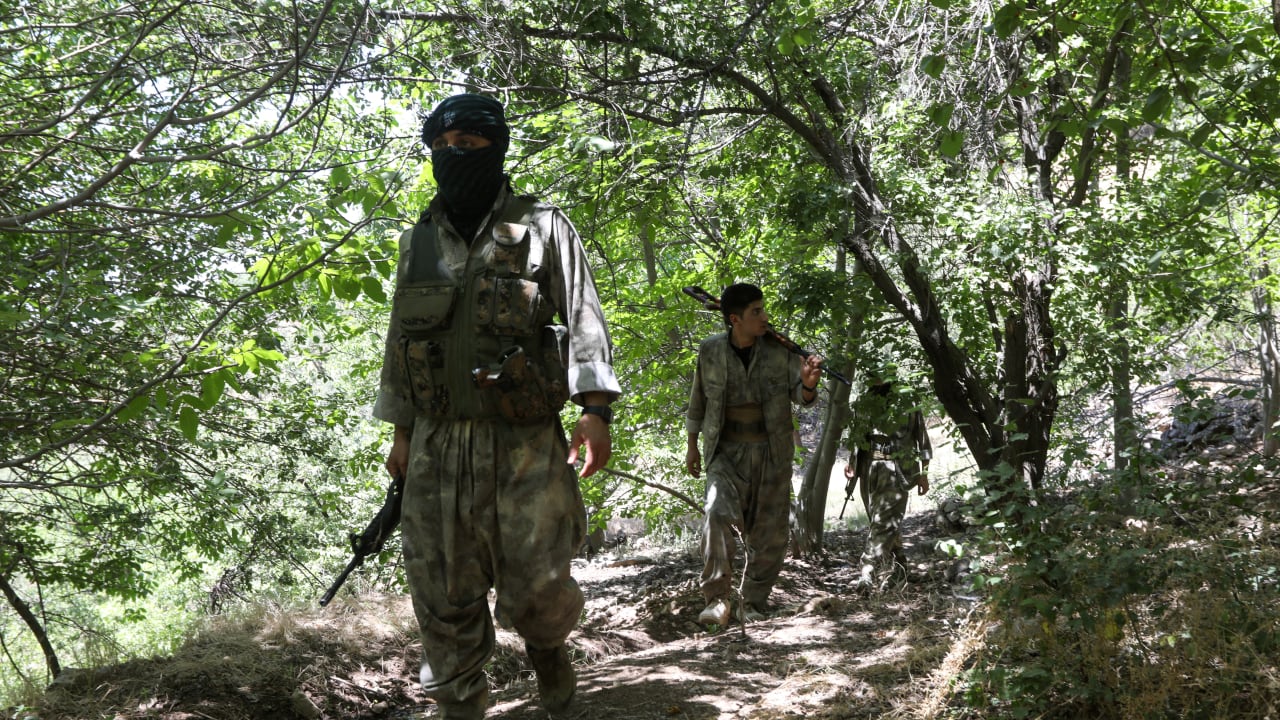
The Kurdistan Free Life Party, or PJAK, is a left-leaning Kurdish party. It is linked to the Kurdistan Workers Party (PKK) and was founded in 2004. Its roots are deeper, and it has said in the past that it has been active in Iran since 1997. As such, it is one of the most recent of the Kurdish Iranian opposition groups. However, many commentators believe that it actually has a large number of supporters and members, even though it is a more recent addition to the landscape. It is co-led by Payman Viyan. Among the Kurdish groups, PJAK is the one with a woman leader in the highest position.
Like the other Kurdish groups, PJAK has said it is open to cooperation with other groups in Iran that oppose the regime. It has been said in the past that “all ethnic, national and religious entities are secured with the fundamental rights of enjoying a life in their own community based on their own identity.”
Like the other Kurdish groups, it also said it works toward democracy, although it uses the term “democratic confederalism” in past statements. Some Kurdish groups believe that PJAK’s links to the PKK could lead to tensions with Turkey and intervention by Ankara if PJAK were seen as gaining too much influence. Unlike PDKI and PAK, which have maintained bases in areas near towns and cities in the KRG, the PJAK has usually shown its members training in the mountains. This may be one reason that Iran has not targeted it as much, because its forces are more dispersed in very rural areas.
Komala
The Komala party, which has several different branches, describes itself as “a social democratic political party from the Kurdish region of Iran. Komala has been seeking a secular democratic federal ruling system to replace the current theocratic regime.” It was founded in 1969 among Kurdish left-wing students. It has been operating since then and has often faced repression. It says that the repression has forced it to organize underground in Kurdish regions.
The Organization of the Toilers of Kurdistan, also known as the Komala – Reform Faction, joined with PDKI, PAK, PJAK, and a group called Khabat on February 22 to work as a coalition against Iran. Reza Kaabi is the leader of the Toilers faction of Komala. T
wo other branches of Komala did not join, likely because of their ideology, which is communist. Komala’s other branches have been called Komala Party of Iranian Kurdistan and sometimes also called Komala Zahmatkeshan and Komala Shoreshgaran. Abdullah Mohtadi is the leader and secretary general of the Komala Party of Iranian Kurdistan. Omar Ilkhanizadeh became Deputy Secretary General. The Iranian Communist Party, led by Ibrahim Alizadeh, is also linked to a Komala branch.
Khabat
The Iranian Kurdistan Solidarity and Democratic Party, also known as the Iranian Kurdistan Fighter Party, is called Khabat or Xebat. It is a more Islamic party of Kurds. It was founded in 1980. Its website notes that “at present, the party is led by its Secretary-General, Baba Sheikh Hosseini. It says it seeks autonomy for Kurds in Iran.” It notes that at “the beginning of the 1980s, a measure of autonomy was achieved in the Kurdish areas of western Iran after conflicts between Kurdish guerrillas and revolutionary guards.”