
Support for Hamas has fallen sharply, but the decline has not translated into stronger backing for the Palestinian Authority (PA), according to a new survey by the Palestinian Center for Policy and Survey Research (PSR).
For more stories from The Media Line go to themedialine.org
Instead, the poll points to broad distrust in Palestinian political leadership, a growing preference for negotiations over armed struggle, and an opening for alternative electoral figures ahead of legislative elections scheduled for November 28.
The findings, presented by Khalil Shikaki, director of PSR, point less to a transfer of support from one established faction to another than to a broader crisis of confidence in the Palestinian political system.
Support for Hamas has fallen from 35% 10 months ago to 24%, bringing it level with support for Fatah, also at 24%. At the same time, 44% of Palestinians now say that neither Hamas nor Fatah under President Mahmoud Abbas deserves to represent and lead the Palestinian people.
Among likely voters in legislative elections, Fatah receives 32% and Hamas 29%, a difference within the poll’s margin of error, while third parties collectively receive 18%.
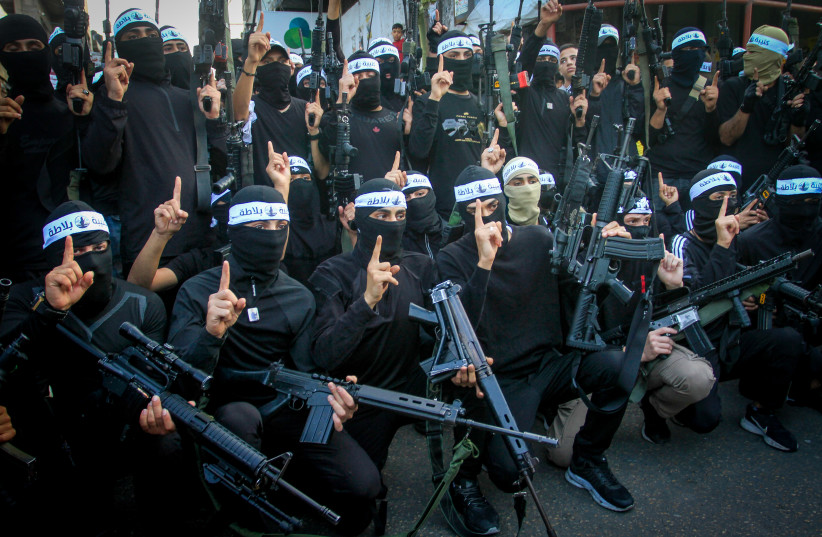
“The most dramatic finding has to do with the fact that Hamas has lost significant support from the Palestinian public,” Shikaki told participants at a media briefing.
The decline is particularly pronounced in the West Bank, where support for Hamas has fallen from 32% 10 months ago to 18%. In Gaza, support declined from 41% to 33%. Shikaki argued that the difference reflects the nature of the surge Hamas experienced immediately after October 7, particularly among West Bank Palestinians.
According to his analysis, that increase was not necessarily driven by greater identification with political Islam or Hamas’ ideological positions, but by the perception that Hamas was actively confronting Israel at a time of mounting Palestinian anger over Israeli policies and settler violence.
“The act itself of resorting to armed struggle in the eyes of the Palestinians was enough for them to support Hamas,” he said during the presentation.
The latest data suggest that some of that post-October 7 support is now reversing.
The change is also visible in perceptions of the Gaza war itself. Only 20% of respondents now say Hamas emerged victorious from the conflict, compared with 39% 10 months earlier. Sixty percent say neither side won, while 15% believe Israel emerged victorious. The shift is strongest in the West Bank, where the share describing Hamas as victorious fell from 48% to 21%.
Satisfaction with Hamas’ performance during the war has meanwhile fallen from 60% to 42%.
Yet declining support for Hamas does not amount to public backing for its immediate disarmament.
Seventy-two percent oppose Hamas giving up its weapons before a full Israeli withdrawal from Gaza, while only 20% support disarmament before such a withdrawal. An identical 72% believe that if Hamas disarmed first, the war would eventually resume and Israel would not completely withdraw.
The numbers illustrate one of the central contradictions emerging from the survey: Palestinians appear increasingly critical of Hamas’s political and military record while remaining deeply skeptical that unilateral concessions would produce an Israeli withdrawal or a durable end to the conflict.
Support increased for 1967 borders two-state solution among Palestinians
A similar contradiction appears in attitudes toward the peace process.
General support for a two-state solution stands at 44%, essentially unchanged from 10 months ago. But when respondents were offered a more specific formula - a Palestinian state based on the 1967 borders - support increased to 56%, including 61% in Gaza.
More consequentially, the preferred methods for achieving Palestinian political objectives appear to be shifting.
Negotiations are now considered the most effective strategy by 44% of respondents, up from 36% 10 months ago and the highest figure recorded by PSR in four years. Support for armed struggle as the most effective means fell from 41% to 27%, its lowest level during the same period. Support for peaceful popular resistance rose from 14% to 19%.

Shikaki cautioned against interpreting the findings as a wholesale rejection of armed resistance. Palestinians remain evenly divided over its broader effectiveness: half believe armed resistance has failed to protect Palestinians or end the occupation and instead contributed to the destruction of Gaza and refugee camps in the northern West Bank, while the other half reject that assessment.
The geographical divide is again substantial. In Gaza, 65% agree that armed resistance has been ineffective. In the West Bank, only 35% share that assessment. The data, therefore, are consistent with greater skepticism in Gaza toward military confrontation, even while insecurity and settlement-related fears in the West Bank continue to sustain support for forms of resistance.
Those concerns are visible elsewhere in the polling. Only 23% of Palestinians overall say they feel personally safe and that their families are safe. In the West Bank, the figure drops to 17%, compared with 31% in Gaza. Eighty-three percent believe corruption exists in PA institutions, and 65% describe the PA as a burden rather than an achievement.
For Shikaki, however, declining support for both Hamas and the current Fatah leadership also leaves political space that has not yet been filled.
At the conference, he described the dissatisfaction as a potential opening for new parties and independent political actors, particularly among younger Palestinians. “There is a fertile ground in the upcoming election for groups, pluralists, political parties, new leaders who want to lead. The dissatisfaction with Fatah and Hamas is clearly providing an opportunity for third parties, but most importantly for new parties that do not exist at the moment,” he said.
Youth could prove particularly important. Shikaki said younger Palestinians are among the most critical constituencies toward the PA and are less ideologically aligned with Hamas than older generations. They also tend to show lower support for the traditional two-state framework and relatively greater openness to a single democratic state with equal rights.
Imprisoned Fatah leader Barghouti receives strong Palestinian support
The most immediate political beneficiary of the leadership vacuum appears to be imprisoned Fatah figure Marwan Barghouti.
When respondents were asked who was best suited to succeed Abbas, 39% selected Barghouti, compared with 16% for Hamas leader Khalil al-Hayya and 15% for Mohammed Dahlan.
In a hypothetical presidential election among likely voters involving Barghouti, al-Hayya, and Abbas, Barghouti receives 54%, compared with 26% for al-Hayya and 14% for Abbas. Meanwhile, 79% of respondents want Abbas to resign.
The question of whether Barghouti could translate polling strength into actual political power was raised by The Media Line during the question-and-answer session at the briefing.
Asked whether Barghouti, despite remaining in an Israeli prison, could emerge as the principal alternative in the Palestinian elections, Shikaki stressed that imprisonment constrains his capacity to campaign directly but does not necessarily prevent a candidacy or an electoral list associated with him.
“Technically, he can do that. Legally, he can do that, unless the Palestinian Authority leadership, that is, the president, decides to issue a decree whereby this is made impossible for him on legal grounds. Right now, there is nothing to prevent him from doing so. The question is going to be how credible this electoral list is going to be,” Shikaki told The Media Line.
He pointed to Barghouti’s previous attempts to position himself independently of the official Fatah leadership and said a strong parliamentary performance could create a path toward a later presidential run.
“That’s, in my view, a very, very credible scenario. I can’t guarantee that this is going to be the case, but I think this would be the most credible scenario,” he said.
Palestinian legislative elections have been announced for November 28, with presidential elections expected in early 2027.
That timetable also raises another variable: Israel’s election, scheduled for October 27, about one month before the Palestinian legislative vote. In a second question from The Media Line, Shikaki was asked whether Palestinian political trends could change substantially depending on the outcome of the Israeli vote.
New Netanyahu government could lower Palestinian confidence in elections
Shikaki said the results could directly influence Palestinians’ perception of whether their own elections - and diplomacy more broadly - could deliver meaningful change. An Israeli result suggesting a government without some of the current coalition’s far-right components, he argued, could increase Palestinian confidence in political participation.
A renewed Netanyahu-led government, in his assessment, could produce the opposite response. “So, if on the other hand, it seems like Netanyahu is going to gain, I think this would be a message for Palestinians that these elections are going to be worthless,” Shikaki said.
“That is, that there will be nothing to be gained by going to elections because Israel isn’t either going to allow them or that whoever is elected isn’t going to be in a position to make much of a difference, whether through violence or diplomacy, as we clearly see now in the current survey, violence is no longer seen as effective,” he added.
Such an outcome, he added, could eventually reverse some of the movement away from armed confrontation reflected in the current polling.
Shikaki said that another Netanyahu-led government, coupled with continued settler violence and what Palestinians perceive as terrorism in the West Bank, could revive support for armed resistance and the belief that “Palestinians have to fight back and defend themselves violently if needed,” he said. That possibility underscores how conditional the changes captured by the survey remain.
In the emerging political vacuum, Barghouti’s popularity, the possible emergence of new electoral lists, and the interaction between the Israeli and Palestinian elections could become increasingly important.
The polling therefore captures not a settled political realignment, but a Palestinian public in transition - less convinced by the strategies and leadership that dominated the years following October 7, while still uncertain about what could credibly replace them.
The survey was conducted between August 5 and 8 among 1,270 Palestinians: 830 in the West Bank and 440 in Gaza. Interviews were conducted face-to-face, with residents displaced from inaccessible areas of Gaza interviewed in shelters. The margin of error was 3.5 percentage points.