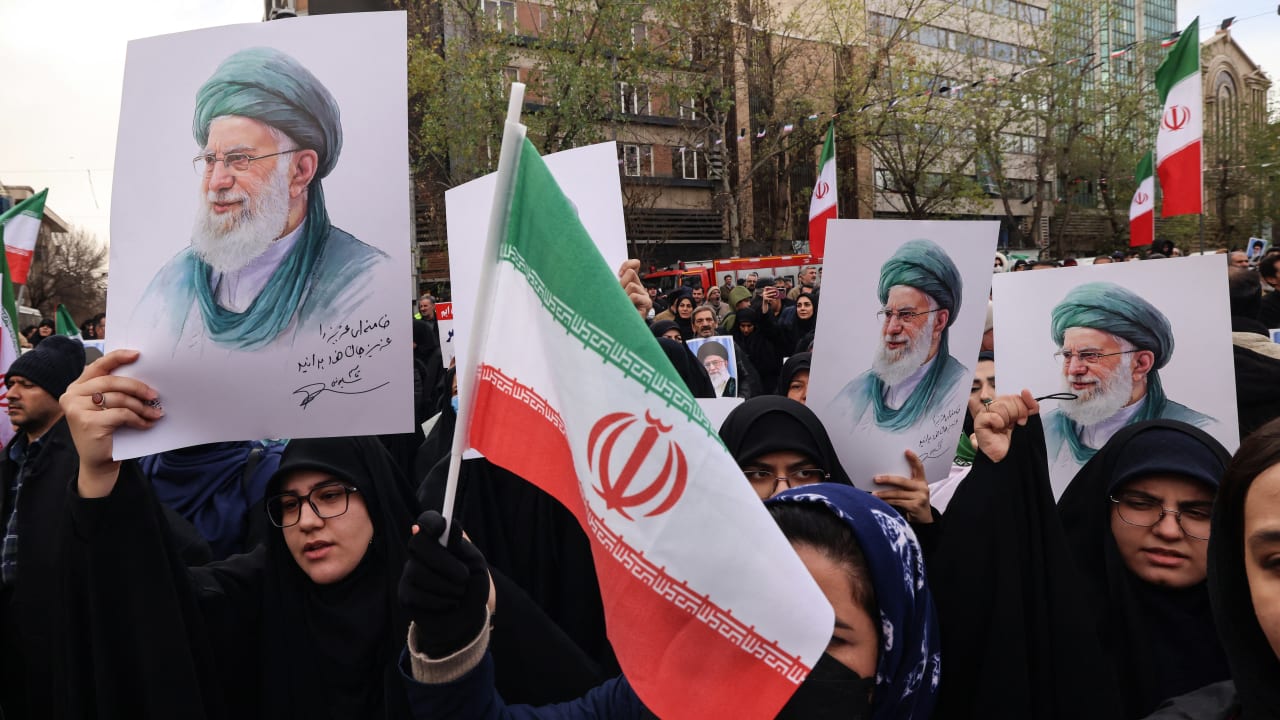
The Iranian regime is using “access diplomacy,” selectively granting entry to Western journalists or influencers seen as sympathetic to the regime or willing to operate within tightly defined boundaries, to reinforce Tehran’s narrative that foreign-backed “rioters” are behind the rising death toll and national instability, experts told The Jerusalem Post on Sunday.
By carefully curating who is allowed to report from inside the country, the regime can project an image of transparency while ensuring that coverage aligns with official messaging, they said. Those granted access often face strict parameters governing what they can film, whom they can interview, and how events may be framed.
Iran’s media landscape is overwhelmingly controlled by Tehran and its security apparatus.
Journalists and independent media outlets frequently face arbitrary arrests, intimidation, and heavy sentences handed down by revolutionary courts, according to the NGO Reporters Without Borders and numerous human rights organizations. Although Article 24 of the Constitution of the Islamic Republic of Iran theoretically guarantees freedom of the press, the 1986 press law gives authorities sweeping powers to censor reporting deemed to “endanger the Islamic Republic,” “offend the clergy and the supreme leader,” or “spread false information.”
ROGER MACMILLAN, a former director of the Persian diaspora site Iran International and an expert in military affairs, told the Post that there was no freedom of the press, only a “state-controlled narrative.”

“Anybody who flies counter to the regime narrative, as has happened to the likes of Iran International, they get labeled as a terrorist,” Macmillan explained.
The regime’s control over information has extended beyond traditional media. On January 8, authorities imposed a widespread Internet blackout, drawing condemnation from the European Parliament, multiple human rights organizations, and UN Special Rapporteur on human rights in the Islamic Republic of Iran, Mai Sato. They accused Tehran of attempting to obscure evidence of large-scale violence against protesters.
IRGC using influencers to legitimize narritive
With digital access largely restored, experts told the Post that Iran had reverted to its former tactics, using the media and influencers to legitimize its claims.
“The Iranian theocracy is remarkably good at understanding the value of shaping the information domain of war,” Lynette Nusbacher, a war historian and former British army intelligence officer, explained.
Unlike in traditional media, influencers “mostly don’t have editors, or they have really light-touch editors. Nobody is saying, ‘Bushra Shaikh, you’re ignoring other views,’ or ‘Bushra Shaikh, you’re credulously accepting the Iranian government line. Cut out that paragraph, and keep it factual,” Nusbacher said, referencing the British TV star-turned political commentator and self-described independent journalist who recently traveled to Iran.
Shaikh, who earlier made headlines for her social media posts on Jews and for blaming Prime Minister Benjamin Netanyahu for the Yom Kippur 2025 attack on Manchester Jewry, has largely mirrored the narrative of Tehran. Shaikh shared accounts of violent “rioters” who had wounded female journalists, stories of youth with “imported” bullets, and security officials being burned alive with wounds inflicted to their genitals.
“Far more important, Shaikh is giving people overseas a vocabulary for accepting the Iranian government line on the protests. She is positioning the protesters in Iran as violent rioters, and as people who commit violence against mothers and sexual violence against women,” Nusbacher explained.
“[Shaikh]’s offering the same message [as the regime], but to a different audience, in a different language.”
Tehran has consistently maintained that fatalities linked to the unrest stem from foreign-backed rioters rather than security forces.
Rebin Rahmani of the Kurdistan Human Rights Network previously told the Post that families of victims had been pressured to publicly attribute deaths to the protesters or lie about them being members of the Basij paramilitary force.
Amnesty International and other major human rights organizations have documented similar allegations.
JONATHAN HACKETT, a US Marine Corps veteran specializing in counterintelligence and the author of Iran’s Shadow Weapons: Covert Action, Intelligence Operations, and Unconventional Warfare, told the Post, “Shaikh’s recent trip to Iran to amplify pro-regime narratives about the recent protests and killings follows a well-trodden path for the regime’s influence operations. These range from maintaining close relationships with local media outlets in the UK, US, Bahrain, Yemen, and Lebanon to regime-sponsored conventions in Iran to attract witting and unwitting foreign public figures who will transmit pro-regime narratives to Western audiences.”
Macmillan added that Tehran brought influencers in recent weeks to “show the softer side of the regime, people like Bushra Shaikh and Calla Walsh have a following in the UK and the States… but they are decidedly skewed and are just parroting the regime’s narrative at [its] behest.”
American political activist Calla Walsh also reported from within Iran, using the talking points of the Islamic regime.
Filmed inside Iran’s Aerospace Exhibition Center, Walsh celebrated Iran’s “indigenous” missile program. Appearing on Iran’s Press TV, she also claimed the recent protests were “CIA and Mossad-backed” and aimed at regime change rather than beginning in response to the economic crisis plaguing the country.
“Glory to the indigenous Iranian missiles that rain down upon the Zionist entity, put settlers under the rubble, and strike existential fear in the cold hearts of the genocidal paedophilic Epstein American regime,” she wrote in one post.
Nusbacher noted that she would have described the missiles as “locally produced,” but Walsh chose language that resonates well with her viewers, which is why her plane ticket to Iran was a good investment for the IRGC. She speaks the language that influences her viewers. They don’t call her an ‘influencer’ for no reason.”
Walsh was hosted by the Islamic Republic of Iran Broadcasting for a four-day event in July called “Condemnation of Terrorism Against Media,” according to Iran International; but it is unclear who paid for her and Shaikh’s latest visit.
Neither Walsh nor Shaikh have yet responded to the Post’s request for comment.
Hackett added, “The regime uses these voices to speak to Western audiences unfamiliar with Iran’s domestic politics… The use of subtle yet clear pro-regime narratives is designed to counter existing narratives about the facts on the ground in Iran.”
Tsuriel Rashi, an expert in professional ethics from the School of Communication at Ariel University, told the Post that at the heart of the issue of influencers reporting on Iran was “the distinction between personal testimony and journalistic reporting.”
“Credibility hinges on methodology, independence, and accountability,” Rashi explained. “When reporting relies primarily on personal experience rather than corroborated sources, documentary evidence, or multiple viewpoints, it lacks the epistemic robustness expected of professional journalism.”
Strict standards enforced for journalists
Reporters, unlike influencers, are held to professional standards but still have to handle “access diplomacy” under authoritarian regimes. These regimes often “grant entry selectively to shape international perception,” he explained.
HACKETT EXPLAINED that Iran has out in place “universal requirements for foreign journalists,” which include “a minder [to] be assigned to accompany foreign journalists and their crews, that film and media must be reviewed, that specific Iranian locations must be included in certain footage, for example Imam Khomenei’s portrait or negative US/Israel imagery, and certain things must be excluded, such as military facilities, certain prisons, protests, etc.”
While difficult, it is not impossible for traditional media to ethically report from within Iran, Rashi shared, stressing the need for “deliberate safeguards.”
“Reporters should explicitly state the terms of access, including any limitations imposed on movement, filming, or interviewing… Observations should be framed as partial and contingent, not comprehensive. Personal impressions must be distinguished from verified systemic realities,” he explained.
“Ethical coverage should incorporate external expertise, diaspora voices, independent analysts, and documented human rights findings to counterbalance controlled exposure…
“Journalists must resist presenting orchestrated scenes as organic social reality, [and] claims made during guided visits should be cross-checked after departure, when freer communication is possible,” Rashi said.
When the BBC’s chief international correspondent, Lyse Doucet, reported from inside Iran for the first time since the regime began its crackdown on protesters last month, it was clearly disclosed that the regime had granted permission under the condition that the footage not be used for BBC Persian. Her report highlighted the voices and fears of Iranians while also informing of the regime’s stance.
RASHI NOTED, “When a major broadcaster such as the BBC negotiates limited access under restrictive conditions, the strategy is technically pragmatic rather than ideological. It reflects a calculus: Partial access may yield valuable reporting that would otherwise be unavailable. In exchange, the broadcaster may accept constraints, such as limiting distribution to certain services… The decision not to share footage with BBC Persian likely reflects the Iranian authorities’ specific political sensitivities toward that service. The BBC’s strategy appears to preserve some level of on-the-ground presence while navigating geopolitical barriers.”
Rashi further explained that “authoritarian access presents a structural ethical dilemma for all journalists, not only independent commentators. Total refusal of access eliminates firsthand reporting; unconditional acceptance risks co-optation. Ethical journalism in such contexts is best understood as a spectrum of constrained truth-seeking rather than a binary of propaganda versus objectivity.”
He concluded by saying that “the central ethical question is not whether reporting occurs under constraint, since nearly all foreign reporting does, but whether those constraints are acknowledged and counterbalanced. Transparency, contextual rigor, and methodological humility are the decisive factors in maintaining both credibility and ethical integrity.”