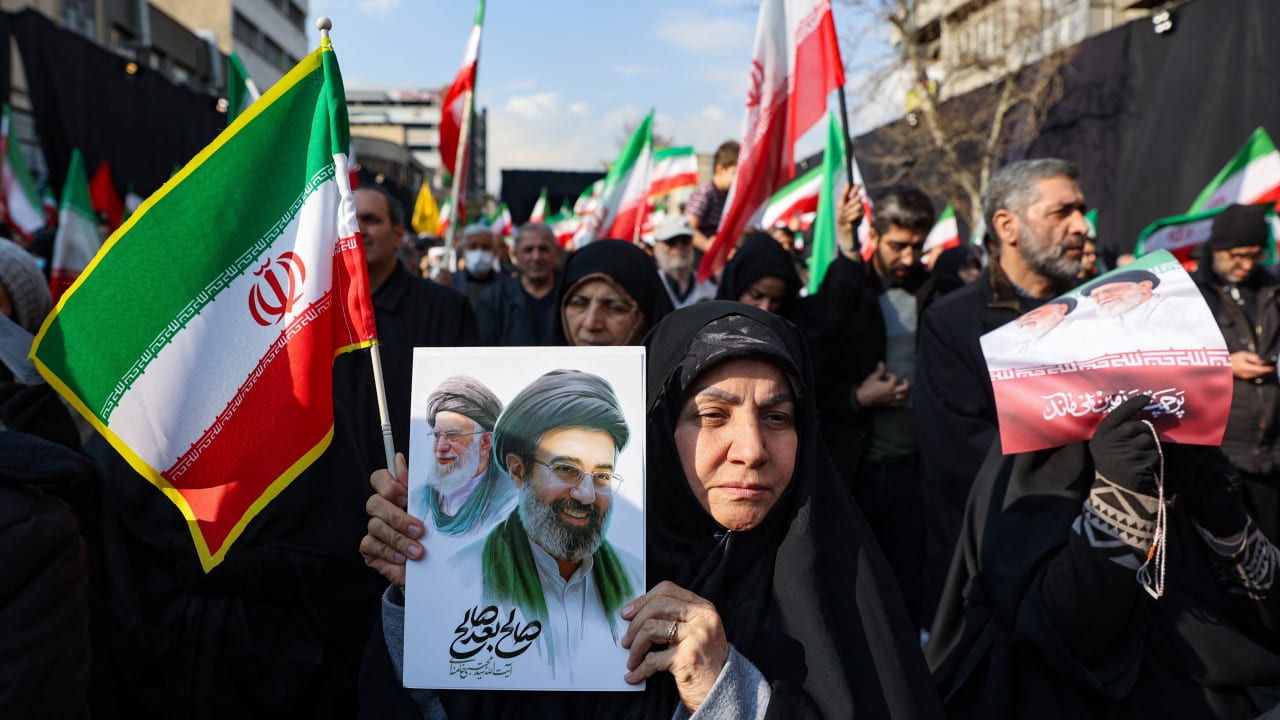
The ascension of Mojtaba Khamenei to the role of Iran’s supreme leader marks a watershed moment in the history of the Islamic Republic.
For decades, experts say, the regime has attempted to maintain a facade of republicanism intertwined with theocratic rule. However, the succession from father to son strips away this facade, transforming the regime into a dictatorship and exposing severe vulnerabilities within Tehran’s power structures.
According to Dr. Tamar Eilam Gindin of the Ezri Center for Iran and Persian Gulf Research at the University of Haifa, the move violates the core tenets upon which the Islamic Republic was founded.
"This is kingship. This is like royal succession. It’s the ultimate sign of dictatorship," she explained, noting the historical irony for a nation that overthrew a monarchy 45 years ago. She highlighted that Mojtaba fundamentally lacks the qualifications traditionally required for the role. "He doesn't qualify because he's not an Ayatollah, and he doesn't have executive experience. At least his father was a Friday preacher and the president."
Dr. Raz Zimmt, Director of the Iran Program at the Institute for National Security Studies (INSS), echoed this assessment, describing the appointment as a fatal blow to the regime's ideological foundation. "This appointment points to the collapse of any basis of legitimacy for this government," Zimmt noted. "The Iranian regime today is pictured much more clearly as an Assad-style regime, with everything that implies. It is another nail in the coffin of the legitimacy of the Islamic Republic."

Despite his new absolute power, Mojtaba Khamenei remains an enigma even to the Iranian people. Operating almost exclusively behind the scenes, he was rarely seen in public, with the first known video of him speaking reportedly only emerging in 2024. According to Gindin, his sudden elevation was met mostly with "uncontrollable laughs" from the Iranian public.
Yet, beneath this lies a figure deeply entrenched in the regime's darkest machinations. Zimmt pointed out that while Mojtaba's exact personal ideologies are rarely publicized, his historical alliances speak volumes.
"We can assume that because he managed his father's office, he is aligned with more radical, hawkish circles," Zimmt said. "Reformist opposition reports have previously claimed he was heavily involved in falsifying the results of the 2009 presidential elections (which resulted in the Green Revolution protest movement). His ties with the Islamic Revolutionary Guards Corps (IRGC) and intelligence organizations point him in a more extreme direction."
Power dynamics in Tehran shifting towards IRGC
With the supreme leader functioning as a shadowy figurehead, the true power dynamics in Tehran are shifting rapidly toward the IRGC. Gindin painted a chaotic picture of the streets of Iran, where communication is heavily restricted, and the IRGC has established heavy checkpoints, with locals describing them as "walking around like ISIS."
For the Iranian public, whose "soul is already sick of the regime," as Zimmt described it, Mojtaba's appointment does not fundamentally change their daily suffering, but it does clarify the battle lines. The true threat to the regime, Gindin argued, will not come from spontaneous anger over the succession, but from organized opposition.
She noted that millions of Iranians look to exiled Crown Prince Reza Pahlavi for leadership, waiting for his signal to take to the streets, as they did to historic effect in recent years.
The power vacuum has also led to public insubordination against the civilian government. Gindin cited a recent incident where President Masoud Pezeshkian apologized for Iranian forces firing at neighboring Gulf countries.
Just hours later, the IRGC openly defied him by firing at Dubai and other Gulf countries, with IRGC-affiliated Telegram channels stating: "Don't listen to the president, this is a war now, we're in charge. The president doesn't know anything."
However, Zimmt cautioned against viewing the IRGC as a single, unified entity that will effortlessly control the new supreme leader. "The IRGC is not a monolithic body," Zimmt explained. "He might be supported by one faction, while others are less enthusiastic. Furthermore, if Mojtaba remains in power over time, he may decide that he does not like this dependence and could initiate a purge within the guards."