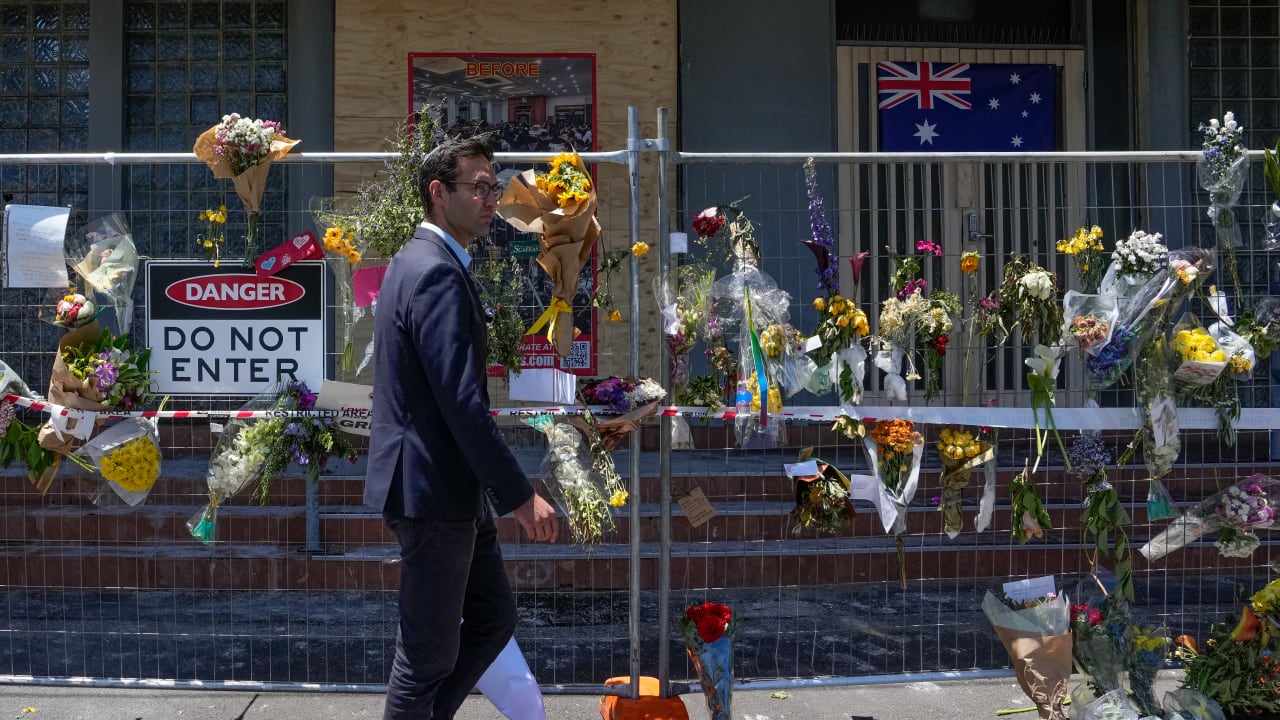
In an unprecedented diplomatic move, Australia expelled Iran’s top diplomat and severed formal ties after its intelligence services verified Tehran’s role in two antisemitic attacks: an arson at a synagogue in Melbourne and an assault on a kosher food company in Sydney. This was not street-level hate – it was state-sponsored extremism.
For many Australians, these revelations were a wake-up call. But for those who track Iran’s playbook, they were entirely predictable. The Islamic Republic has long weaponized antisemitism, not just as domestic rhetoric, but as a projection of global power. What we’re witnessing in Australia is not an isolated act of hostility, but part of a broader campaign: undermining Western democracies by attacking their pluralistic foundations from within.
Australia responded with rare clarity. In addition to the expulsion, Canberra officially designated Iran’s Revolutionary Guard Corps as a terrorist organization and issued its highest-level travel advisory: Do not travel to Iran. It was a direct rebuke to a regime that uses diplomacy as cover for espionage, intimidation, and ideological warfare.
Australia isn’t the only country being targeted by the Iranians. Since the Israel-Hamas War broke out in October 2023, there have been several foiled Iranian-linked attempts to attack Jewish or Israeli targets in various countries across Europe, such as the UK, Sweden, Germany; and around the world, such as the assassination plot on Rabbi Shneor Segal in Azerbaijan.

Australia's vulnerability to antisemitic warfare
So why was Australia chosen as a target, and what made the country potentially vulnerable to antisemitic warfare, specifically from Iran?
• Strategic American ally: Australia is a cornerstone of America’s Indo-Pacific strategy, a democratic nation in a region increasingly shaped by strategic competition with China. Since the 2021 AUKUS pact (the trilateral security partnership between the US, UK, and Australia), its strategic value has only grown. By targeting Australia, Iran is signaling that no ally of the West is beyond reach.
• Large and visible Jewish community: With roughly 120,000 members, highly visible, well integrated in society, concentrated in Melbourne and Sydney, and known for their support of Israel, Australia’s Jews are both symbolic and strategic targets. As one of the largest Jewish communities, the Australian Jewish community has many well-known buildings that provide easy-to-locate targets.
• Rise in antisemitism: Australia has been one of the worst when it comes to the rise in antisemitism since Hamas’s terrorist attack on Israel on October 7, 2023. From then to October 2024, there were more than 2,000 antisemitic incidents in the country, according to the Executive Council of Australian Jewry.
In the past year alone, antisemitic incidents in the country have surged by 317%. In addition, the recent rise in public support for Pro-Palestinian positions created the atmosphere that allows externally supported and funded attacks appear as if their grassroots.
Iran didn’t manufacture that trend, but it knows how to exploit it. State-funded propaganda flows through platforms like Al Jazeera and TikTok. Shadowy operatives fuel hatred that appears to be grassroots. As Australian Security Intelligence Organisation chief Mike Burgess noted, “Iran was responsible for a transition in October last year when the violence more directly targeted people, businesses, and places of worship… Iran started the first of those.”
• Geographic proximity to Southeast Asia: Iran and its proxies (such as Hezbollah) have operated in this region for years and have attempted numerous attacks against Israeli or Jewish targets.
Australia’s proximity to major international travel hubs like Bangkok, Jakarta, and Kuala Lumpur, where travel barriers for Iranians are relatively low, makes it a convenient operational base. In addition, recruitment of anti-Israel actors from the local population is easier, and short flight times coupled with large traveler volumes enable swift and stealthy deployment.
• Geopolitical and psychological distance from the Middle East: While Australia’s intelligence services are highly competent, they have traditionally prioritized local threats, especially homegrown right-wing extremism. Unlike Europe, where Iran’s tactics are more familiar, Australia has been seen as a softer target, particularly when Israeli and American intelligence resources are stretched thin across regions deemed a higher priority.
Threats to the democratic world
Prime Minister Anthony Albanese described the attacks as “extraordinary and dangerous acts of aggression orchestrated by a foreign nation on Australian soil.” He’s right. However, this isn’t just about Iran. It’s about an evolving threat to the democratic world.
In the first half of the 20th century, states waged open antisemitic campaigns against their own Jewish citizens. Today, authoritarian regimes act in the shadows by outsourcing hatred, amplifying it through proxies, cloaking it in populist outrage, and exporting it abroad. The line between domestic hate and foreign manipulation is blurring. And that’s the point.
The case of Australia should set off alarms across every liberal democracy. Antisemitism is no longer just a social ill; it’s a geopolitical tool – one that adversarial regimes use to divide societies, undermine institutions, and project power without firing a shot. Iran is using these tactics to serve their interests against Israel and the US, and is working to dismantle the internal fabric of society in the process.
Western governments must recognize this strategy for what it is: not just hatred, but hybrid warfare. Antisemitism is no longer just hatred toward the Jews or an extreme response to Israeli politics; it’s a tool used to weaken Western democracies. They must respond accordingly, following Australia’s lead, with clarity, coordination, and consequences.
The writer is a Middle East Initiative fellow at the Harvard Kennedy School of Government and an Elson Israel fellow at the Jewish Federation of Tulsa. He is a former executive director of the Reut Institute and an expert on Israel-US relations and world Jewry.