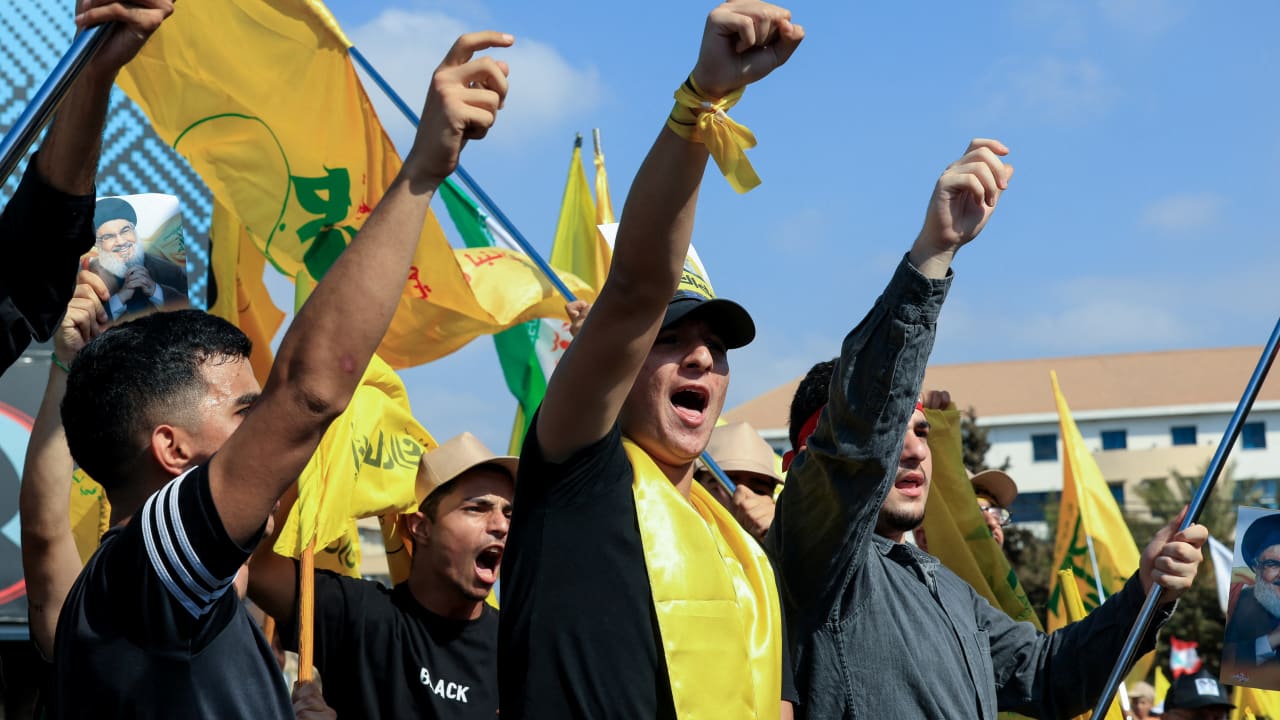
The protest movement in Iran reflects a deep crisis that will affect not only the conduct of the regime, fearful for its future and fighting for survival, but also the future of Hezbollah in Lebanon.
Within a single day, what began as an economic protest transformed into a comprehensive uprising against the regime itself, accompanied by demands for its removal. The unrest has gradually spread to all 31 provinces of the country.
Iran was already facing severe economic distress, compounded by acute water and energy crises. Yet since January 2025, the Khamenei-led regime has transferred a billion dollars to Hezbollah, as part of its effort to maintain and strengthen the organization. This extensive financial assistance underscores Hezbollah’s immense importance to the regime, even in the post-Nasrallah era.
The question, however, is whether Iran can reap the dividends of this investment while mired in a severe internal crisis and facing a tangible American military threat. The regime relies on Hezbollah to bolster its deterrence posture vis-à-vis the US and Israel, and also to help suppress protesters, whose numbers reportedly peaked at nearly two million, according to the opposition-affiliated Iran International, although the unrest had somewhat subsided at the time of writing.

Various militias have arrived in Iran
Since the protests escalated, media outlets, including CNN, have reported that militants from various militias arrived in Iran to assist in suppressing the unrest. CNN reported that approximately 5,000 fighters from four Iraqi militias – Kataib Hezbollah, al-Nujaba, Kataib Sayyid al-Shuhada, and the Badr Organization – were deployed for this purpose.
These reports align with a January 12 statement by Kataib Hezbollah’s secretary-general, Abu Hussein al-Hamidawi, who declared to the Iranian regime and to Khamenei that his organization was “unambiguously with you and will defend the Iranian people.” Testimonies from Iranian citizens also indicate that foreign, Arabic-speaking elements participated in the repression.
Kataib Hezbollah further threatened on January 16 to attack US bases in Iraq and across the region should the Iranian regime be attacked.
Hezbollah showing restraint
Hezbollah itself, however, condemned the protests in a January 13 statement, adhering to the regime’s narrative that the unrest reflects an American-Israeli conspiracy rather than an authentic expression of the Iranian people’s will. Unlike its Iraqi counterpart, the Lebanese-based terrorist group refrained from expressing readiness to participate in suppressing the protests or threatening to assist the Iranian regime if attacked.
This restraint stems from Hezbollah’s complex political predicament in Lebanon. The Lebanese state’s ongoing efforts to disarm the organization underscore that, given its current weakness, Hezbollah cannot even signal an intention to assist the Iranian regime in crushing protests. Such a move would provoke fierce criticism from Lebanese political elites and society, who already accuse Hezbollah of being an Iranian actor rather than a Lebanese one.
Moreover, should US President Donald Trump follow through on his threats and attack the Iranian regime, Hezbollah would likely be unable to join any retaliatory campaign against American interests in the region or against Israel, unlike the Houthis. Doing so would expose it to a US military strike and give Israel a pretext for a broad assault, rather than limiting itself to targeted strikes against Hezbollah operatives and infrastructure.
It bears recalling that, in light of Hezbollah’s weakening under Naim Qassem, one of the groups founders who replaced Hassan Nasrallah as its leader when he was assassinated in October 2024, the organization did not assist the Iranian regime during the Iran-Israel 12-day war. According to the Emirati media outlet The National, citing Lebanese sources, Hezbollah committed to the Lebanese state that it would not participate in that war or drag Lebanon into it, following pressure from senior Lebanese officials.
Terror org in precarious position
Beyond this, if the protests succeed and the Iranian regime is overthrown, Hezbollah would face grave danger due to multiple factors. The organization is deeply dependent on Iran, and a regime collapse could place it in an existential predicament. Its rivals in Lebanon’s political arena and in society – already declaring that the fall of the Iranian regime would spell Hezbollah’s end and enable the establishment of a sovereign Lebanese state – would likely seek to fully exploit such a development.
Top Iranian commanders emphasized after the fall of the Assad regime that Tehran spent the past decade equipping Hezbollah with local production capabilities. While the terrorist group uses these capabilities along with smuggling from Iran and Syria, this arsenal appears primarily designed for fighting Israel. A significant portion of it would be ill-suited to a struggle for the organization’s very survival inside Lebanon.
As the Syrian case demonstrates, sectarian violence tends to surge following tectonic shifts in the region. Hezbollah could therefore face mass violence from some of its rivals. The scale of change anticipated under a free Iran is already evident in a chant heard among Iranian protesters: “Not Gaza, not Lebanon, my life for Iran.”
Furthermore, in a manifesto published on January 15 outlining his anticipated policies, crown prince in exile Reza Pahlavi emphasized that he would establish peace with Israel, end support for terrorism, and cooperate with regional and global actors against extremist Islamism.
The overthrow of the Iranian regime would clearly serve Israel’s strategic interests. Consequently, Tehran’s demands for “fair play” and its complaints about foreign interference ring hollow, given its own history of dispatching tens of thousands of mercenaries to Syria to defend Bashar al-Assad, along with its blunt military interventions across the region and beyond. Israel would reap substantial benefits from such a tectonic shift, whose repercussions would resonate throughout the Middle East, particularly in Lebanon.
In its current fragile condition, Hezbollah appears incapable of assisting the Iranian regime if attacked or of suppressing renewed protests. Israel should act to promote such a scenario, while preparing for the possibility that Hamas may launch attacks from Lebanon in support of the Iranian regime.
The author is an expert on Iran and Shi’ite political Islam at the Misgav Institute for National Security and Zionist Strategy.