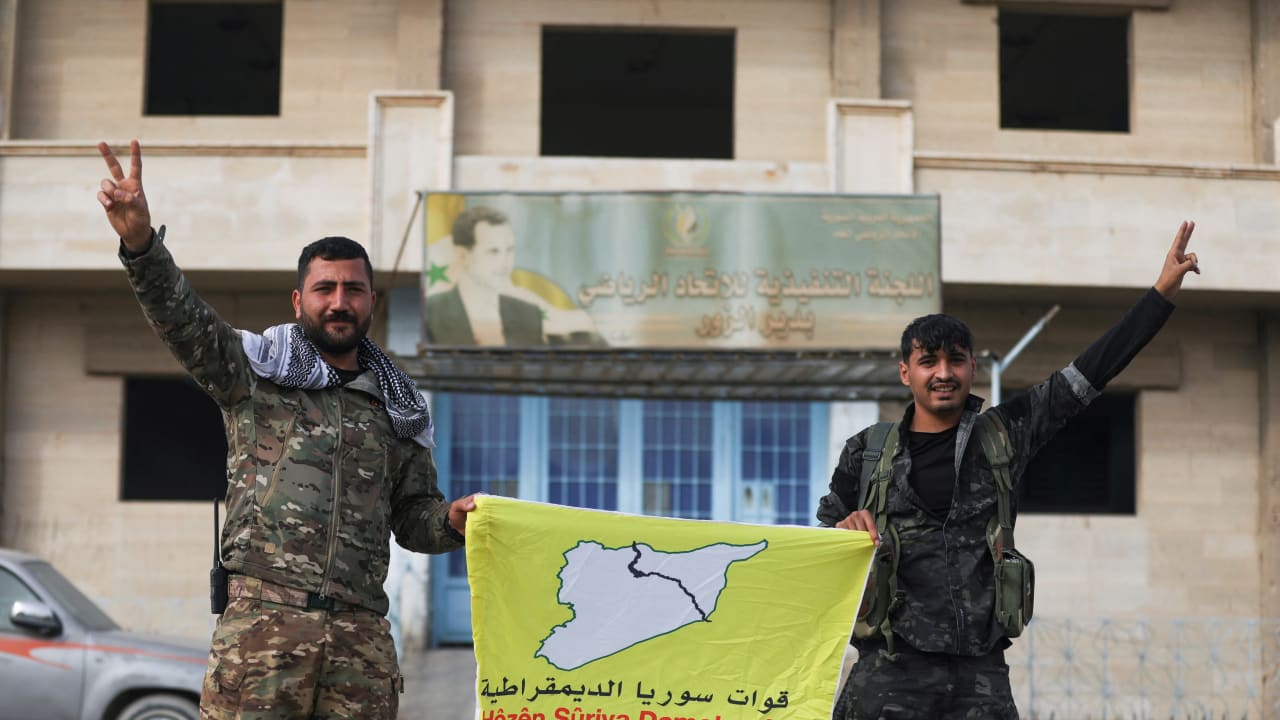
The collapse of the Kurdistan Rojava Autonomous Administration in Syria is not a sudden surprise. It is the outcome of long-planned foreign interventions, strategic miscalculations, and deep Kurdish political weaknesses.
What has happened in Rojava is more than a local crisis.
It is a warning to the entire Middle East about the dangers of strategic blindness and missed opportunities. The Kurds lacked a political vision based on solid foundations. With the thesis of “we want to be part of a decentralized Syria,” they weakened their own position with their own hands.
From the outset, Turkey considered the existence of Rojava unacceptable.
The issue was not merely border security; the central aim was to prevent Kurds from gaining any political status in any territory. Turkey has pursued this strategy systematically.

The 2018 occupation of Afrin, a Kurdish city, followed by the 2019 operation along the Serekaniye – Tal Abyad line with the explicit approval of the Trump administration, represented parts of a long-term plan to gradually dismantle Rojava.
These assaults were not a surprise. The real failure lay in the Kurds’ inability to prepare diplomatically and strategically to counter this process without a clear political vision.
Kurds politically expendable
Under the Trump administration, the US approach to the Kurds was highly instrumental. The Kurds were indispensable forces against ISIS on the battlefield, yet politically expendable.
During this period, Tom Barrack, a key figure in US-Syria policy and Trump’s inaugural committee chairman with close ties to Gulf states and Turkey, acted in alignment with Ankara’s priorities.
This fact should not be concealed. While Turkey’s hostile posture toward Israel is well known, Ankara’s push to eliminate Kurdish autonomy went largely unchecked in Washington.
This strategic blindness endangered not only the Kurds but also Christians and other minorities in Syria, as well as Israeli security interests in a destabilizing Syria.
The Kurds report that immediately after the Israel-Syria talks in Paris on January 5, 2026, attacks on Aleppo took place on January 6, and they claim that Israel’s stance during the Paris meetings enabled the Shaara administration’s actions.
On January 5, 2026, Israel and Syria held talks in Paris under US guidance, highlighting the decisive American role in shaping regional security discussions. It would be misleading to place blame on Israel. Kurdish representatives have historically had no official, institutionalized relations or formal demands toward the State of Israel.
Their engagement has mostly been symbolic and distant. Kurdish representatives deliberately kept relations limited due to sensitivities in the Arab world and Turkey, which in turn hindered the establishment of trust from the outset.
Israel cannot realistically provide military protection to the Kurds.
The Kurds are a resilient, battle-hardened people capable of defending themselves. Yet in today’s world, no victory won solely through force is sustainable.
The core Kurdish weakness is not military but diplomatic, institutional, and political. The Kurds lack an effective foreign policy apparatus, enduring policy institutions, and robust lobbying mechanisms.
Kurds around the world have taken to the streets daily in recent weeks, holding marches and rallies, demonstrating a strong sense of unity within their community. This shows that the Kurdish people can rally around a shared sense of destiny and collective future.
This popular unity will not produce lasting results if it remains purely grassroots. Kurdish political actors must transform this energy into sustainable institutional and political cohesion. Without internal unity, military, diplomatic, and strategic success is impossible.
At this juncture, the role of the Jewish diaspora, particularly in the United States and Europe, is vital. They can help open doors in Washington, establish think tanks and policy centers, and mobilize international lobbying efforts. What the Kurds need is not arms but strategic guidance, institutional acumen, and diplomatic capacity.
Furthermore, there exists a historical sympathy and shared sense of destiny between the Kurdish and Jewish peoples. In recent years, as antisemitism has risen across Europe, anti-Kurdish sentiment has also become more visible.
The fight against antisemitism and anti-Kurdish ideology stems from the same underlying sources. Diaspora engagement, therefore, is critical not only for protection but for mutual recognition and long-term political influence.
The current Kurdish integration into the Syrian Arab Republic is being framed as short-term normalization. Yet a cemented Islamist or jihadist dictatorship in Syria would pose a direct threat not only to Kurds and Christians but also to Israel and the Jewish people.
For Israel, a jihadist-controlled Syria means hostile forces on yet another border, potential arms flows to Hezbollah, and the elimination of any remaining pluralism in the region.
Upcoming Israeli-Syrian negotiations will be critical in determining whether space remains for minority communities and political diversity in Syria’s future. History is clear: once jihadist ideologies consolidate power, they tolerate no alternative communities.
The dismantling of Rojava is not an endpoint but a stark warning. For the Kurds, this defeat demonstrates clearly that status and security cannot be achieved without building political unity and diplomatic capacity.
For Israel and the Jewish world, it signals that the emerging threats in Syria cannot be observed passively. The critical question is no longer who will protect whom; it is who will shape the future through collective wisdom, institutional strength, and solidarity.
The Kurdish people have risen. Now their political leaders must transform this unity into lasting institutional and strategic power.
The writer is a Kurdish exiled journalist, political analyst, and Middle East observer focusing on Turkey, Iraq, Iran, Syria, and Kurdish affairs. a.mardin@icloud.com