
When Médecins Sans Frontières (Doctors Without Borders) revealed over the weekend that it had suspended all noncritical operations at Nasser Hospital in January after staff reported armed men moving weapons and interrogating patients, it did something no other major medical or humanitarian organization has done since October 7.
It inadvertently validated what Israel has been saying for years.
According to the organization’s statement, armed individuals had been seen in recent months using the hospital compound for military-related activity.
More specifically, MSF stated that its medical teams witnessed suspected movement of weapons, as well as incidents of intimidation and arbitrary arrests of patients by armed terrorists, noting an uptick in such activity since the ceasefire began.
MSF’s acknowledgment is limited and cautious. It does not mention any terrorist organization by name, and includes a call on “all armed groups, as well as Israeli forces, to respect medical facilities.”
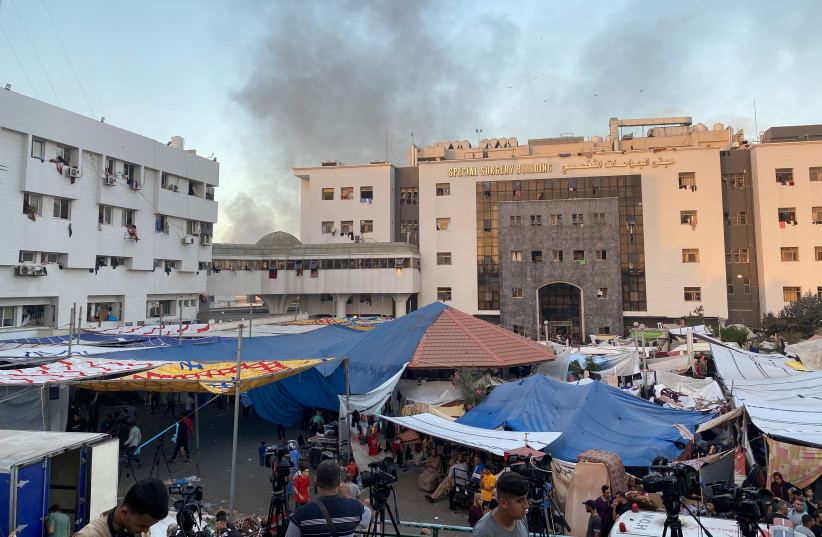
MSF recognition of armed groups operating within a Gaza hospital echoes IDF statements
However, its significance cannot be understated.
For the first time during the war, a major international organization has publicly recognized the presence of armed groups operating within a Gaza hospital.
For years, the IDF has maintained that Hamas systematically embedded itself in and beneath civilian infrastructure, including medical facilities. Hospitals across Gaza, including Nasser Hospital, were exploited by Hamas terrorists and used as command centers, weapons storage, and an operational human shield against Israeli strikes, the army has repeatedly said.
Some hospitals even served as links in Hamas’s vast tunnel network, which the group poured millions into building, while Gaza’s civilians were left to fend for themselves above ground.
These claims were often dismissed or downplayed by international NGOs and UN agencies, many of which accused Israel of exaggeration or fabrication to justify military action. Now, MSF’s own words echo the IDF’s continued warnings about Hamas’s militarization and exploitation of Gaza’s hospitals.
The topic of Gaza’s medical institutions has fueled a fiery debate over the course of the war due to Hamas’s use of them and the question of whether Israel should strike targets in or near those facilities. That debate has led to some of the harshest criticism against Israel during the war, not all of it unjust.
In August of last year, a mistaken attack on the same Nasser Hospital prompted Israel’s Foreign Ministry to release a statement, expressing its “deep regrets” over the strike that killed several journalists.
The IDF admitted in this instance that the attack on the hospital was approved, meaning there was some Hamas target in place. Still, it also said it was probing the attack, meaning significant aspects of the strike and its results were viewed as a major mistake, as per reporting by The Jerusalem Post’s Yonah Jeremy Bob.
Yet, Israel has consistently argued that Hamas’s strategy relies precisely on the expected backlash; the terrorist organization embeds itself in sensitive civilian sites intentionally, knowing Israel will either be deterred or condemned.
Reaching past mutual mistrust
In admitting such activity was seen by its staff, MSF also stepped beyond a fraught relationship with Israel, one which was further strained in recent weeks due to its refusal to provide Israel with a list of its Palestinian and international staff in order to resume operations in Gaza and the West Bank.
Israel eventually said it would move to terminate MSF from acting in Gaza, after the organization backtracked on its public agreement to provide the list.
Further, as exclusively reported by the Post’s Mathilda Heller, Israeli ministry documents viewed exclusively by the Post alleged that MSF had “practiced advancing an extreme anti-Israeli narrative under the guise of humanitarian activity.”
This reflects the mutual mistrust that has plagued Israel’s relationship with some global NGOs during the war. International organizations have often portrayed Israel as uniquely dismissive of humanitarian law. Despite that, what MSF has now acknowledged could prompt a reassessment.
It should also serve as a wake-up call to other international organizations and officials who have repeatedly belittled or dismissed Israel’s claims about Hamas’s use of medical facilities. If armed terrorists are exploiting hospitals, the first obligation of humanitarian groups should be to acknowledge that reality publicly.
Doing so is not a public endorsement of all Israeli military action in Gaza, nor does it undermine concern for civilians, who should remain the main focus for NGOs operating in Gaza. Instead, it coincides with what MSF wrote – the use of hospitals for military purposes endangers everyone at the facility, from medical staff and aid workers to Gazan patients and Israeli soldiers.
If more international organizations are willing to recognize what Israel says it has long known, the public discourse on Gaza’s hospitals may finally begin to align more closely with reality. What happens underground may not be visible to cameras above. But the truth, sooner or later, surfaces.