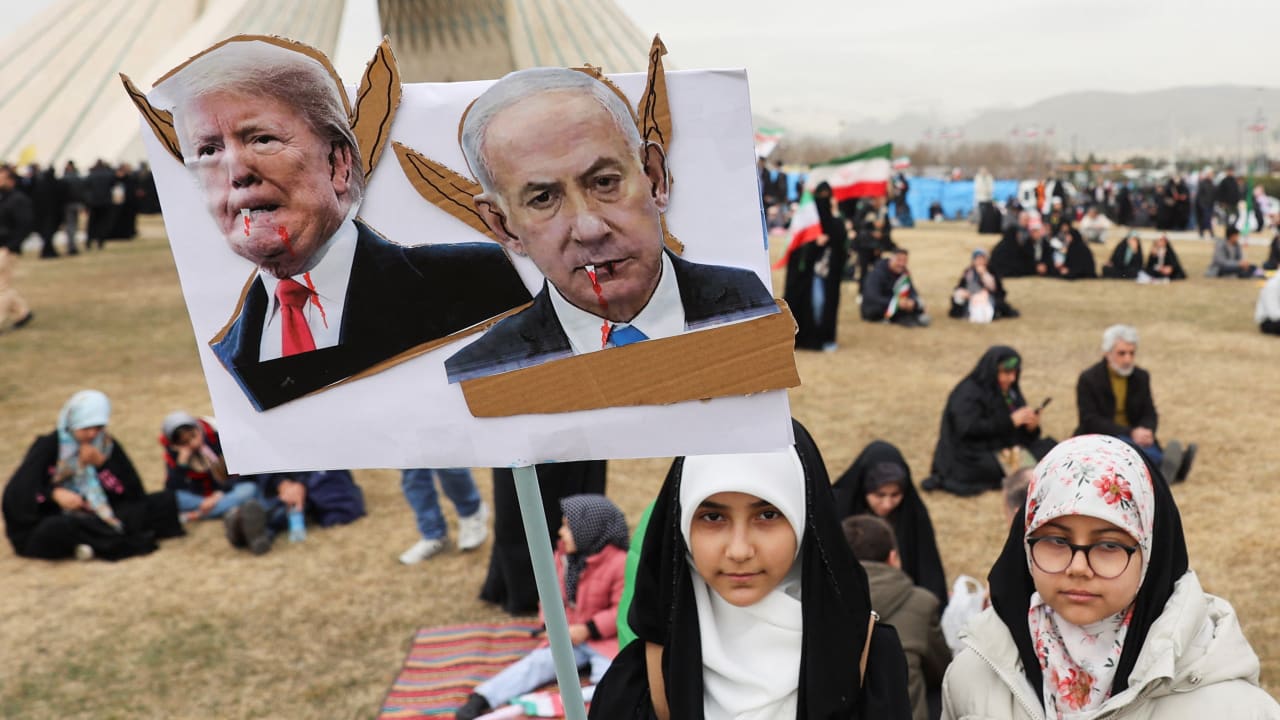
Iran’s most effective weapon is not uranium enrichment; it is the West’s reluctance to draw clear distinctions.
For decades, the Islamic Republic has pursued a coherent and openly articulated strategy: consolidate authority through repression at home, expand influence through proxies abroad, and advance strategic military capabilities that would alter the regional balance of power. Its leaders have not disguised their hostility toward Israel – they have institutionalized it.
Yet Western discourse continues to frame Israel’s confrontation with Iran as though it were a conventional dispute between comparable actors contributing equally to instability.
That framing should have ended on October 7.
When Hamas, armed and financed by Tehran, carried out the largest massacre of Jews since the Holocaust, it was not the product of miscalculation or spontaneous grievance. It was the operational expression of declared ideology. The attack demonstrated what occurs when intent is dismissed as rhetoric and threats are interpreted as posture.
Still, the language of symmetry returned.
The danger of moral symmetry
Commentary reverted to describing “cycles of violence” and “mutual escalation,” dissolving the distinction between those who initiate aggression and those who respond to it. In that narrative, agency disappears and responsibility blurs.
The systems at the center of this confrontation are not analogous.
Israel is a parliamentary democracy with an independent judiciary, a free press, competitive elections, and citizens who openly challenge their government. Policy decisions are debated publicly. Leaders are scrutinized. Authority is constrained by institutions.
Iran, on the other hand, is a theocratic regime that criminalizes dissent, restricts speech, suppresses protest movements, and imprisons journalists. Political opposition is neutralized. Power is concentrated in unelected clerical structures.
One government survives through consent and law.
The other survives through fear, censorship, and execution.
These distinctions are structural. They are not rhetorical devices.
The meaning of the latest US deployment
This week, The Wall Street Journal reported that the Pentagon has ordered a second aircraft carrier strike group to prepare for deployment to the Middle East as the United States assesses the possibility that negotiations with Tehran may collapse. Such deployments are not symbolic. They reflect an evaluation that deterrence requires visible capacity.

Aircraft carriers are not instruments of messaging; they are instruments of consequence.
The preparation of a dual-carrier presence reflects an understanding that Iran’s posture – sustained proxy warfare, continued strategic advancement, and ideological hostility – cannot be treated as episodic tension. It is systemic.
For Israel, the stakes are immediate. Hezbollah’s missile inventory places civilian population centers within range. Iranian financial and military support has transformed local militant groups into coordinated regional actors. A nuclear-capable Iran would fundamentally alter Israel’s security calculus and the stability of the broader Middle East.
In this environment, moral clarity is not emotional – it is functional.
When Western institutions frame defensive measures and expansionist strategy as parallel forms of escalation, they shift pressure toward restraint by democracies while granting strategic ambiguity to regimes that exploit it. That imbalance does not reduce risk. It increases it.
This is not a call to suspend scrutiny of democratic governments. Democracies require accountability. Israel’s public disputes over policy reflect institutional health. But there is a categorical difference between evaluating the decisions of an elected government and obscuring the nature of a regime that enforces ideology through coercion and exports instability as policy.
Confusion at this level has consequences. When declared hostility is treated as hyperbole and deterrence is treated as provocation, policy becomes reactive. Strategic actors who rely on ambiguity gain time and leverage.
Does the West recognize the systemic differences?
Iran’s leadership understands that hesitation in its adversaries is an asset. It understands that diplomatic caution combined with moral uncertainty can slow decisive action. It understands that language shapes outcomes.
The question facing the West is not whether it prefers moderated rhetoric. It is whether it recognizes the structural difference between systems that operate under institutional constraint and those that consolidate power through repression.
Civilizations do not endure by refusing to distinguish between adversaries and allies – they endure by identifying the nature of the threats they face and responding proportionately.
In a region where threats are declared openly and acted upon decisively, moral symmetry is not restraint.
It is an invitation.
The author is a writer, strategist, and public speaker specializing in community mobilization, messaging, and advocacy. She is brought in to help organizations and leaders build engaged audiences, clarify their message, and translate ideas into real-world action. She is the host of The Silent Revolution podcast and is on Instagram @LindaAdvocate.