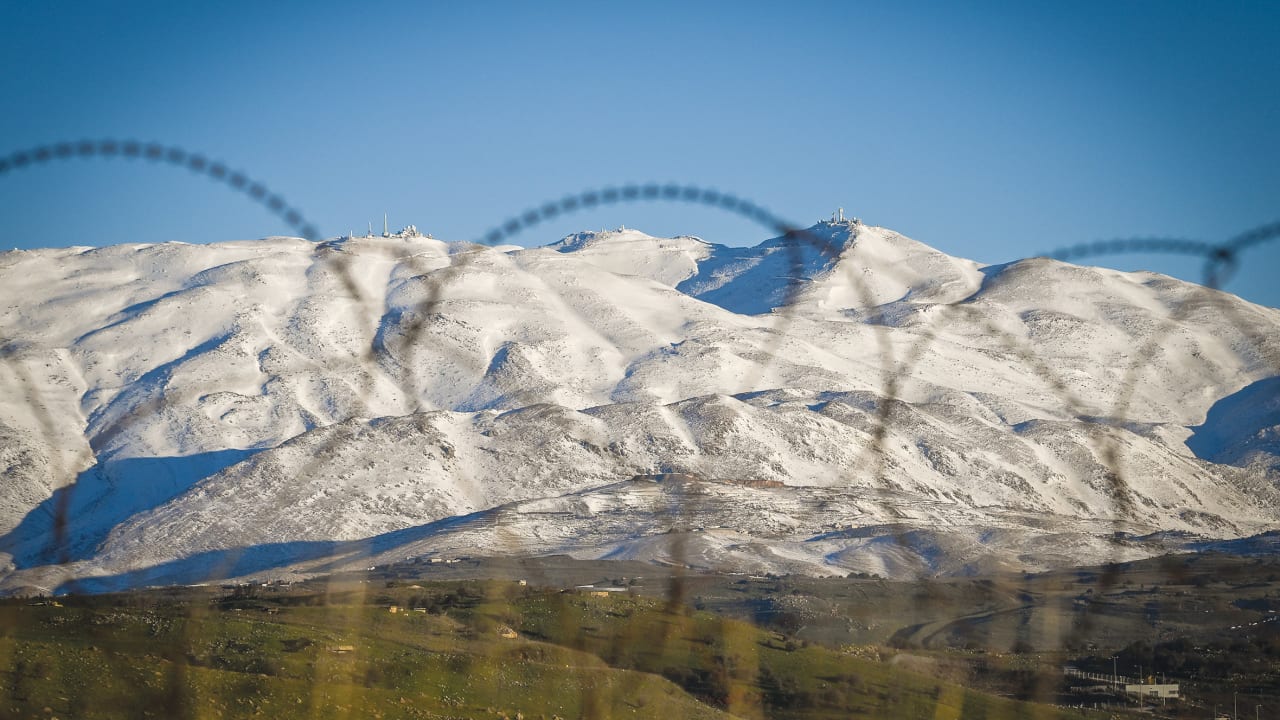
This past Sunday night, a small group of Israelis quietly crossed the security fence on the Golan and walked into history.
They were neither armed nor violent. Instead, members of the Pioneers of Bashan simply went to lay a cornerstone for a future Jewish community in an area under Israeli control in southern Syria.
The IDF quickly detained them and escorted them back, but not before they declared that “settlement in Bashan is essential to preserve the achievements of the war.”
Many Israelis will dismiss the episode as fringe activism, a curiosity, or even a provocation.
They shouldn’t. The Bashan is part and parcel of our ancestral patrimony and is critical for Israel’s security. In December 2024, after the fall of the Assad regime in Syria, the IDF entered the buffer zone on the Golan Heights and liberated the highest peak of Mount Hermon, along with much of the surrounding area, which is part of the Bashan. It is time to bolster Israel’s presence and make it permanent by allowing Jews to settle there.

Mentioned dozens of times in the Tanach, the Bashan is a vast volcanic plateau – much larger than the Golan Heights – stretching from the slopes of Mount Hermon in the north down toward the Yarmuk River in the south and eastward, deep into what is today southern Syria’s Hauran plain.
The Golan Heights that Israel controls today forms only the western edge of this historic region.
Its black basalt soil, formed by ancient lava flows, created exceptionally rich pasture land. That is why the Bible speaks of the “fatlings of Bashan” (Ezekiel 39:18), a symbol of fertility and prosperity.
When the Israelites approached the Promised Land, it was in the Bashan that they defeated the mighty kingdom of Og. The Bible recounts that Israel captured 60 fortified cities in the area (Deuteronomy 3:4), and the territory was subsequently allotted to the half-tribe of Manasseh.
In other words: The Jewish story in the North does not begin with the modern State of Israel. It begins with Moses.
Long before diplomats invented ceasefire lines, Jewish sovereignty in the Bashan was part of the original map of Israel.
But Jewish life in Bashan did not end with the Bible. During the Second Temple period, the region contained numerous Jewish towns and fortresses. The city of Gamla became one of the fiercest centers of resistance to Rome in 67 CE during the First Jewish Revolt.
In the centuries that followed, Jewish communities flourished across the plateau. Rabbinic sources refer to scholars known as the Rabbis of Nawa, or Neveh (Jerusalem Talmud, “Sanhedrin” 3:5), and Torah sages who lived and taught in Bashan during the Mishnaic and Talmudic eras. Archaeologists have uncovered dozens of synagogues and villages bearing Hebrew inscriptions and menorah carvings, proof of sustained Jewish rural life long after the Temple’s destruction.
Even in the early Zionist period, Jewish settlement returned. Lands in Bashan were purchased in the late 19th century, and Jewish farming villages briefly existed there more than a century ago, before regional instability forced their abandonment.
For nearly 3,000 years, the Jewish map included Bashan, whether Jews ruled it or not.
Modern Israelis tend to think of the Golan Heights as a military buffer, a defensive necessity born in 1967. That is true but incomplete. The Golan is only the western slope of the ancient Bashan.
Historically, whoever controlled Bashan controlled the approaches to the Galilee. The plateau overlooks northern Israel like a balcony over a courtyard. Armies descending from the northeast, whether Arameans in ancient times or Syrians in modern ones, repeatedly used it as an invasion corridor.
But military control without a civilian presence has repeatedly proven temporary; areas held only by soldiers are treated as provisional, and provisional borders rarely endure.
After the Hasmonean conquest in the 2nd century BCE, Jews again settled the region and built communities there.
After the Six-Day War, Israel returned to the Golan, part of the Bashan, for the same reason: survival.
And now it is time for the Jewish people to reclaim the Bashan.
SOME VIEW the activists who crossed the fence this week as reckless. But the question they raised is serious: What happens when Israel controls territory militarily yet refuses to treat it as part of its national future?
Security control without a civilian presence is temporary by definition. Soldiers defend; civilians anchor. Without a population that believes possession of the land is permanent, hesitation eventually replaces deterrence.
Every Israeli knows this intuitively. We saw it in southern Lebanon. We saw it in Gaza.
A rare strategic moment
And today we see it in the unstable Syrian arena – militias, proxies, and jihadist factions competing for influence just kilometers from Israeli towns. The collapse of central authority across the border has created a rare strategic moment – a window that history suggests will not remain open indefinitely.
Now is the time to seize the opportunity.
The “oaks of Bashan” (Isaiah 2:13) – a biblical symbol of strength – were once shorthand for the northern reaches of the Jewish homeland. Even today, a community on the Golan bears that ancient name – Alonei Habashan.
Hence, the pioneers detained earlier this week were not inventing a claim; they were reviving one.
To be sure, no responsible government can permit civilians to cross an active military border zone. The army was correct to remove them.
But dismissing them would be a mistake.
Because the activists highlighted something deeper than policy: a strategic hesitation at the heart of Israeli thinking. We control land but fear to belong to it. We hold territory but avoid its meaning.
And yet, Jewish history repeatedly shows that settlement follows security, and then creates it.
From the Galilee to the Negev, from the Jordan Valley to the Golan, presence became protection.
The question facing Israel is not whether a handful of activists should establish a hilltop outpost beyond a fence. The question is whether the Jewish state understands that some places are not bargaining chips but foundational pillars.
Bashan was conquered by Israel under Moses, and it became a borderland repeatedly contested across history.
Today, once again, the territory stands between Israel and the chaos of the Levant.
The Bashan is knocking, awaiting the return of its children, the Jewish people.
Israel must now decide whether it hears it as noise or as a call.
The writer served as deputy communications director under Prime Minister Benjamin Netanyahu.