
Yes, it’s an age-old story: good vs evil, might vs right. The strong prey upon the weak, and the weak pray for a hero to save them. The situation always looks bleak – and will invariably get worse before it gets better – but ultimately justice prevails, and the story has a happy ending.
We could certainly be talking about the here and now. This scenario is not only one we’ve seen before, one we relive every spring; it is coming alive even more so this year as we share our Seder tables with sirens and safe rooms.
Egypt was a mighty empire; it had an army that was second to none and an emperor who truly believed that he was selected by God – if not that he was God himself. Pharaoh thought he was invincible and entitled to rule over all others.
He would come – like all too many other dictators throughout history – to select the Jews as his primary victims. At first, this was simply the lowering of their caste, taking us from privileged citizen to persecuted slave. But it would soon morph into mass murder and move from defaming and delegitimizing Israel as a nation to casting the Jewish boys into the river.
However, from that same river emerged a savior, a man of modesty who fled from glory, even as he fled from Egypt, but who would come to symbolize the ideal leader, embodying virtues that rarely go together: wisdom, strength, humility, and self-sacrifice.
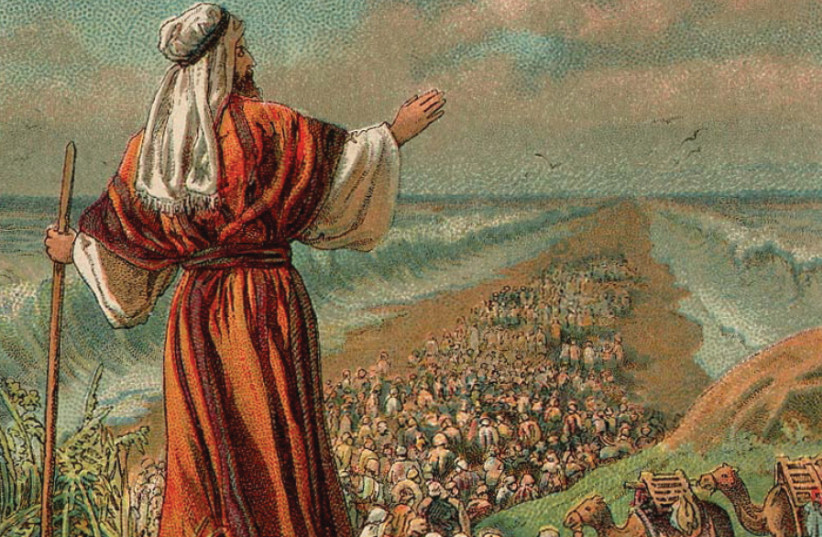
Moses wore two very different uniforms – the royal dress of the palace, and the brit milah of the Jewish faith.
He demonstrated his abhorrence of evil when he slew the Egyptian who was beating upon a Jew; that was his moment of truth, when he had to decide once and for all just who and what he was. The Torah says (Exodus 2:12), “He looked this way and that, and saw no man.” As Rabbi Nathan Lopes Cardozo observes, “Moses looked deep into himself and knew that he could not be both Egyptian and Hebrew at the same time; to be a real, complete man he must finally choose his loyalties and his destiny.” Moses decided to cast his lot as a Jew and severed himself forever from the palace.
Moses was a reluctant hero
But he was a reluctant hero. He fled to Midian, where he lived as a shepherd for 60 years. He had no intention whatsoever of returning to Egypt, let alone leading a people he had never known to freedom and a new-old land. He tenaciously fought God – a portent of things to come, when he would argue with the Almighty for the good of the nation – and listed all the reasons he was unfit to be God’s messenger.
But it was precisely this diminution of himself that convinced God that Moses was the right man for the job, for he would surely put the people before himself and look to their welfare rather than his own.
Moses expressed this succinctly when he characterized the nation of Israel as “six hundred thousand foot soldiers, of which I am [but one]” (Numbers 11:21). Finally convinced – compelled? – by God to take up the mantle of leadership, Moses brought a shepherd’s care for the flock to the diverse and challenging nation. The man of modesty, even timidity, would fiercely fight on behalf of his people – against both the Pharaoh and the God who chose him [Moses] – and rightfully earn the title “the great defender of Israel.”
Along the way, as Pharaoh deviously tried to turn the Jews themselves against him, Moses would encounter any number of co-religionists seeking to “dethrone” him. Dathan, Abiram, worshipers of the calf, rebellious spies, even his own cousin Korah, sniped away at him continually.
At times, Moses succumbed to his exasperation, and burnout beckoned; “Do me a favor, kill me” and get me out of here! he moaned to God (Numbers 11:15), but he saw his mission through, bringing the nation to the brink of Israel’s border. As is so often the case with our leaders – Begin, Sharon, and Rabin being modern cases in point – Moses did not end his career as he had hoped, in a blaze of glory. Even his burial place will remain forever unknown. But precisely because he was mortal, because he was human with failings and foibles along with superhuman qualities, he became the model par excellence of a leader.
IT’S A classic question and mystery as to why Moses’ name is mentioned but once in the Haggadah, and then only parenthetically. It seems unreasonable – even cruel – that the central figure of the entire Exodus saga is not featured.
Many reasons have been offered for this. Some say the authors of the Haggadah did not want to make a cult hero out of Moses. Others suggest that Moses himself, due to his great humility, would have wanted to de-emphasize his part in the iconic story, preferring to let the people, rather than the man, take center stage.
But I have another theory. I think that Moses was trying to tell us – via his exclusion – that you don’t have to be a Moses to change history. You don’t have to be superhuman; you just have to be a person who cares about others, who has a vision, who will do anything and everything to advance the cause of the nation of Israel.
Each and every one of us should rise to the occasion and seek justice, seek victory, seek fulfillment for this amazing and miraculous country of which we are a part. Here, now, in this cataclysmic era, in this final stage of our long, eternal journey to redemption, each of us can – and should – be a Moses.■
The writer is director of the Jewish Outreach Center of Ra’anana.
rabbistewart@gmail.com