
As an Israeli, I am done hearing the word “resilient.”
Not because we aren’t resilient. We are one of the most resilient nations on the planet. But after the years of emotional and physical hell we have endured, that word feels like a cop-out and does not accurately describe how we feel right now.
It is not just physical exhaustion from a full month of disrupted sleep and routine. It is not just the two and a half years of nonstop war with missiles, rockets, hostages, death, destruction, global antisemitism, and diplomatic isolation.
The reality is that Israel has been in crisis mode for the better part of six years, and our so-called resilience has reached a breaking point. Between the pandemic, Operation Guardian of the Walls, a government that has led to Israel’s worst public image in its history, the internal chaos surrounding the judicial reform protests, and then everything since October 7, Israelis are completely spent.
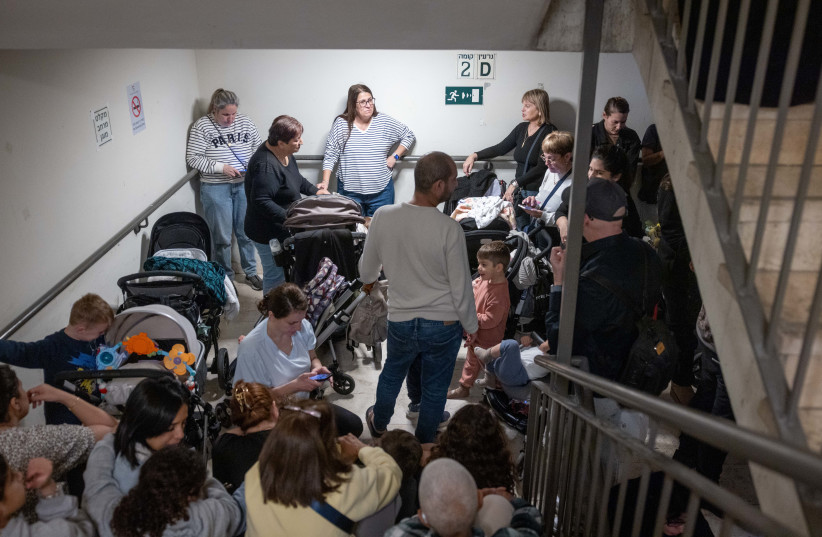
Jewish diaspora communities tend to romanticize this reality
Resilience means the ability to recover quickly from difficulties or adapt well in the face of stress, change, or adversity. That definition may describe us in theory, but the truth is that none of us has actually recovered from the last six years. The scars we carry are invisible but real, and they will have long-term consequences.
People, especially in the West, who have never experienced war or sustained trauma, often imagine it as something cinematic and distant. They see clips of Israelis who are partying in shelters, sitting in bars and cafes, or building apps to use during emergencies, and they assume that life here continues more or less uninterrupted.
In Jewish diaspora communities, there is also a tendency to romanticize this reality, to frame it as strength or unity in a way that feels deeply disconnected from what people here are actually experiencing. That perspective is not only inaccurate, it has also caused real frustration among Israelis who feel profoundly misunderstood.
There have been countless clips shared on social media of Israelis going about their lives as usual and even attending celebrations. I have shared those clips myself to show that Israelis refuse to let terrorism dictate our lives. But those images do not mean that Israelis are unfazed by what is happening.
They do not show nervous systems being jolted awake multiple times a night by alerts. They do not show how long it takes for the body to calm down after running to a shelter. They do not show the exhaustion of having to keep working because taking time off is not an option. They do not show the physical toll that constant stress takes on the body.
They do not show parents trying to balance work while caring for children who cannot go to school, all while functioning on almost no sleep. They do not show what it means to live in the north, near the Lebanese border, where communities have been under relentless bombardment from Hezbollah at a frequency that is almost impossible to comprehend.
The word resilience does not begin to capture that reality.

We knew that a strike on Iran was inevitable, and there has been a constant undercurrent of anxiety across the country for months. Still, people continued to go to work, travel, sit in cafes, and even take trips abroad because life here has always required that kind of forward motion. If we stopped every time there was a threat to annihilate us, we would not survive. But beneath that surface, the anxiety has been constant and inescapable.
Many Israelis are willing to endure prolonged hardship
To say that living in Israel during this time has been difficult is an understatement. Since December, there has been a growing awareness that a broader regional war with the Islamic Republic was coming. After witnessing even a fraction of how the regime, through the IRGC and Basij, has brutalized its own people, this is no longer only about regional stability. For many Israelis, after enduring years of attacks from Hamas, Hezbollah, the Houthis, and militias in Iraq, it has also become about confronting the source.
There is a widespread understanding that real change in the region requires dismantling the system that funds and directs these groups. Many Israelis are willing to endure prolonged hardship if it means a future where Iran’s people can reclaim their country and where the constant threat from these proxies is diminished.
You will continue to see images of life in Israel that look vibrant and full, because Israel is, at its core, a vibrant country. But those moments exist alongside exhaustion, fear, and a level of strain that is difficult to convey from the outside.
If you want to support us, do not call us resilient right now. Just say you are thinking of us. Ask how we are holding up. Check in, simply and sincerely, because that kind of acknowledgment means more than any label ever could.