
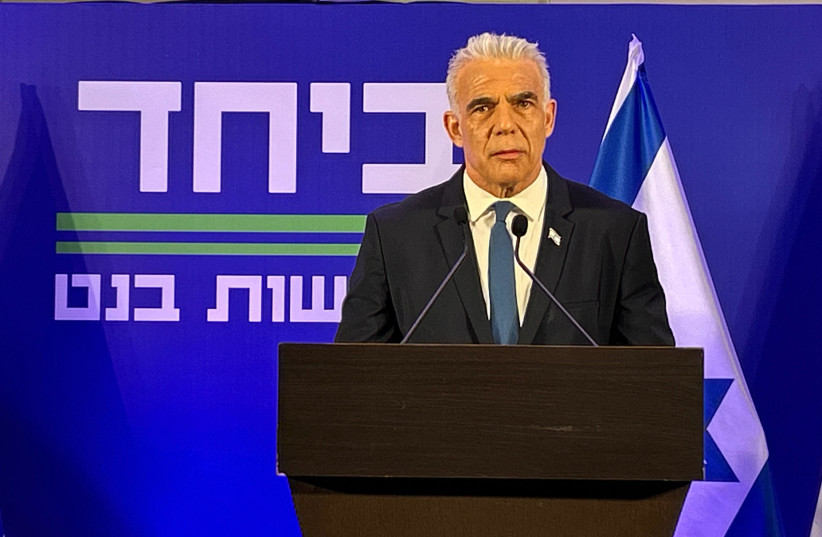
The announcement by Naftali Bennett and Yair Lapid regarding their joint electoral alliance will undoubtedly have significant implications for the Israeli political system ahead of the 2026 elections, expected to take place in late October.
History teaches us that it is difficult to predict the electoral fate of political alliances in Israeli politics. At times, they achieve considerable success, as seen in the 2015 elections with the alliance between Labor, led by Isaac Herzog, and Hatnua, led by Tzipi Livni.
The Zionist Union, under their leadership, won 24 seats, whereas pre-merger polls had projected the two parties separately to receive about seven seats fewer.
In other cases, however, the whole proves smaller than the sum of its parts, as demonstrated by the 2013 alliance between Likud, led by Benjamin Netanyahu, and Yisrael Beytenu, led by Avigdor Liberman. While early expectations suggested that the joint list would secure more than 40 seats, the outcome was widely regarded as an electoral disappointment, with only 31 seats won.
Possible scenarios resulting from the alliance
Analyzing the Bennett-Lapid alliance presents several plausible scenarios. On the one hand, similar to Lapid’s alliance with Benny Gantz ahead of the April 2019 elections, which led to the formation of Blue and White and a result of 35 seats, Bennett and Lapid may well celebrate a strong showing on election night.
Prior to the alliance, most polls projected Bennett’s party at over 20 seats, while Lapid’s Yesh Atid hovered around seven. Thus, the combined party’s potential could approach 30 seats.
On the other hand, it is equally plausible that Bennett’s right-wing image among the Israeli public – shaped, among other things, by his support for annexing Area C and his criticism of the Supreme Court – may deter many of Lapid’s center-left supporters from transferring their support to their new list.
Conversely, Bennett’s own supporters, many of whom are identified with the “soft Right,” may be alienated by the alliance with Lapid, who has expressed firm support for cooperation with the Arab Joint List. These voters may instead shift toward alternative right-wing options, such as Netanyahu or Liberman.
In such a scenario, Bennett and Lapid may quickly discover that the “whole is smaller than the sum of its parts,” with their new party, tentatively named “Together,” ending up closer to 20 seats than to 30.
Who benefits if the alliance is a failure
If the alliance ultimately proves to be a failure rather than a success, several political actors could benefit electorally from the move.
In any case, the primary beneficiary appears to be Lapid himself. Having lost nearly 75% of his voters since securing 24 seats in the 2022 elections, the alliance – much like his previous partnership with Gantz – ensures his political survival and continued relevance.
Without such a move, it would not have been unreasonable to assume that Yesh Atid might struggle to cross the electoral threshold as the 2026 elections approach. Another politician who may stand to gain is Gadi Eisenkot, whose party is currently polling close to 15 seats.
If Lapid’s supporters find it difficult to back Bennett, Gadi Eisenkot may emerge as a viable alternative, potentially boosting his party, Yashar!, toward 20 seats. This could position Eisenkot as the primary governing alternative to Netanyahu and the Right, thereby consolidating his standing as the leading challenger at the expense of other center-left parties.
In conclusion, it will soon become clear whether this “Brothers’ Alliance 3.0” will be judged a success or a failure. What is certain, however, is that there is at least one political figure who is likely to welcome the Bennett-Lapid alliance: Netanyahu.
For Netanyahu, Bennett’s move signals a definitive break with right-wing voters and alignment with the center-left bloc. In addition, voters from the religious-Zionist camp may return to their traditional political home, thereby ensuring that Bezalel Smotrich crosses the electoral threshold, automatically strengthening Netanyahu’s bloc by approximately two seats.
Should even five seats’ worth of Bennett supporters shift to Netanyahu’s bloc following the alliance with Lapid, it is plausible that Netanyahu will have effectively closed the gap on his path to electoral victory.
The writer is a lecturer and research fellow at the University of South Wales, UK. Author of Collapse: Israeli Labor Party 1992-2024.