Astronomy
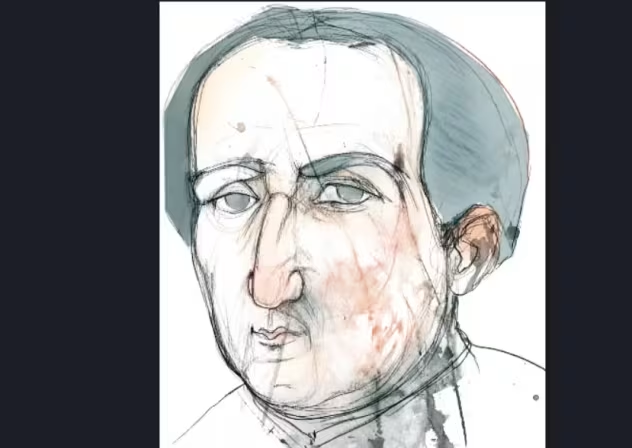
On Columbus Day, remember Abraham Zacuto, the Jewish astronomer history forgot - opinion
In 1935, the International Astronomical Union formally adopted the name Zagut for a lunar crater honoring Abraham ben Shmuel Zacuto. Modern astronomy has, literally, written his name on the Moon.

The Perseid meteor shower is back: All the best places to watch shooting stars in Israel

Researchers decode 200-year-old Red Sea navigational chart, revealing lost seafaring secrets

Selling light after dark: Satellite designed to reflect sunlight to Earth approved by FCC
Grapevine June 4, 2023: Remembering Ilan Ramon
Movers and shakers in Israeli society.

Strawberry Moon to shine bright in Sunday morning's sky
The Strawberry Moon will be visible on the night of June 3 and has ancient connections to Native American agriculture.

Scientists expand search for signs of intelligent alien life
Deliberate transmissions to potential aliens from Earth should be considered only if by global consensus humankind deems it safe and appropriate, Gajjar said.

Israeli astrophysicists may have solved the mystery of early massive galaxies
A new theoretical model made by Israeli astrophysicists reveals an excess of massive galaxies, in contrast to previously accepted theories.

Milky Way may not be the shape we thought - study
Over the years, astronomers have classified galaxies into three main shapes: elliptical, irregular and spiral.

Astronomers identify asteroid belt, revealing hidden planets - study
This newly discovered belt may have been discovered after a collision triggered a dust cloud.

Astronomers capture dying star engulfing a planet - study
According to the study, the planet was likely similar in size and composition to our solar system's Neptune or Jupiter.

Scientists discover that galactic collisions cause quasars - study
Contrary to previous beliefs that the quasars are formed at the peak of galactic collision, researchers found that they are actually formed during the initial stages of collision.

Detailed dark matter map provides further support for Einstein's theory of general relativity
Astronomers have created the most detailed map of dark matter distribution.

What are mysterious cosmic objects shining brighter than the sun?
They produce way more energy than the sun and appear to break a physical boundary called the Eddington limit - now scientist found a possible explanation.
