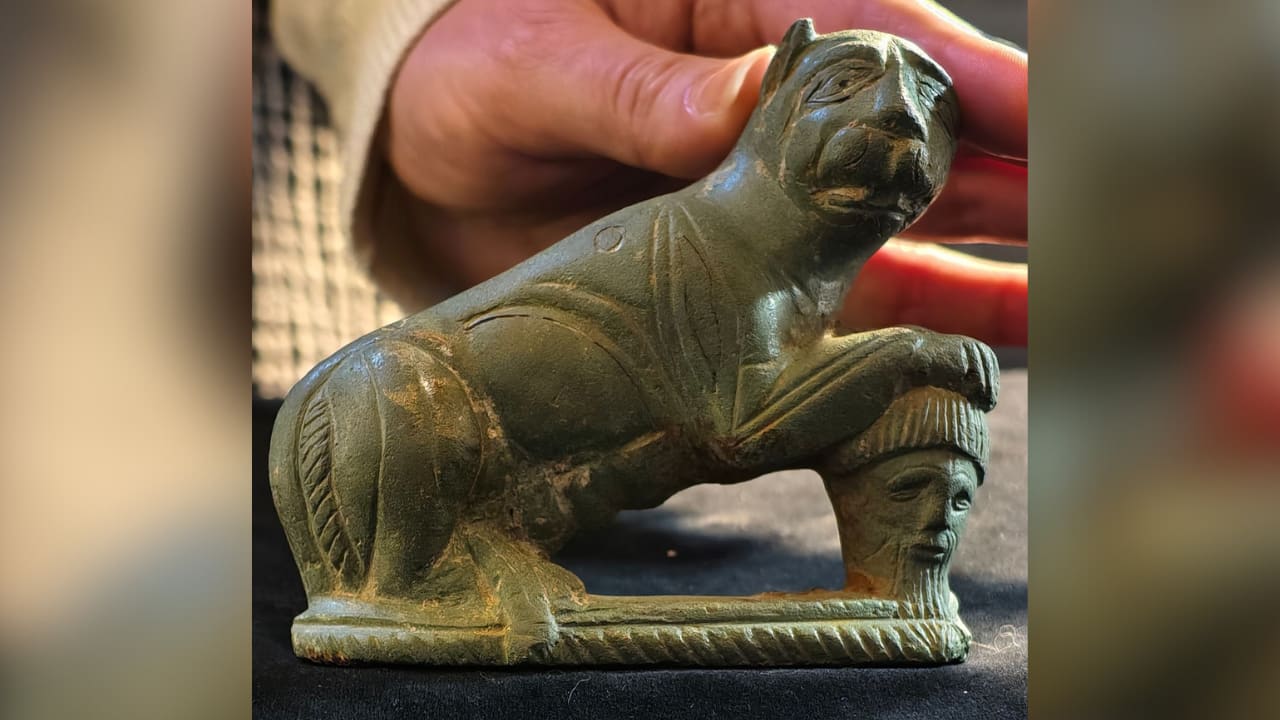
A rare Roman carriage ornament displayed in late January at the British Museum marked Essex’s first archaeological find and is set to be declared a “treasure,” under the 2023 amendment to the UK’s 1996 Treasure Act.
The ornament, made of copper alloy, depicts a panther with its paws atop a bearded man’s severed head, while the back of the panther is hollow and filled with lead.
Under the Act, archaeological finds can be designated as a treasure if they are deemed to be of historical, archaeological, or cultural importance.
The ornament, which was originally found in 2024 by metal detectorists outside the town of Harlow in Essex, has been dated by researchers to circa 43-200 CE.
ESS-8AC18A Roman Vehicle Fitting by Mark.Jeffcock on Sketchfab
“The size of the Harlow fitting, and the presence of a motif beneath the front paw are closer to finds identified as fittings which attached the strap linking draught animal collars to the yoke,” according to the government’s official description of the find.
Essex Portable Antiquities Scheme (PAS), a government-sanctioned group dedicated to recording local archaeological finds, announced the ornament’s new status in a January social media post, during an event at the British Museum.
“Big cats represent the power of the Roman Empire, and the paw on the severed head, domination over its enemies,” Essex PAS’s post added, noting that careful blending of Roman and local styles represents the Roman conquest of Britain.
“This is unparalleled in vehicle fittings across the Empire, making this example unique.”
County Finds Liason Officer Lori Rogerson and archaeologist Dr. John Pearce of King’s College echoed the sentiment to the BBC. “There is nothing quite like it in Romano-Britain,” Pearce said.
Rising number of reported archaeological finds in Britain
The ornament was one of 79,616 artifacts discovered by the public and reported to British authorities in 2024, showing a significant rise in reported finds since 2022 and 2023.
“The continued rise in the number of finds reported through the Portable Antiquities Scheme is a testament to the dedication of finders across the country,” Ian Richardson, Acting Head of Portable Antiquities and Treasure at the British Museum, said in a January statement.
“Their responsible reporting allows us to build a richer and more detailed picture of life in the past, while ensuring that important objects are preserved for public benefit.”