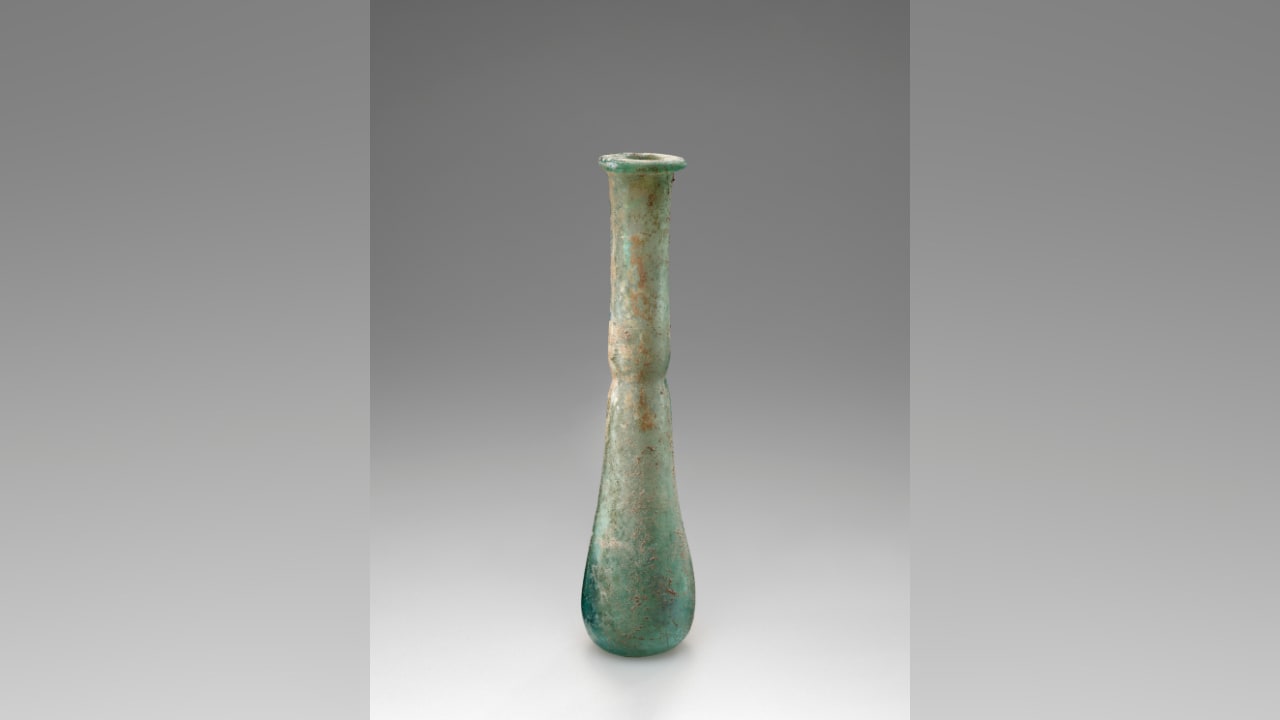
A new chemical analysis revealed evidence that ancient Roman physicians used human feces in medical practices, after researchers analyzed residue inside a 1,900-year-old Roman glass vial, confirming classical accounts of this practice for the first time.
Cenker Atila, an archaeologist at Sivas Cumhuriyet University, told Live Science in an email that he first noticed that the “clay capped candlestick-shaped” vial contained residue while working in the Bergama Archaeology Museum’s storage rooms.
The vial, also known as an unguentarium, is commonly believed to have held perfumes or cosmetic oils.
When researchers opened the vial, Atila noted to Live Science that “there was no bad smell,” and that while residue was found in seven different vessels, “only one yielded conclusive results.”
Using gas chromatography and mass spectrometry, researchers discovered that the “Roman unguentarium originally contained fecal material” and noted that though the origin of the feces couldn't be identified, the ratio of coprostanol to 24-ethylcoprostanol suggested it was human.
![Galen of Pergamon, Greek physician, surgeon and philosopher in the Roman Empire. From ''Biographical Illustrations'', by Alfred Howard. [Thomas Tegg, R. Griffin and Co., J. Cumming, London, Glasgow and Dublin, 1830]. Artist Unknown.](https://images.jpost.com/image/upload/f_auto,fl_lossy/c_fill,g_faces:center,h_537,w_822/705493)
Residue may have been the work of famed ancient physician Galen
Also discovered in the residue’s chemical analysis was carvacrol, a major component of thyme oil, which researchers believe may have been included to mask the smell of the feces.
“Because we are well-acquainted with ancient textual sources, we immediately recognized this as a medicinal preparation used by the famous Roman physician Galen,” Atila said in his email.
Galen’s medicinal work has heavily influenced Western medicine and turned the ancient city of Pergamon, in modern-day Turkey, into a major hub of Roman medicine during the second and third centuries.
The study further explained that using fecal matter in medicine has been a part of many medical traditions, as “excrement was used in Talmudic, Ayurvedic, Babylonian, and even early Christian medical writings," and between the 5th century BCE and the 5th century CE by several Greek and Roman physicians in "therapeutic contexts."
“This study provides the first direct chemical evidence for the medicinal use of fecal matter in Greco-Roman antiquity,” the researchers added.
“These findings closely align with formulations described by Galen and other classical authors, suggesting that such remedies were materially enacted, not merely textually theorized."
The study was conducted by researchers from Sivas Cumhuriyet University and Istanbul universities, and the findings were published in the Journal of Archaeological Science: Reports in January.