
A massive complex of several mikvaot, believed to have been used by Jewish pilgrims, has been uncovered at the foot of the Temple Mount on the outskirts of the Old City of Jerusalem.
The discovery was made during five seasons of excavations, directed by Prof. Uzi Leibner and Prof. Orit Peleg-Barkat of the Hebrew University of Jerusalem’s Institute of Archaeology.
“The Hebrew University has been excavating in the Ophel since 1968. Not continuously, but over the years,” Leibner and Peleg-Barkat told The Jerusalem Post. “It started with Benjamin Mazar, who was the president of the Hebrew University, right after the Six-Day War. Later, his granddaughter, Eilat Mazar, also excavated here, mainly Iron Age remains in the eastern part of the archaeological park. After she passed away, we stepped in.”
The complex, which stretches across about 280 square meters, was found at the Ophel archaeological site and includes a large central pool and several mikvaot. It is located near the now-sealed “Triple Gate,” which served as one of the main entryways to the Temple Mount in antiquity.
During the Second Temple period, the archaeologists explained, the gateway led to an underground staircase that led upwards to the middle of the Temple Mount’s plaza. Another gate to the west, known as the “Double Gate,” is also blocked today, but the blockage is reachable from inside if one starts on the plaza side and walks down.

Site likely played a significant role in ancient pilgrimage to Second Temple
Both its location and size suggest it played a significant role in ancient Jews' journeys to the Temple in Jerusalem. The complex allowed them to undergo ritual purification at one of the site’s mikvaot before heading to the Temple Mount.
“Our excavation is right at the foot of the staircase climbing up to the Triple Gate. So, it’s a major location, about 50 meters from the gate itself,” Leibner said.
At the center of the complex, archaeologists unearthed a large plastered pool with steps descending into it from all four sides. It measures approximately 12 by 9.5 meters and dates back to the early first century CE.
Northwest of the central pool, archaeologists exposed an ashlar (finely dressed stone) structure containing four rooms. Three of the rooms were identified as mikvaot, and also dated back to the beginning of the first century CE.
“This part of the complex was buried beneath a later structure from the late fourth century,” Leibner explained, gesturing toward the section where three of the ritual baths were found. “Eilat Mazar, before she passed away, excavated a bit up here. This whole area was covered by a huge Byzantine house. She broke the closing eastern wall open, and she found this beautiful ashlar facade.”
All of the mikvaot include an extremely rare feature: drain holes carved into the floor of the immersion pools, indicating that the complex may have been supplied by a permanent source of running water.
They, along with the central pool, were connected to an extensive drainage system that flowed out into the Kidron Valley. The drainage channels, where archaeologists found many ancient coins and pottery shards, stood up to over two meters high.
“It is uncommon in mikvaot that you can empty the immersion pool and replace the water,” Leibner explained to the Post. “This is one of the hints that brings us to the idea that there was running water here. Not just collecting rainwater as [is] typical, but running water.”
He added that it could be connected to the aqueduct that fed the Temple Mount from the area of the Hebron Mountains.
Of the three mikvaot, only one survived at its full height of 4.2 meters in a rare act of preservation, including its vaulted stone roof and the shaft that supplied it with water.
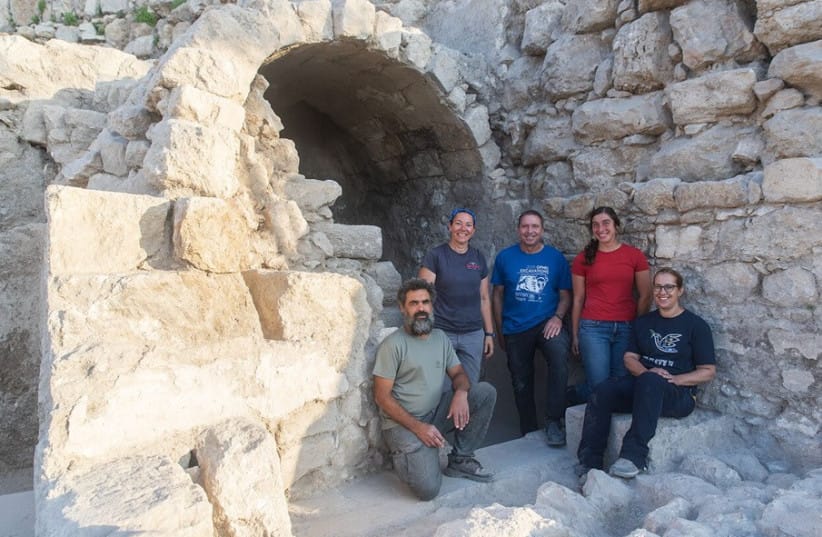
The surviving mikveh served as a water reservoir during the Byzantine period, Leibner told the Post.
Two of the mikvaot feature carefully hewn ashlar steps. Between the large pool and the ashlar structure lies a courtyard paved with large ashlar slabs.
However, the excavations also revealed that the monumental complex was not the first public purification facility built at the site.
Archaeologists uncover earlier built mikveh
Beneath it, the Hebrew University expedition uncovered remains of an earlier ashlar-built public purification complex that included a large mikveh, probably dating to the first century BCE.
Peleg-Barkat explained that this mikveh most likely fell out of use once the second-phase drainage channel was built, as the drainage cut through the immersion pool and rendered it unusable.
The discovery points to a longer history of ritual purification activity in the area immediately adjacent to the Temple Mount.

“What we have here is two clear distinct phases,” Peleg-Barkat said. “We have this monumental structure from the Second Temple Period, destroyed in the First Jewish Revolt against Rome in the year 70, with dramatic evidence of destruction inside the structure.”
After its destruction, the area was abandoned for several centuries until the Byzantine period, when it was rebuilt with domestic structures.
“The complex goes to the heart of our research into the archaeology of Second Temple-period pilgrimage,” said Leibner and Peleg-Barkat. “How the area immediately south of the Temple Mount was designed to accommodate the many pilgrims who came to Jerusalem to visit the Temple, and what activities and rituals took place near its gates.”
Excavations of the Ophel were conducted by the Institute of Archaeology at the Hebrew University of Jerusalem in cooperation with the Armstrong Institute of Biblical Archaeology, with funding from the Israel Science Foundation (ISF), the Armstrong Institute, and the Hertog Center for the Archaeological Study of Jerusalem.