Roald Dahl is a terrible messenger for a serious conversation about Jews and Israel.
Which is part of what makes “Giant,” the new Broadway play about the beloved children’s author’s 1983 antisemitic outbursts, so unsettling. The play asks urgent, complicated questions about Israel, Jewish solidarity, and Diaspora responsibility - but it puts them in the mouth of a man whose own views were so steeped in bigotry that they distort everything he says.
The play, which opens tonight on Broadway, revisits the controversy over an antisemitic book review he wrote for a UK literary journal. That essay, meant as a heartfelt, outraged response to Israel’s 1982 war in Lebanon and the toll it had taken on civilians, veered immediately off the rails into bigotry.
Dahl attributed Israel’s perceived excesses to a “race of people” who “switched so rapidly from being much-pitied victims to barbarous murderers.” He also spewed that US policy was controlled by “powerful American Jewish bankers” and charged that the government was “utterly dominated by the great Jewish financial institutions over there.”
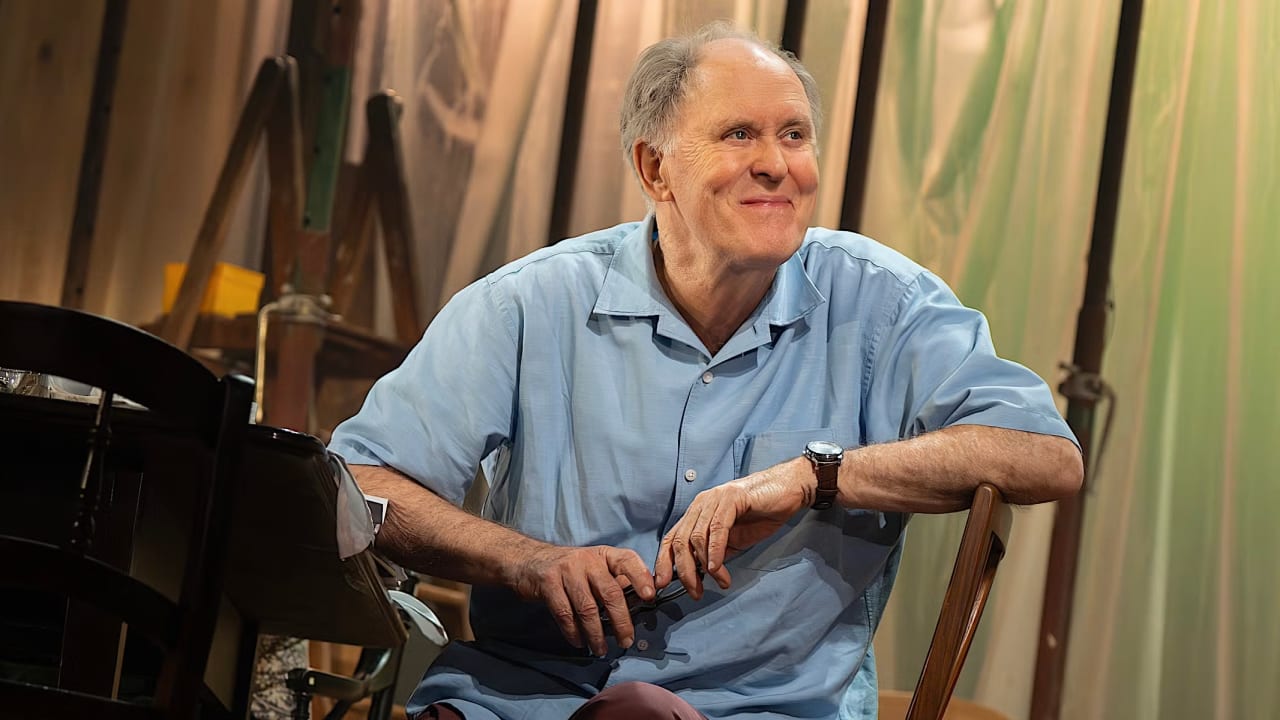
John Lithgow stars as the towering - literally and figuratively - author of “Charlie and the Chocolate Factory” and “James and the Giant Peach.” Over the course of its two acts, Dahl’s British Jewish publisher and an American Jewish sales rep dispatched from Farrar, Strauss and Giroux try to convince the author to issue an apology.

The play was conceived before October 7, but its relevance has grown exponentially, even uncannily, since it first ran in London to great acclaim starting in 2024. In “Giant,” Dahl details the Israeli airstrikes that destroyed hospitals in Lebanon in 1982.
On the night I saw the play, Israel had announced that it was stepping up attacks aimed at Hezbollah infrastructure in Beirut. Lithgow’s line about the 1982 war was greeted by the audience with a sort of audible hush.
Play explores Diaspora's relationship with Israel
But the play is at its most immediate in its endoscopic exploration of the Diaspora relationship with Israel. Lithgow as Dahl demands that his two Jewish guests account for Israel’s actions - not just defend them, if they dare, but confess their own complicity as supporters of Israel in what the IDF is doing in Beirut.
When Jessie, the American visitor, suggests that not all Jews support the Israeli government - and shouldn’t be held accountable for those who do - Dahl’s response is withering and specific. “Of course, yes,” says Dahl, “there’s those tiny weeny progressives - the New Israel Fund, I know about them - but they’re really a minor player, no? Seen as crazies? Are they? Tiny crazy gang of peace-loving bleeding-heart hippies. Hardly the main swim. Is that right?”
The “seen as crazies” line lands hard. Rosenblatt hits on an uncomfortable truth: American Jewish organizations have worked hard over the years to isolate Jewish groups, from Breirah to NIF to J Street, that are critical of Israel.
If you are the self-lacerating type, you might see the show and dwell on all the ways Diaspora Jews failed to speak out or support the dissenters inside Israel. That was a thrust of a conference earlier this month, held by Smol Emuni, an organization of liberal, observant Jews deeply critical of Israeli policy in Gaza and the West Bank.
“We must call out the suffering, the destruction, and destruction of justice,” said Rachel Landsberg, the group’s co-director, in a keynote address. “We must grapple with our own accountability, and we must ask, what are our world responsibilities as Jews shaped by Torah and as Americans whose government and institutions play a role in this reality.”
Those who take a different view, and who are more inclined to defend Israel than atone for its sins, also found moments to cheer in “Giant.” The night I saw the show, there was raucous applause and hoots of approval when Jessie at last confronts Dahl, who was a Royal Air Force fighter pilot in World War II.
She asks what Dahl might think if England were under attack from France, the way “the PLO fired hundreds and hundreds of rockets from Southern Lebanon into Israel.”
“What would your government do - if militants constitutionally committed to wiping Britain off the map started firing rockets into Kent from the French coast? For 10 days? Serve tea and scones?” she demands.
In the play as in real life, however, Dahl is not engaging in a good-faith debate about a country’s right to self-defense. Nor is he interested in a deep conversation about Jewish peoplehood, the ways Jews can feel a deep attachment to Israel and have conflicted (and conflicting) feelings about its policies, nor how, at the end of the day, Israel’s government has zero interest in what Diaspora Jews think about its actions.
Lithgow portrays Dahl as many in his lifetime saw him (he died in 1990): witty, winning, and charming at one moment; prickly, defensive, and cruel the next. The publisher, Tom Maschler, a revered figure in British publishing before his death in 2020, offers a stirring defense of Dahl’s gifts as a storyteller who “picks a glorious, playful path through the chaos of childhood.”
Coming from a Jew - a child survivor of the Holocaust who embodies a very British reserve when it comes to his identity - his speech is the closest the play comes to answering the perennial question about whether you can separate the artist from the art (for a deeper dive into that question, I recommend a terrific new podcast, “The Secret World of Roald Dahl,” which offers a full picture of the author as spy, screenwriter, pilot, husband, father, inventor and provocateur).
But I suspect Lithgow’s undeniable charm and the unanticipated potency of his criticism of Israel - coming at a time when such criticism is heard regularly, sometimes in petitions signed by hundreds of writers - have led some reviewers to accuse the show of offering grist for the haters.
Melanie Phillips, the pro-Israel columnist at The Times of London, reported that “the audience laughed sympathetically at the on-stage Dahl putting down the Jewish woman who objects to his rampant Jew-hatred,” adding that “some of his vile lines are what British Jews are now hearing as a matter of unexceptional routine.”
I didn’t hear sympathetic laughter to Dahl’s Jew-hatred, although I can imagine a pro-Palestinian activist cheering when Dahl says that a character’s Zionism is based on the idea that “a Palestinian child… has to be less equal than an Israeli.”
By the play’s end, when the script quotes the real-life Dahl verbatim, it’s made clear that Dahl’s screeds about Lebanon are not (only) those of a deeply troubled humanitarian, but an avowed antisemite.
In 2020, Dahl’s family issued a belated apology for his antisemitism. Not that his bigotry has had much impact on his legacy. Top-tier directors like Steven Spielberg and Wes Anderson continue to adapt his work, and in 2021, Netflix bought the rights to the author’s entire catalogue.
Dahl’s bigotry is undeniable, but the conversation “Giant” stages is not about redeeming him. It’s about exploring the fraught, ongoing moment - and conversations that are messy, uncomfortable, and essential, no matter who is speaking.