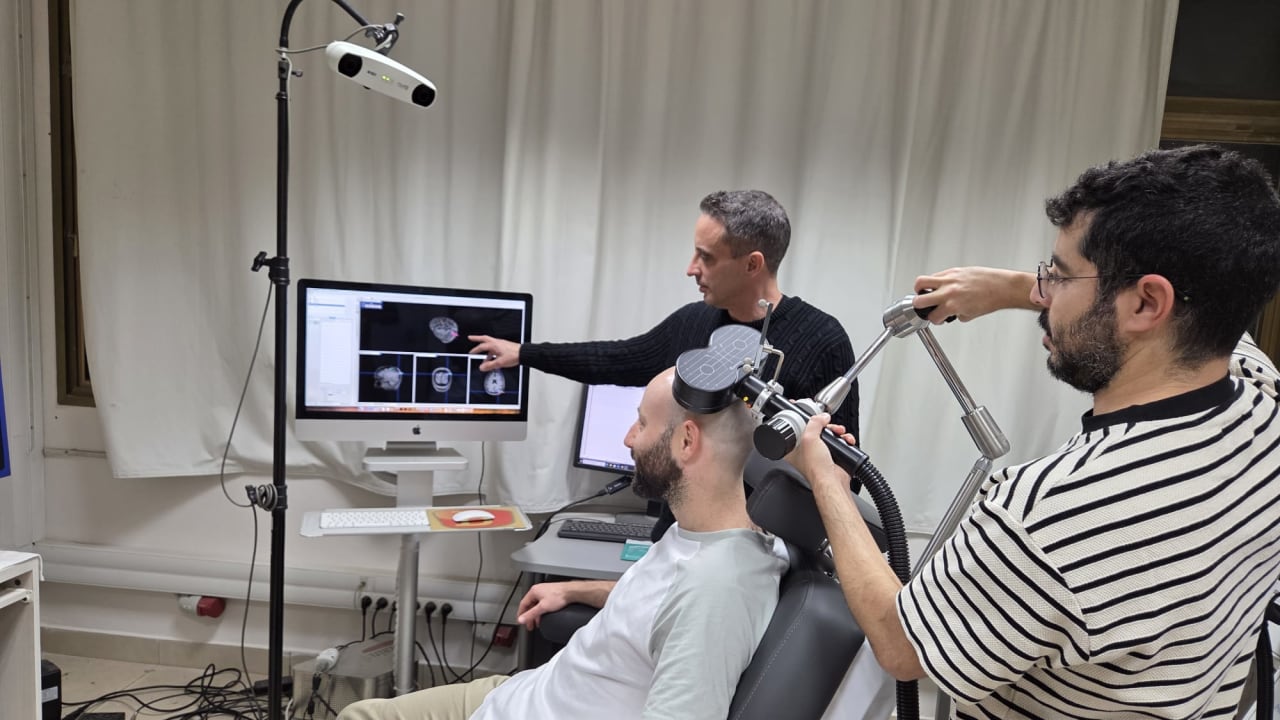
Researchers at Tel Aviv University reported preliminary results on Wednesday showing that noninvasive brain stimulation significantly reduced intrusive memories in adults with post-traumatic stress disorder.
The five-session pilot, conducted in Tel Aviv and published in the journal Brain Stimulation, used individualized transcranial magnetic stimulation targeted to hippocampal networks. The approach, the team said, may offer a new tool for Israelis affected by the October 7 attacks and the Israel-Hamas War.
Because direct stimulation of the hippocampus is invasive, the researchers used functional MRI to identify, for each participant, superficial cortical regions connected to the hippocampus, then applied TMS to those sites. Ten adults with PTSD completed five weekly sessions in which the traumatic memory was first reactivated, followed by stimulation during the memory’s labile reconsolidation window. The goal was to alter how the memory is re-stored, easing the frequency and intensity of flashbacks.
Participants showed consistent improvement with sharp declines in intrusive memories, according to the team. Imaging also showed reduced connectivity between the hippocampus and the stimulated regions, indicating a measurable neural change alongside symptom relief.
Israeli mental health-related needs rise in wake of October 7
Israel has documented a broad rise in mental-health needs since October 7, with national surveys showing increases in anxiety, depression, and related conditions and record demand for services. Defense officials have also reported a spike in PTSD among service members following the war, with the caseload expected to keep growing in the coming years. Against this backdrop, Israeli institutions have tested multiple innovations for trauma care, from neuro-feedback-based tools to clinic-guided protocols.

The authors cautioned that the pilot was small and lacked a control group, calling it proof of feasibility. A larger, controlled clinical trial is underway at the university to assess efficacy and durability over time. Initial coverage of the method and its promise has appeared in the local press.
The study was conducted in the laboratories of Prof. Nitzan Censor and Prof. Yair Bar-Haim at the School of Psychological Sciences and the Sagol School of Neuroscience, with doctoral students Or Dezachyo and Noga Yair, in collaboration with Prof. Ido Tavor’s lab. Co-authors included Noga Mendelovitch, Dr. Niv Tik, Dr. Haggai Sharon of Tel Aviv Sourasky Medical Center (Ichilov), and Prof. Daniel Pine of the National Institute of Mental Health.