
The famous burp: In almost every home with a new baby, the same instruction is heard, “Don't forget to pick him up for a burp.” The parent places the baby on their shoulder, pats gently, waits a minute, two, ten, sometimes half an hour, and meanwhile the baby has already fallen asleep, wakes up, cries again, and a cycle of feeding and soothing begins once more. But the medical truth is simpler: A burp can help some babies, but it is not a biological necessity after every meal.
While nursing or drinking from a bottle, some babies swallow air. This air can accumulate in the stomach, causing a feeling of fullness, discomfort, spitting up, or crying. For such babies, a short break in the middle of the meal or at its end, upright holding, and gentle pats, might help. On the other hand, a baby who nurses calmly, eats at a good pace, does not squirm, does not spit up much, and falls asleep comfortably, does not have to go through a long burping ritual.
The feeding method also has an effect. Nursed babies may swallow less air than babies who receive a bottle, but this is not an absolute rule. A nipple with a flow that is too fast, a poor feeding position, or a bottle held at an unsuitable angle can cause air swallowing. Therefore, sometimes the solution is not more patting, but rather adjusting the nipple, slowing down the feeding pace, and taking short breaks.
It is important to distinguish between a burp and managing spit–ups. Many babies spit up even after a perfect burp. The spitting up stems from the structure of the digestive system at an early age, from a small stomach volume, and from an esophageal sphincter that is still maturing. Therefore, one should not expect that a burp will prevent every spit–up. It can ease discomfort, but it does not “seal” the stomach.
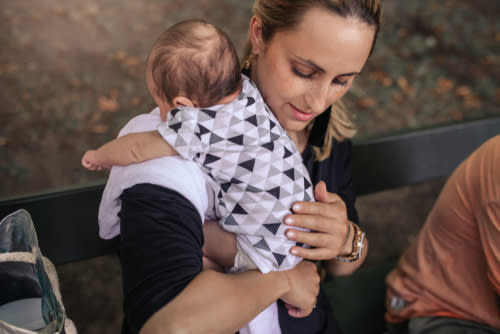
With a bottle–fed baby, you can stop once in the middle of the meal, hold them upright for a few minutes, and then continue. At the end of the meal, you can hold them on the shoulder or in a supported sitting position, while supporting the head and neck. There is no need for strong pats. A gentle pat or a light massage on the back is sufficient.
If after a few minutes a burp did not come out and the baby is calm, you can let them be. There is no need to wake a sleeping baby just to get a burp out. If they wake up, squirm, or seem uncomfortable, you can pick them up again and try. Good parenting is not measured by the number of burps.
When is it nevertheless advisable to consult? When there are multiple projectile vomitings, lack of weight gain, refusal to eat, coughing or choking during feeding, cyanosis, blood in the vomit or stool, or extreme restlessness after every meal. In such cases, it is not a problem of “a burp didn't come out,” but rather a need for a medical evaluation.
General warning signs that always require a visit to the emergency room
- Any fever in a baby under 3 months old
- Fever lasting more than 3 consecutive days
- Failure to urinate for over 10 consecutive hours
- More than 3 consecutive vomitings
- Bleeding on the skin
- Excessive sleepiness or loss of consciousness
- n extreme headache that wakes one from sleep or a fear of light
- Blurred vision Bloody cough or bloody stools
- Shortness of breath and an inability to complete a sentence
Dr. Itay Gal is a specialist in pediatrics, a sports and aviation physician, and the medical commentator for Maariv. For more articles click here