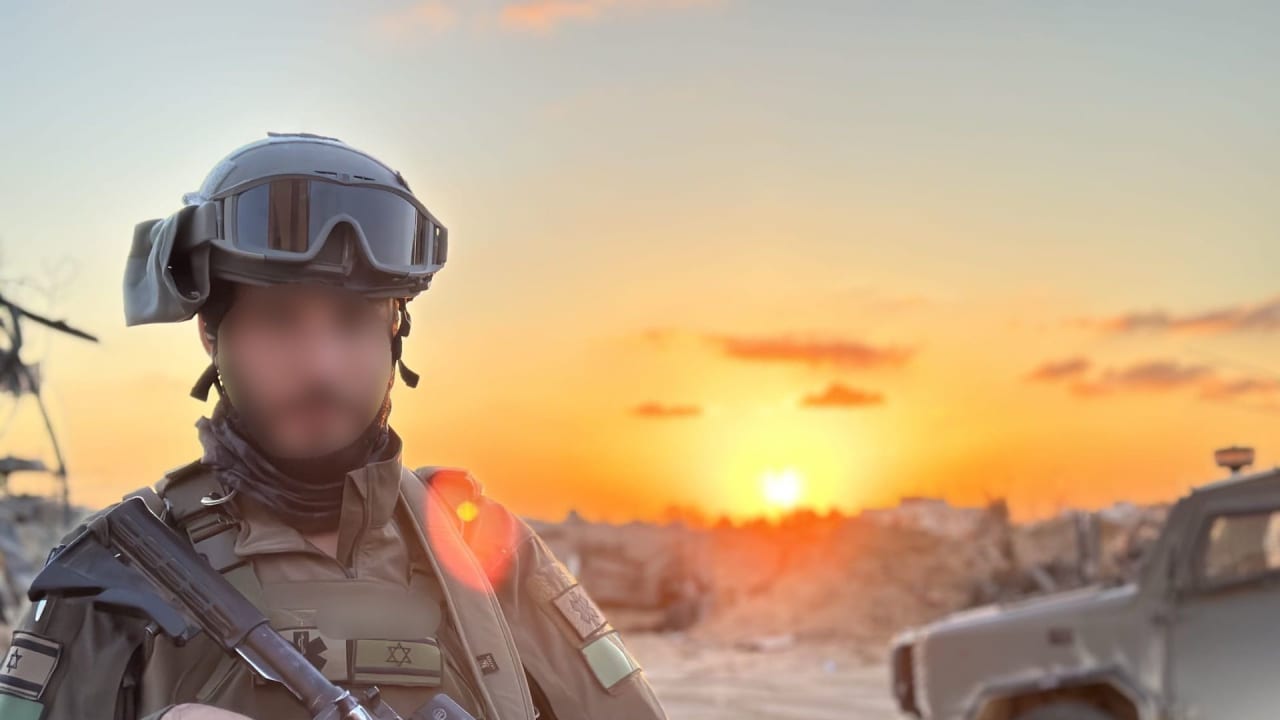
“I think the phrase ‘never again’ isn’t just a passive phrase that we have to say,” Captain A. reflected in an interview with The Media Line, linking his grandfather’s survival story to his own decision to serve in the IDF. For the Deputy Company Commander for Medical Affairs in Battalion 7475, the sentence is not rhetorical. It is the framework through which family history, national responsibility, and personal service converge.
For more stories from The Media Line go to themedialine.org
Captain A.’s grandfather, who passed away only a few months ago, was born in Kassel, Germany, into a world that would soon collapse. At the outbreak of the war, his father managed to escape to England, but the rest of the family was not as fortunate. “Him, his mother, and his younger brother were sent to various camps and ghettos,” Captain A. said. In one of the labor camps, the family followed a brutal routine. His grandfather and his mother were sent out to work each day, while his younger brother, too young to be useful, remained behind.
“One day when they came back, his brother disappeared,” he recalled. There was never an explanation. “There is no documentation or record of what happened to him. There was no one, until this day, no one has been able to say what happened to his brother.” His grandfather was around seven years old. His brother was three. It would take decades before he could accept what the silence almost certainly meant.
After the war, his grandfather and great-grandmother made it to England, where they were reunited with his father. From there, he rebuilt a life that was deliberately forward-looking. For most of it, the Holocaust remained unspoken. “Up until about 20 years ago, he would never speak about the Holocaust,”

When that silence finally broke, it did so completely. “The first time we heard about it was when he’d been convinced to speak in the synagogue one year about his experiences,” he said. “Since that day, it was like opening the faucet. He never stopped since.” What followed was a second chapter of his grandfather’s life, one defined by testimony rather than survival.
He spoke widely and publicly, addressing schools, companies, and government institutions. He met Queen Elizabeth multiple times and later met the king. He even accompanied the prince and princess on visits to the camps, serving as a living witness to places that many knew only through photographs and textbooks. “He managed to reach hundreds, if not hundreds of thousands, if not millions of people with his story,” Captain A. said.
An unrealized dream
Despite that public role, Israel remained an unrealized dream for his grandfather. “He’d always wanted to move to Israel,” Captain A. said. “He was never able to.” His grandparents visited frequently, but his life remained rooted in England. Captain A.’s parents still live there today. He was the one who made the move alone.
“I always wanted to live in Israel,” he said. “But I had to serve in the army.” That decision was shaped by more than ideology. For him, it was the practical expression of a lesson learned at home. “History has proven to us that if we don’t look after ourselves and we don’t look out for ourselves, no one else is going to,” he said. “It’s important for Israel to be a strong country and to have a strong army.”
The moment when family history and national crisis collided came on October 7. Captain A., his wife, and their children were in Israel visiting his grandparents, who were spending the holiday there. The couple’s youngest child was only three months old. “We’d woken up at 6 o’clock because of the baby,” he recalled. “At 6.30, our phones started exploding.” Within hours, the visit turned into a farewell. “We kissed and hugged and said goodbye,” he said. “I went home to take my wife and kid home and was called up a couple of hours later.”
His grandparents were still in Israel at the time. A few weeks later, his grandfather was interviewed in England, where he articulated a sentiment that struck deeply. “He said that on October 7th, he felt safer in Israel than he felt in England with the anti-Semitism that was still going on,” Captain A. said. For a man who had survived the Holocaust and spent his life in Britain, the statement was stark.
Telling his grandfather about his decision to serve had been emotional even before the war. “He was very emotional,” Captain A. said. “He, of course, wanted me to stay safe and make sure not to get into any trouble.” His grandparents traveled to Israel for his swearing-in ceremony. “He was very proud,” he said. “It was important to him.” Pride became something his grandfather shared openly. “They were always showing off about what their grandson was doing.”

That pride stood in contrast to how little the previous generation had known. Captain A.’s father, raised by a survivor who rarely spoke about the Holocaust, grew up without understanding the full extent of his father’s past. “They knew very vaguely what had happened,” he said. “They didn’t know the details. They didn’t know exactly how bad it had been.” His grandfather, he explained, did not define himself through survival. “He built his life, he built a family, he built a business. It was important for him to be a member of the community and not a survivor.”
Only when he began speaking publicly did the community understand who he was. That transformation, from silence to testimony, shaped how Captain A. understands remembrance today. “As we get further and further away from any historical events, it becomes more difficult,” he said. With the number of Holocaust survivors rapidly declining, memory is increasingly mediated. “It’s now becoming second-hand and third-hand stories.”
That distance, he warned, creates vulnerability. “It’s becoming easier and easier to be a Holocaust denier,” he said, pointing to the growing presence of denial and distortion in mainstream discourse. “That’s now our responsibility and our challenge, to carry on with the message, to carry on with their legacy and their story.”
Resurgance of global antisemitism
The resurgence of antisemitism worldwide made those concerns painfully real for his grandfather in the final months of his life. “The anti-Semitism which we’re seeing, the rioting and the shocking levels are pre-Holocaust levels,” Captain A. said. His grandfather passed away “about two and a half months ago,” at a time when attacks on Jewish communities were again dominating headlines. “It was very upsetting to him, and it took him back to times he was sure he would never see again in his lifetime.”
For Captain A., the war was not defined only by combat or strategy, but by moments of direct human contact. Serving with Home Front Command after October 7, he was assigned to hotels housing evacuees from southern Israel. “One of the roles and responsibilities which were given immediately after October 7th was to be in the hotels where the people who had been evacuated from the South were staying in Jerusalem,” he said. The mission was simple but profound: “To be there in uniform and to help them with whatever they needed and to make them feel safe.”
What he encountered reminded him of his imagined view of displaced people throughout history. “Completely helpless, reliant on other people for food, for clothes, for their basic living needs,” he said. Helping families with everyday tasks, caring for children, and offering a sense of stability became central to his experience. “To then have a little bit of warmth and kindness,” he said, “was very humane.”
He also witnessed the broader response of Israeli society. “To see how also everyone in Israel was sending huge amounts of clothes and food and trying to care for them in any way possible was very warming and humane.” It was a moment of continuity he never discussed directly with his grandfather, but one he believes would have resonated deeply. “It’s something which he would have been proud of,” he said.
Captain A. is now a father himself. His son is two and a half years old. The question of transmission is no longer abstract. “I’m not going to say he’s going to grow up on the stories,” he said, “but he’s going to know who his great-grandfather was.” The recordings and interviews his grandfather left behind will form part of that inheritance. “He’s definitely going to hear all about him,” Captain A. said, adding that his great-grandfather’s life will serve not only as history, but as an example.
For Captain A., the chain linking Kassel to Jerusalem has not been broken. Survival led to silence, silence gave way to testimony, and testimony now finds expression in service. “It was very important to put action behind the meaning, never again,” he said. In his view, remembrance without responsibility risks becoming ritual. Responsibility, by contrast, is lived daily, in uniform, among civilians, and within a family still carrying the weight of history forward.