
The images from Bnei Brak on Sunday were jarring.
Two female IDF soldiers, who had gone into the city to pay a house visit, were extracted by police from an unruly mob throwing objects, screaming epithets, and overturning trash bins.
By the end of the day, a police motorcycle was set alight - a pair of tefillin and a prayer book inside the motorcycle storage box also burned - and a patrol car was overturned. Three officers were injured, and some 27 people were arrested - seven of whom were brought before a judge. By Monday afternoon, all but two under house arrest had reportedly been released.
The same language, the same story
The condemnations were swift and harsh: from Prime Minister Benjamin Netanyahu, opposition leaders, the heads of haredi political parties, and rabbinical leaders. The theme woven throughout the haredi responses was the same: Those responsible were a small, fringe minority who did not represent the community.
Sound familiar? It should.

Whenever there are acts of violence perpetrated by representatives of one sector in this country or another, those condemning them from that community insist they are not representative of the whole.
It is the same formulation invoked when extremists in Judea and Samaria attack Palestinians or clash with IDF soldiers. Settlement leaders and right-wing politicians condemn the actions and say they are the work of only a radical fringe – “wild weeds” – that do not reflect the mainstream.
It was the same language used when anti-Netanyahu protests got out of hand – when highways were blocked, bonfires lit, and acts of vandalism crossed the line.
Last September, during protests near the Prime Minister’s Residence in Jerusalem, trash bins and tires were set alight. The fire spread and engulfed a nearby vehicle. Protest leaders quickly condemned the incident, stressed that it did not represent the movement, and raised funds for the family.
The truth is that the phrase – “it is only a fringe minority” – is often accurate. In each camp, the overwhelming majority do not riot, burn, or attack. But the recurrence of the phrase – across sectors and across ideologies – raises a more uncomfortable question. If every camp has its “small minority,” and every leadership disowns it after the fact but does little more, what prevents the next small minority from testing the line again?
The truth is that the phrase - “it is only a fringe minority” - is often accurate. In each camp, the overwhelming majority do not riot, burn, or attack. But the recurrence of the phrase - across sectors, across ideologies - raises a more uncomfortable question. If every camp has its “small minority,” and every leadership disowns it after the fact, what prevents the next small minority from testing the line again?
Bus driver hits and kills Haredi protester
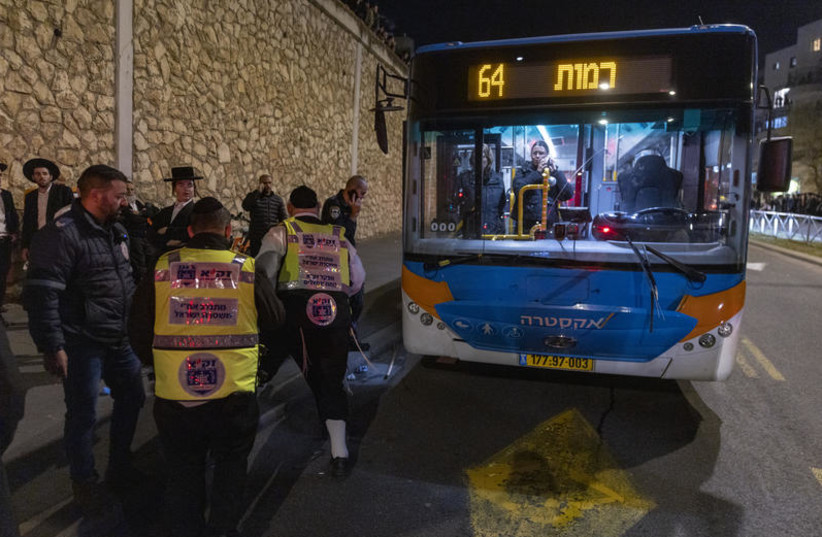
Sunday’s riot did not erupt in isolation. Just weeks ago, on January 5, another confrontation tied to the haredi draft issue ended in tragedy on Jerusalem’s Yirmeyahu Street.
During an anti-conscription rally, youths blocked a bus. The driver called the 100 emergency line, reporting that he was being assaulted and that the road was being obstructed. Moments later, as he drove through the intersection, 14-year-old Yosef Eisenthal was struck and killed.
Police arrested the driver for questioning. Haredi lawmakers immediately labeled the incident “murder.” Protest organizers insisted the rally had been peaceful and rejected claims that the driver had been attacked.
Two narratives crystallized almost instantly.
In parts of the haredi street, the death was held up as proof that demonstrators were expendable. “Haredi blood is not cheap,” a Shas statement read.
Outside the haredi community, the focus was different: a driver under assault and feeling threatened, roads blocked, order in the capital collapsing into chaos.
That episode deepened mistrust between police and protesters, between state authority and a haredi community that feels under siege.
Against that backdrop, the images from Bnei Brak land differently.
January 5 followed a similar script. Organizers of the anti-draft rally insisted that it had been peaceful and orderly, that the fatal confrontation with the bus took place outside the designated protest area, that blocking the bus was not part of the plan, and that any threat to the driver was made by the extreme. The reflex was familiar: Isolate the act, and shield the broader cause.
That instinct – to quickly narrow responsibility to a fringe minority operating independently and to isolate the act from the movement – may be politically understandable. No leadership wants to see their entire community stigmatized by the actions of a few.
The consequences of the reflex
But there is a structural consequence to that reflex. When every sector insists the violence came from its margins, and its leadership is satisfied with issuing condemnations blaming an extremist minority, then the responsibility for setting and enforcing boundaries falls elsewhere. It falls to the state.
On Sunday in Bnei Brak, 28 people were arrested. By Monday afternoon, two reportedly remained under house arrest.
The police demonstrated operational control. They extracted the soldiers. They restored order. But deterrence is not measured only in tactical success. It is measured in the consequences.
If each sector sees its fringe members detained and swiftly released, the lesson learned is not necessarily caution. It is calibration: How far can they push before the state pushes back?
This pattern is no longer confined to one community. Settler extremists are clashing with soldiers. Haredi radicals are confronting the police. Secular protest fringes blocking highways and damaging public property.
The grievances differ. The ideologies diverge. But the dynamic is strikingly similar: State symbols become the target.
Every democracy has fringes. The question is not their existence. It is whether they operate in arenas where policing carries a political price. In Israel, those arenas are often highly mobilized, electorally essential communities – whose political representatives sit in governing coalitions.
That makes condemnation easier than confrontation, and it also ensures recurrence, since condemnations don’t carry much bite.
The phrase “small minority” may be accurate. It may be sincere. It may even be necessary to prevent collective blame.
But when every camp invokes it, denunciation cannot be the end of the story, but it often is.
Israel is strong enough to contain its fringes. The harder question is whether it is prepared, across all camps, to impose consequences on them.
If every side disowns its fringe but does little beyond lip service to control it, then the only entity left to own the problem is the state. The record from Sunday – swift arrests followed by swift releases – shows how difficult that task remains.