
As the Hamas attack unfolded against Israel on Oct. 7, there was a failure at all levels of command and leadership to come to grips with what was happening. In the new book While Israel Slept by Yaakov Katz and Amir Bohbot, the authors tell a short story about Prime Minister Benjamin Netanyahu being put in touch with a resident of Kibbutz Be’eri. “The chaos was so vast that even Netanyahu felt like he needed to hear firsthand what was happening.”
This is one of those sentences that stands out.
One would think in a country as small as Israel, where “Never again!” is one of those slogans everyone hears, year after year, that the prime minister would know what was going on along the border of Gaza during a massive attack. Katz and Bohbot document this systematic failure in a compelling narrative that brings readers back to Oct. 7 and raises many questions about how this disaster unfolded.
Israel is the country that was supposed to protect the Jewish people from another Holocaust.
Every year in Israel, politicians and generals boast about how the country is strong and protects its people.
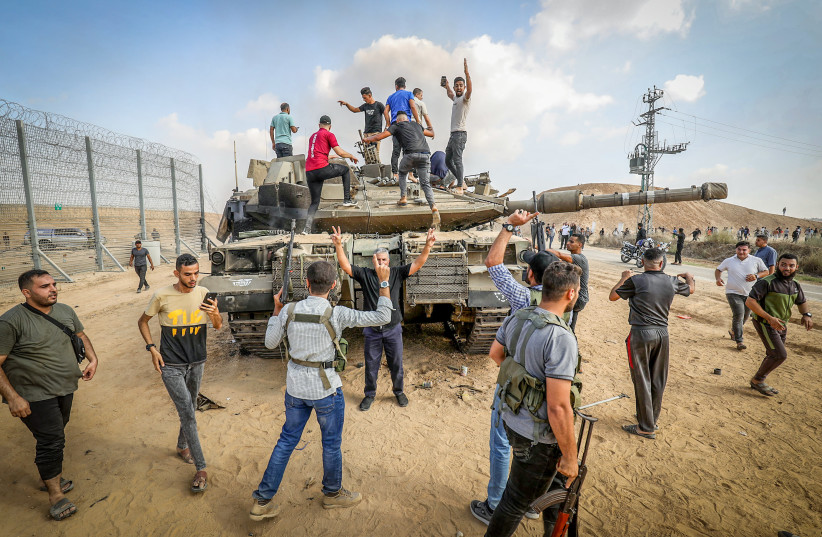
This was what people were told before Oct. 7. On that day, all the slogans and boasting were shown to be empty. Rather than “Never again!” Israel let the Jewish people be massacred again, just like in the Shoah.
Women and children, as in the case of the Bibas family, were herded into captivity.
Hamas had around six hours of almost complete freedom to do what it wanted to thousands of people. Rape. Murder. Kidnapping.
As time goes by since Oct. 7, the horrors of that day seem to fade as the country continues to have to fight an endless war in Gaza. The country that defeated three countries in six days in 1967 can’t defeat Hamas in Gaza or replace it. Israel also can’t bring its own hostages home after 22 months of war. While Israel Slept: How Hamas Surprised the Most Powerful Military in the Middle East is an attempt by two excellent authors to try to explain what happened on that terrible day.
Almost every page is peppered with stories that continue to shock us regarding how unprepared Israel was. For instance, at one point during Sukkot 2023, just prior to the Hamas attack, there was a meeting at IDF headquarters in Tel Aviv with the prime minister.
“Some of the participants showed up at IDF HQ in Tel Aviv in jeans and T-shirts,” the authors record. These were the people who presided over the decision to leave the border mostly undefended on Oct. 7. While Hamas was training and preparing for war, they didn’t treat anything with the seriousness it deserved.
Eighteen-year-old female soldiers on the border, who were left there without weapons to defend themselves, were expected to wear uniforms at their posts, to dress to a standard. But those at the top were in T-shirts. When the war came, those soldiers would be massacred or carted off to be hostages, and those hostages would be left in Gaza for a year.
This wasn’t David Ben-Gurion’s or Menachem Begin’s Israel, where women soldiers wouldn’t have been abandoned and carted off to Gaza. It was the T-shirt-wearing, “everything is fine” Israel that appeased Hamas and watched as Hamas trained for war and left the border undefended.
The reason the border was undefended was because of the groupthink that apparently permeated the IDF, military intelligence, and up to the top levels. “Gaza seemed relatively calm, with some indications that Hamas’s leadership was focused on maintaining the status quo, particularly after the arrival of Qatari funds.”
We now know that although there was intelligence about Hamas’s plans, it wasn’t taken seriously. As the authors note, Israel’s Military Intelligence, “Aman,” believed there might be a conflict “characterized by rocket fire and one or two tunnel infiltrations.”
WHEN ISRAEL finally went into Gaza after the disaster of Oct. 7, the IDF initially did well. It was able to recover from the disaster and move forward in Gaza. The ground offensive led to the discovery of a massive treasure trove of Hamas documents.
“It became one of the largest real-time intelligence operations in modern history – devices would be sent back to Israel and almost immediately evaluated by someone in Aman or Shin Bet [Israel Security Agency].” The theme the authors come back to again and again is how Israel had to return to viewing Hamas as a threat after Oct. 7.
There is a section of the book devoted to the activities of Unit 504, a military intelligence unit that specializes in human intelligence, such as gathered through interrogations. “The operation involving Unit 504 was just one example of how unprepared Israel and the IDF were for the Hamas attacks on Oct. 7. The unit, one of Israel’s best, was not even thinking about Gaza as a target until the morning of the attack.”
Hamas threat wasn't taken seriously; warnings were ignored
Hamas had been fighting Israel for 30 years and had killed numerous Israelis, but for some reason, it was not seen as a threat that needed to be taken seriously.
However, there were voices in Israel who had warned about Hamas and wanted Israel to stop appeasing the terrorists.
In November 2018, then-defense minister Avigdor Liberman spoke in a cabinet meeting and “pushed to launch Operation Lightning Strike, the code name the IDF had given the campaign to destroy the tunnels, a simulation of which he had personally overseen a few months earlier.”
Unsurprisingly, the IDF and other politicians resisted Liberman’s desire for an offensive. Nothing was done. Hamas grew stronger. Liberman resigned. And Israel was left undefended as the Hamas threat grew.
Between 2018 and 2023, Israel also became drunk on mythical stories about success. This feedback loop was clear in the short conflict with Hamas in 2021. As the authors tell it, Israel believed it was successful against the Hamas “Metro” of tunnels in Gaza. “When I look at the balance of achievements, there is no question at all,” Israel’s then-chief of staff, Aviv Kohavi, said. “We were much more successful than Hamas. There is no doubt at all.”
Netanyahu “also hailed the operation, claiming that it had boosted Israel’s deterrence.” He claimed that Israel had dealt Hamas a “blow it cannot imagine.” In retrospect, this was all nonsense. Israel declared victory and put out stories about great successes that were largely an illusion, which fed the feedback loop that led commanders to decide the border could be left defended by a handful of troops on Oct. 7.
Katz and Bohbot have provided an important account of Oct. 7 and the road to the disaster. They also provide some recommendations in their concluding chapter about how Israel should reform its intelligence gathering and come up with an exit strategy for dealing with Gaza.
However, the book suffers from a sense that it meanders from a compelling discussion of how the attack unfolded to a much longer discussion about the rise of Hamas and the appeasement of the group. This organizational decision, to start on Oct. 7 and then detail the early operations in Gaza and then go back to the lead-up to the war, can leave the reader wanting more of a chronological narrative.
Where the book is strongest is in marshaling the decades of experience that both authors have from their background as military reporters. They’ve both been here in Israel as the decisions leading to Oct. 7 unfolded in the last decades.
For instance, after Israel’s 2005 withdrawal, the authors note, “We attended briefings and tours of the Israeli-Gaza border where the most senior defense officials in the country told us that if the Palestinians fired even one single rocket, Israel would retaliate with unprecedented force.” Once again, one senses a theme. Israeli officials boasted and talked tough. Then they appeased.
Many questions raised
The book raises many questions about the war itself. For instance, the authors tell how defense minister Yoav Gallant conducted a “surprise” visit to Sderot before the war. He met with Col. Haim Cohen, the commander of the Northern Gaza Brigade.
However, no urgency seems to have trickled down to actually making sure posts such as the base at Nahal Oz, where so many unarmed women soldiers were located, were secure. When Hamas attacked, the base was overrun, and commanders didn’t even seem to know a massacre had unfolded for hours. What did Gallant and Cohen discuss, if not the basic ability to defend Israeli communities and have forces in place to defend bases like Nahal Oz?
There’s a theme that also comes up regarding Oct. 7, in which many senior officers were on vacation. Maj.-Gen. Yaron Finkelman, head of Southern Command, was on vacation in the North. The head of Military Intelligence, Aharon Haliva, was on vacation in Eilat. In the hours before the attack, Israeli officials received some information that indicated a possible Hamas attack. However, the groupthink was not to “tip off Hamas” by reinforcing IDF units on the border.
This explanation has been provided to journalists since Oct. 7, but it makes no sense. Why would Israel not do the basic thing of reinforcing units to protect civilians? The IDF has one primary job, and that is to defend Israel. “The IDF directive was not to let Hamas know that Israel knew what it knew – firstly to avoid burning sources and secondly to avoid raising panic within Hamas,” the authors write. Why would Israel be so fearful of Hamas’s “panic”?
On the one hand, the IDF had reduced intelligence sources in Gaza and wasn’t even focused on Gaza, but on the other, it was worried about burning sources there? The two explanations don’t make sense and appear to be a cover for the failure of Oct. 7. The failure wasn’t due to some kind of 3-D chess of not wanting Hamas to know the IDF knew; it was due to complete systematic failure.
There are other things that don’t make sense. The authors paint a picture of IDF chief of staff Herzi Halevi “and his men [being] cautious in these initial hours. If this was real, they wanted to be ready.” However, when the attack came, it didn’t seem that Halevi, Gallant, or most of the top brass sprang into action. They weren’t ready. That is why the prime minister had to find someone to call a civilian in Be’eri. And even then, the prime minister didn’t seem to move with urgency. He thought the situation was being dealt with. Col. Eitan Paz, the commander of the Israeli Navy’s Ashdod Naval Base, was told in the early hours before the attack “not to do anything that would tip off Hamas that Israel was on high alert.”
However, the IDF was not on high alert. In fact, it was not on alert at all. Like the story of Halevi, the story of the IDF not wanting Hamas to know it was on alert is contradicted by the fact that the forces were not on alert, and no reinforcements were sent for many hours. “Hours ticked by as the General Staff slowly absorbed the severity of the situation and moved to mobilize forces toward the Gaza Division.” Meanwhile, Jewish families were carted off as if it were 1941 or 1880.
The account of the disaster of Oct. 7 continues to leave questions about what happened. Key commanders remained “holed up” as Israeli communities and bases were overrun. Commanders hid in their command posts rather than leading from the front, as Israeli commanders have historically done. While IDF commanders then distinguished themselves in the war, the performance on Oct. 7 and the lack of any reprimand leave a scar. The authors correctly note that the “Israeli government and military failed the people of Israel on Oct. 7, 2023. We need to make sure that this does not happen again.”
- WHILE ISRAEL SLEPT: HOW HAMAS SURPRISED THE MOST POWERFUL MILITARY IN THE MIDDLE EAST
- By Yaakov Katz and Amir Bohbot
- St. Martin’s Press
- 336 pages; $29