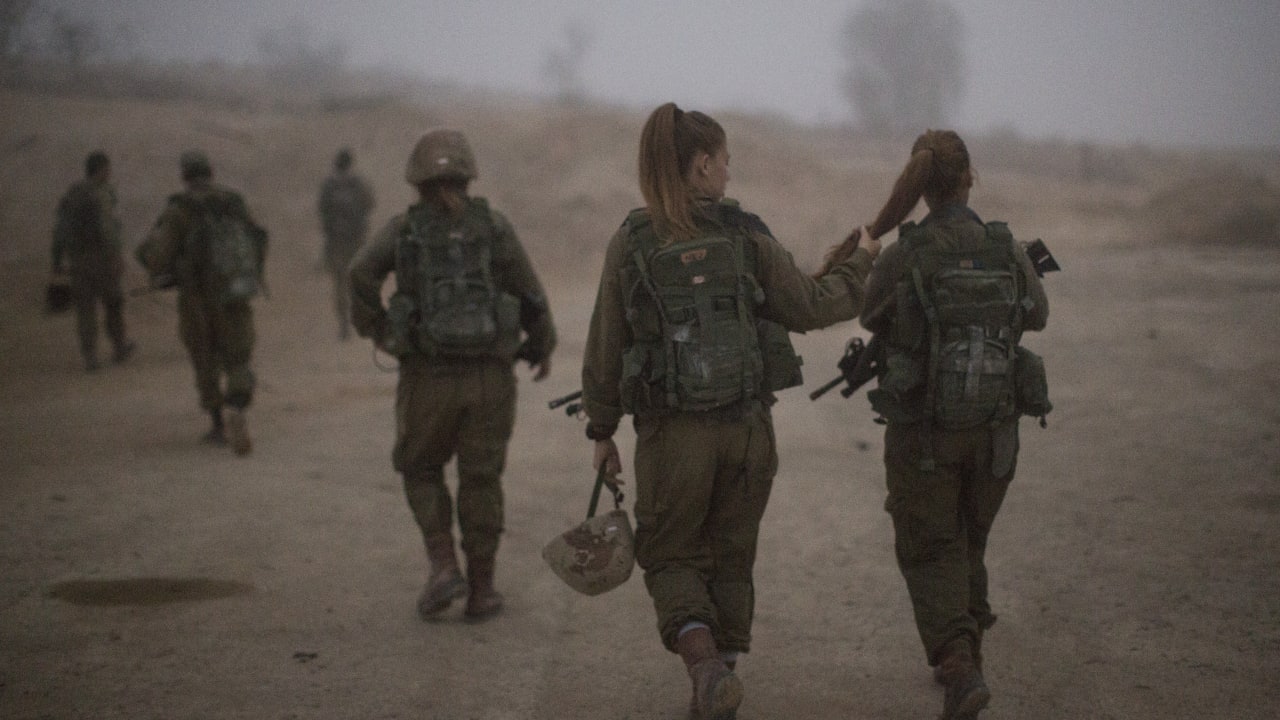
A new company of female IDF intelligence collection technology officers will soon be joining the Shahaf 869 Intelligence Unit within the 91st Division to assist in preventing Hezbollah’s rearmament efforts.
Focusing on southern Lebanon, Shahaf has already helped locate and kill around 60 Hezbollah terrorists over the last year. The unit has also located and enabled the destruction of dozens of Hezbollah terror facilities, weapons storage areas, and observation-lookout positions. Additionally, Shahar has assisted the air force and artillery units in better targeting Hezbollah positions in hundreds of operations.
The announcement comes as the debate has reignited about the place of women in military combat units.
In November, The Jerusalem Post exclusively reported on having embedded with a group of female field intelligence soldiers spying on hostile elements in Syria, including a visit to Position 720 on the Israel-Syria-Jordan tri-border.
595th Battalion Commander Lt.-Col. “G.,” operations officer Maj. “M.,” and intelligence collection soldiers “S.”, “D.,” and “V.,” – all of them other than G. being female soldiers – all spoke with the Post to provide an in-depth snapshot of what it’s like to sneak through Syria to help keep Israeli forces ahead of the curve.
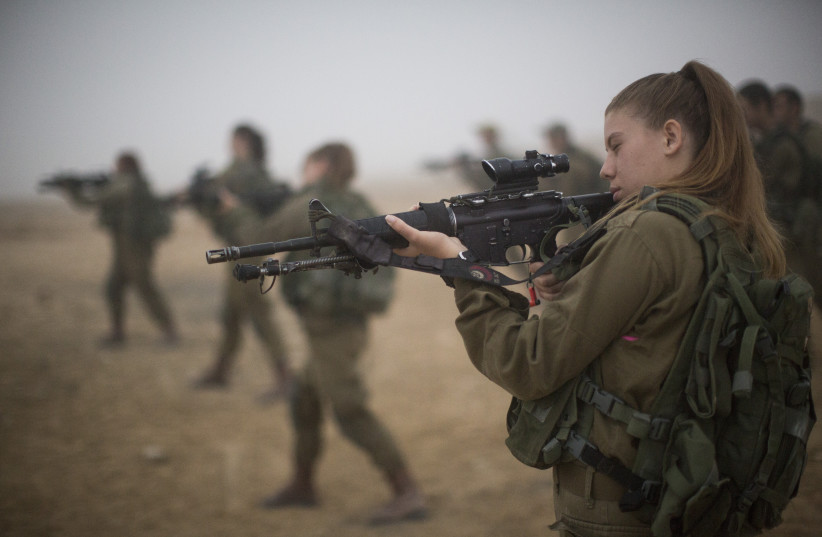
The three female intelligence collection soldiers, S., D., and V., specifically specialize in drone field intelligence collection.
While it might sound like they are sitting back safely in headquarters, they are very much deep in the field and potentially in danger, utilizing a tactical drone from up close so that they can eyeball whatever the drone sees.
Drone use grows across IDF for intelligence missions
M. added that since the Israel-Hamas War, drone use has expanded so exponentially in the IDF that essentially every platoon commander, and sometimes even only a few soldiers, have their own drone assigned for collecting forward intelligence.
G. commented that one of the arts of using a drone to collect intelligence in Syria is figuring out the ideal height at which to fly the drone in differing circumstances.
In principle, it would be ideal to fly a surveillance drone as low as possible to get the most specific information and the highest resolution surveillance available.
But in many situations, flying too low risks blowing the surveillance, which would alert the targets and enable them to adjust to avoid surveillance, defeating the whole purpose of clandestine intelligence collection.
The 595th has helped locate and catch Iranians, Hamas terrorists, jihadists, and just about anyone who could threaten Israel in its Syrian security zone or nearby.
S., D., and V. are all part of a new generation of IDF combat women who do not hesitate to pounce on enemies in hostile territory.
These women seem to be precisely the kind of confident and forward-leaning field intelligence officers that help lead Israel’s post-October 7 more aggressive strategy in enemy territory.
Now, the IDF hopes to add similar elements to its intelligence collection in southern Lebanon.