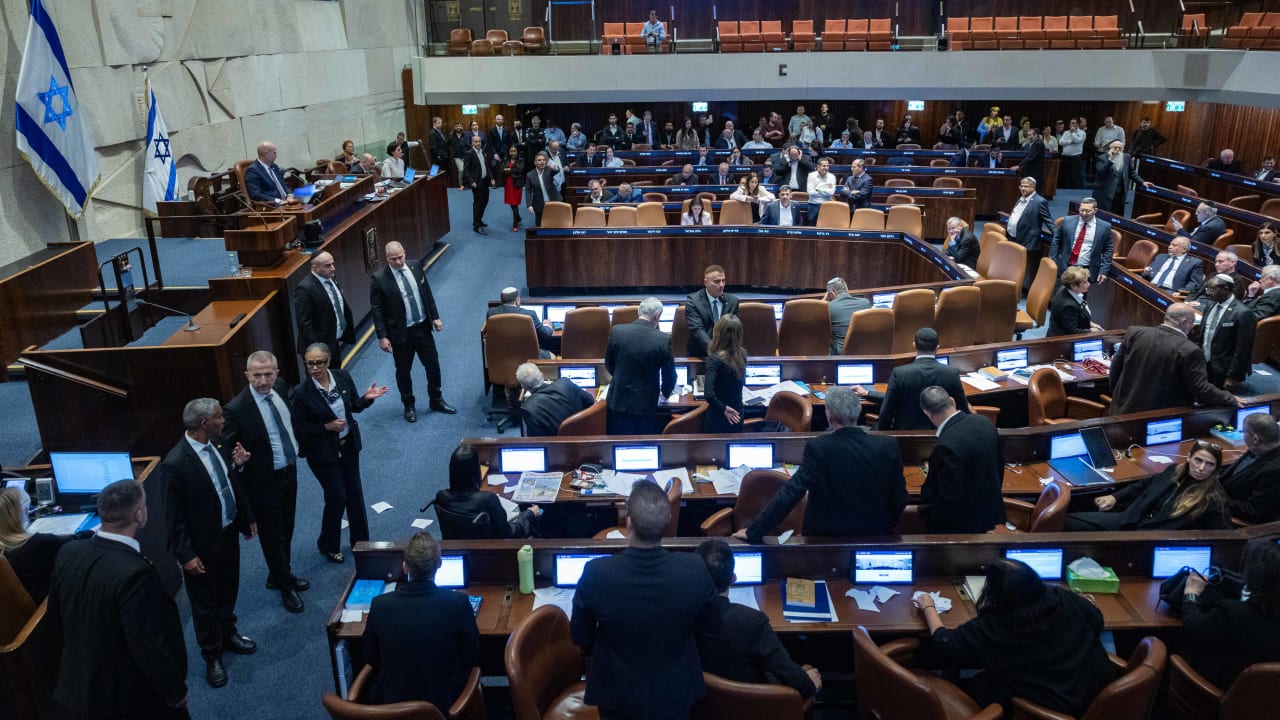
Governments in Israel generally fall more with a procedural whimper than with a dramatic ideological bang – a pattern that helps explain why the scheduled Knesset vote on Wednesday on the first reading of the 2026 budget is looming so large.
If the vote is postponed, or if the haredi (ultra-Orthodox) parties – angry over the lack of progress on the haredi conscription law – choose not to support it and it falls, then for all intents and purposes the government will fall with it.
By law, the budget must pass by March 31, or the government automatically collapses. But because there is a mandatory 60-day waiting period between the first reading and the second and third readings, ministers warn that the first reading must pass this week for the 2026 budget to meet that deadline.
If the budget does not pass by the end of March, new elections must be held within 90 days.
That reality explains the dramatic buildup to Wednesday’s vote. The haredi parties have threatened to vote against the budget or not vote unless a version of the conscription bill they can accept is passed – meaning a significantly watered-down law.

On the other side, Finance Minister Bezalel Smotrich has warned that the budget cannot be held hostage to the whims of every coalition partner, and that if the haredi parties choose not to vote for it, the Knesset should be dissolved.
It sounds like high drama. In practice, it is less so.
Elections must be held by late October 2026, at the latest. Even if the vote fails on Wednesday and the budget subsequently does not pass by March 31, elections would be held in early July – roughly three to four months earlier than scheduled.
Even in the more extreme scenario – if elections were triggered immediately - they would likely take place in late spring or early summer, just a few months ahead of schedule. That is hardly a political earthquake. Much of the talk about “early elections” is therefore somewhat overblown, since elections are coming anyway, by law, in another nine months.
Against this backdrop, Prime Minister Benjamin Netanyahu convened an emergency meeting following the failure to bring the budget’s first reading to a vote as planned on Monday. Present were Shas leader Arye Deri, United Torah Judaism’s Moshe Gafni, and Smotrich.
Smotrich wears two hats. As the finance minister, the budget is his responsibility. But he is also the head of the Religious Zionist Party, which is under relentless pressure from its base not to allow a haredi conscription law that lacks real enforcement.
That pressure has intensified since the war, as the religious Zionist community has paid a disproportionately heavy price. According to a recent Ariel University study, 34% of the fallen soldiers in the Gaza war came from this community, which makes up roughly 12%-15% of the country’s Jewish population. Among fallen reservists, about 45% were from the religious Zionist sector – a level of overrepresentation far exceeding its share of the population.
Under these circumstances, agreeing to a draft law without real teeth would not be coalition management for Smotrich; it would be electoral self-harm – especially at a time when elections, one way or another, are fast approaching.
Haredi parties face pressure from sanctions
The haredi parties are facing pressures of their own. For them, the issue is not only ideological. The sanctions currently in place – most notably the loss of child-care subsidies for those who do not serve – are not theoretical.
They are immediate, tangible, and increasingly painful. Household incomes are being squeezed, and that pressure is being felt directly by the haredi politicians.
Their electorate is not looking for promises or process. It is looking for results.
Since October 7, the public debate has understandably focused on one question: why does the vast majority of haredim not serve in the army? But before the war, the national debate over the haredim centered on something else entirely: employment, not enlistment.
With about a quarter of all first graders today studying in haredi institutions, the low workforce participation among haredi men is no longer a marginal issue. It is not a sustainable model.

For years, the IDF itself was ambivalent about large-scale haredi enlistment, wary of the logistical and cultural challenges involved. The country’s greater concern was economic: limited haredi workforce participation, minimal tax contribution, and growing dependence on state support.
That is why, in the previous Bennett-Lapid government – even when no haredi parties sat in the coalition – the emphasis was less on military service and more on lowering the age at which haredim could receive formal exemptions and enter the workforce.
Then October 7 changed the national conversation. The war brought home for most Israelis the urgency of expanding the pool of those bearing the security burden – an urgency obviously not yet internalized by the haredi political and religious leadership.
But it is not these high-profile ideological disputes that now threaten the government. Those have been present for months, even years, without bringing the coalition down.
The government is now teetering on the abyss because of something far more prosaic: the calendar. Budget deadlines, procedural requirements, and the inability to keep postponing Knesset votes have narrowed the coalition’s room for maneuver. In Israeli politics, governments often survive deep disagreements – until the numbers and the deadlines finally converge.
There is ample precedent. Netanyahu’s first government did not collapse at the height of its ideological battles over Oslo or relations with Washington. It unraveled later, when coalition discipline eroded, and routine parliamentary management became impossible, prompting Netanyahu to opt for early elections rather than face procedural defeat.
More recently, the Bennett-Lapid “change government” survived profound ideological contradictions precisely by avoiding them – until it could do so no longer. It lost its Knesset majority and its ability to function day-to-day. In both cases, ideological differences weakened the coalition, but it was parliamentary procedure that delivered the final blow.
The same dynamic may now be unfolding. Months of ideological sparring within the coalition seem now to be coming to a head over a procedural issue. The question is no longer whether the coalition is under strain – that has been clear for months – but whether it can navigate the next calendar hurdle without falling apart.
Whether the government survives this budget vote or not, the political system has already shifted into preelection mode, as the coalition partners are prioritizing how they appear to voters over preserving the coalition. And in Israeli politics, that usually signals that the government is moving into its final phase.