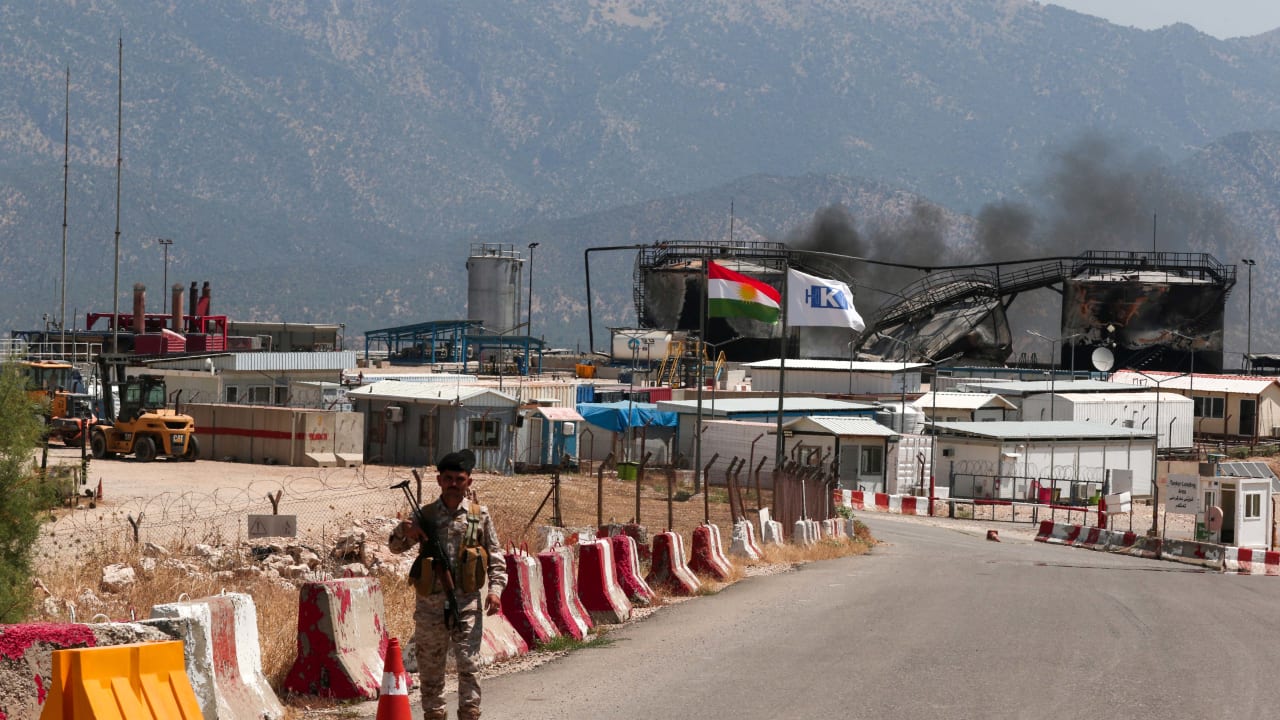
Baghdad needs to do more to respond to drone attacks - that is the message being communicated to Iraq this past week by Western countries after approximately 20 drone attacks in Iraq.
Most of the attacks targeted energy infrastructure in Iraq’s Kurdistan Regional Government in northern Iraq. The KRG has blamed Iranian-backed militias affiliated with the Popular Mobilization Forces for the attacks.
Iraq’s government has been slow to respond. It finally said that it had investigated a series of drone attacks on radar installations that occurred on June 24. Those attacks coincided with the end of the Iran-Israel conflict.
Iraq’s parliament was supposed to discuss drone attacks on July 21. However, the session ended without a discussion. Rudaw media in Erbil, a Kurdish channel, noted that the Kurdish parties in parliament had boycotted the session.
“Lawmakers from the Kurdistan Democratic Party (KDP) and the Patriotic Union of Kurdistan (PUK) boycotted the session. Only three Kurdish parliamentarians attended it, according to Soran Omar from the Islamist Kurdistan Justice Group (Komal). Two of them left the session before it ended,” the site reported.

It was not clear initially why the Kurdish parties pulled out, but it appears they did not feel the discussion would actually address the drone attacks on their region.
“Dara Sekaniani, a Kurdistan Islamic Union (KIU) lawmaker and member of the Iraqi parliament's legal committee, said he left after it became clear the drone strikes would not be discussed,” Rudaw noted. This is likely what caused the parties to decide to boycott the session.
Rudaw noted that “since early July, nearly 20 drone attacks have hit the Kurdistan Region, mostly targeting oil fields and causing significant financial losses. No group has claimed responsibility for the attacks and there have been no new attacks since Erbil and Baghdad reached a new agreement on finances and oil exports on Thursday.”
Frustration with Baghdad grows
The Kurdistan autonomous region is growing increasingly frustrated with Baghdad’s response. The leaders have likely communicated this to their Western colleagues.
The KRG has close ties to the US and some other Western countries. Many countries work with the autonomous region to support its fight against extremism and also its stability.
“We see that very often Iraq and the Kurdistan Region become victims of those militias that are outside authority. I can say that the Iraqi government cannot control those armed groups,” Srwa Mohammed, a Patriotic Union of Kurdistan (PUK) lawmaker in the Iraqi parliament, told Rudaw. “Despite having general authority, and the prime minister being the commander-in-chief of the armed forces, there are still militias that operate outside the law and do not follow official authority,” Mohammed added.
Some believe that the drone attacks are linked to tensions with Iran and also oil deals. For instance, Rudaw noted that “in March, the US rescinded waivers allowing Iraq to import energy from Iran.
The Kurdistan Region subsequently signed multibillion-dollar energy deals with American companies in May to develop its oil and gas fields - contracts that Baghdad rejected as unconstitutional and challenged in court. However, Iraq’s Supreme Court on Monday ruled in favor of the KRG, upholding the contracts.”
The same report noted that “on Tuesday, Iraq's state-run North Oil Company signed an initial agreement with US-based HKN Energy for the development of the Hamrin oil field in Basra province, just hours after a drone strike targeted one of HKN’s oil fields in the Kurdistan Region. On Monday, Iraq’s Council of Ministers approved a new deal to resume salary payments and restart Kurdish oil exports. Under the agreement, the KRG must export all of its oil through Iraq’s State Oil Marketing Organization (SOMO), keeping 50,000 barrels per day for local consumption and delivering 230,000 barrels daily to Baghdad.”
Is Iraq quietly enabling the PMF to carry out drone attacks?
The PMF are a group of Iranian-backed militias who are also official paramilitaries of Baghdad. For instance, Kataib Hezbollah is part of the PMF. It killed three Americans in Jordan in a drone attack in January 2024. It also kidnapped Princeton researcher Elizbaeth Tsurkov. This illustrates how these groups know how to use drones and are willing to commit crimes, apparently at the behest of Iran.
Recent investigations point to the drone attack being launched from the Kirkuk region, according to a KRG official. The drones may have been launched from near Dibs, a town that is south of Altun Kupri. Dibs used to be controlled by the Kurdish Peshmerga until 2017, when the Iraqi army pushed the Kurdish forces out of Kirkuk. Since then, pro-Iranian groups have played a larger role in Kirkuk.