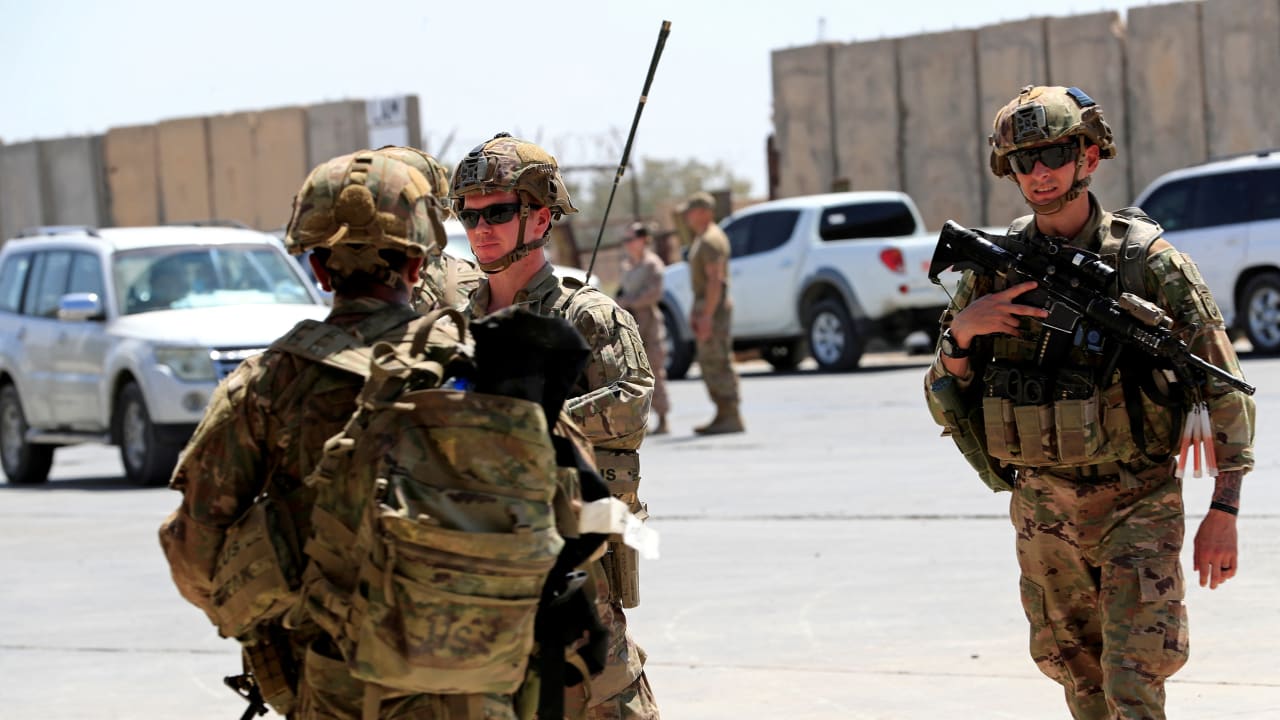
Iraq’s Prime Minister Mohammed Shia al-Sudani met with the incoming commander of the anti-ISIS mission.
The meeting came after the new commander, Brig. Gen. Kevin J. Lambert, arrived in Iraq to take up his post leading Combined Joint Task Force – Operation Inherent Resolve.
This coalition, which was established by the US in 2014 to fight ISIS, grew in 2015 and 2016 to include dozens of countries. Today, it faces questions about what its mission will be in the future.
Lambert takes over from US Army Maj.-Gen. Kevin C. Leahy. Leahy led the coalition from August 2024. He took over from Maj.-Gen. Joel Vowell in 2023. Each of the coalition commanders serves a one-year term, and Lambert is the 11th commander.
In 2024, the Pentagon announced that the mission would be in a transition phase, which is projected to end in September 2025. It was never clear what that would mean. Will it mean US troops will leave parts of Iraq?

They are only deployed in a few places today, such as in Baghdad and Al-Asad base, as well as sites in the autonomous Kurdistan Region. The Kurdistan Regional Government wants the US to stay. Baghdad may have other ideas. This is why Sudani’s meeting was important.
Before looking at the Sudani meeting, it’s worth recalling what the Pentagon said about the mission in 2024.
“The coalition nations and Iraq recognize that ISIS in Syria remains a significant threat to the region and pledged to continue working to ensure the enduring defeat of ISIS."
The second phase looks to prevent the return of the ISIS terrorist threat in Syria. Iraq will allow the coalition ‘to continue to support counter-ISIS operations in Syria from Iraq throughout the second phase of the transition until at least September 2026, subject to conditions on the ground and, obviously, consultations among future political leaders of Iraq and the United States.’”
Sudani welcomed the US officials to his office on Monday. He hosted US General Michael Kurilla, commander of US Central Command, and his accompanying delegation, along with US chargé d’affaires Steven Fagin.
“At the beginning of the meeting, the prime minister welcomed the delegation, which included the new commander of the International Coalition Forces against Terrorism in Iraq and Syria, Brig.-Gen. Kevin Lambert, and the outgoing commander, Maj.-Gen. Kevin Leahy,” the Iraqi Prime Minister’s Office said.
Iraq’s prime minister discussed the cooperation between Iraq and the coalition. He also discussed “preparations for transitioning to bilateral security relations with coalition member states. Discussions also covered the work of the Iraq-US Higher Military Commission, as well as security cooperation and coordination, in addition to developments in Syria and their implications for regional security.”
Iraq's security concerns
Iraq’s prime minister is concerned about security and also about what happens in neighboring Syria.
Prior to the fall of the Assad regime, many Iranian-backed militias in Iraq operated in Syria. They used to travel through Qaim on the border to Syria’s Albukamal.
When the Assad regime fell, the militias and their Syrian friends fled to Iraq. Iraq is concerned about Syria. It may also be concerned that any chaos in Syria could spill over to Iraq. For instance, the fighting in Sweida led to the mobilization of Bedouin tribes in the Euphrates river valley.
Many of these tribes have tribal connections to those in Iraq’s Anbar province. As such, anything that happens in Syria can affect Iraq, because the Euphrates river valley is essentially one large area that links the two countries historically. In the pas,t extremists used the valley to enter Iraq to fight as insurgents against the US. Later, Iranian-backed militias went back up the valley from Iraq into Syria.
The Iraqi Prime Minister’s Office noted that “Sudani stressed the importance of maintaining stability, avoiding triggers that could escalate conflicts, and upholding the sovereignty of states in accordance with UN charters, international resolutions, dialogue, and mutual understanding. He emphasized the need to activate diplomatic efforts and cooperation to reinforce security and stability in the region.”
What happens next is unclear. The US commander presides over a mission with only a few thousand troops. It’s primarily a mission that involves some training and equipping of partner forces and some advising.
As the US redeploys troops, it’s possible that the mission will have fewer than 1,000 personnel in Syria and similar numbers in Iraq. It’s also possible the troops will be consolidated to the Kurdistan region and one or two bases in Syria.
With ISIS largely defeated, that may make sense for the mission. However, the US role in both countries likely has influence and leverage that go far beyond just boots on the ground. The US role, along with what’s left of the international coalition, can be a force multiplier in terms of stability. Iraq’s leader is watching, as are the US-backed Syrian Democratic Forces and the new Syrian government.
In addition, Iran and Turkey are likely watching as well.