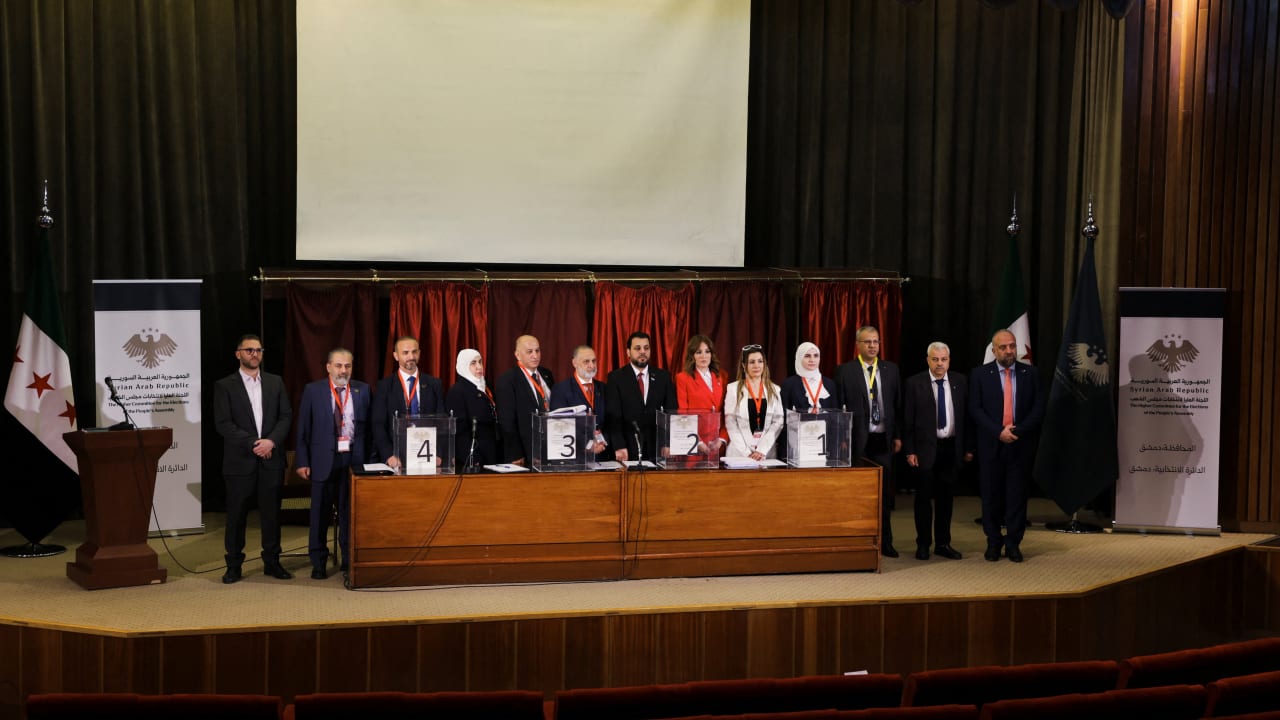
Syria recently held complex parliamentary elections, which are designed to give the country a new parliament. These elections were expected to be held over the last months as the country transitions to a new system of government after 50 years of dictatorship, which ended in December 2024.
In the wake of the fall of the Assad regime, Syria appointed a new transition government. This took shape between January and March 2025. The new government is led by Ahmed al-Sharaa, the former head of the Hayat Tahrir al-Sham group.
The new government has a cabinet and ministries. The most powerful ministries, such as Defense, Foreign Affairs, and Interior, are led by HTS men. However, around half the ministers are independents, and some are minorities such as Kurds, Druze, Alawites, or women.
Now, Syria has taken the next step towards electing a parliament, which is supposed to have 210 members. The elections were supposed to choose 140 members of parliament, and 70 were supposed to be appointed by the president. As such, a third would be appointed and two-thirds elected.
However, some areas of Syria are not controlled by the transitional government. Sweida has been run by the Druze since July, and eastern Syria is run by the Syrian Democratic Forces, a group led mostly by Kurds. Another area of eastern Syria, called Tel Abyad and Serekaniya, is run by the Turkish-backed Syrian National Army. In all these areas, the elections were postponed.

As such, the elections were supposed to choose only 121 of the members of the new parliament. In fact, they chose 119, according to reports. It remains to be seen how and when the president will choose the 70 allotted to him.Reports are not focused on key aspects of the electoral process.
Not a mass election with a popular vote
This was not a mass election with a popular vote. Rather, 7,000 people were chosen as electors in various districts, and they then elected the new parliament. This is a kind of electoral college system.
It’s not clear how representative the election was. Some argue that it was not representative and that the electors were chosen by those linked to the new government. Nevertheless, it appears much more of an attempt at the first steps toward democracy than the previous authoritarian Ba’athist Assad regime.
Focus now shifts to how many minorities and women were chosen in the elections. This is seen as a kind of bellwether as to Syria’s inclusiveness. The BBC reported that “only 13% of the seats contested were won by female and minority candidates. Observers said six women and 10 members of religious and ethnic minorities were among the 119 people elected to the new People’s Assembly on Sunday.”
The actual number of minorities appears to be slightly more than that. Three Kurds were elected in Afrin. A fourth Kurd was also elected. They are linked to the Kurdish KNC party. In addition, it is believed that four Alawites were elected in the coastal areas of Lattakia and Tartous. In addition, two Christians were elected, and up to three members of the Ismaili minority. Four Turkmen were elected as well. This adds up to 17 members of minorities. The figure of 17 appears to ignore the Turkmen, who are also a Syrian minority group.
The president of Syria now has a chance to also appoint more women and minorities to the parliament. Syria faces a bit of a catch-22 here. It is being judged by a standard that is not used for some other countries in the region.
For instance, while many think that women and minorities should be included in parliaments and in leadership roles, how many women and minorities are included in Israel’s cabinet and parliament? The number of women in the Knesset increased between 1988 and 2015, but since then has remained the same at around 30 women out of 120 seats.
Women are also better represented in Turkey’s parliament. According to Turkey’s Anadolu, 121 women serve in the 600-member parliament, meaning around 20%. In Iraq, a quarter of the seats are allocated to women. Women also make up around 30% of candidates running in the next elections in Iraq. In all these democracies, Turkey, Israel, and Iraq, minorities are also elected. Syria, therefore, is expected to have a trend similar to neighboring states. However, it does not have a system like Lebanon, where seats are reserved for various groups.
It’s unclear if Syria will learn from the limited elections it has held and broaden them next time or reserve seats for minorities.