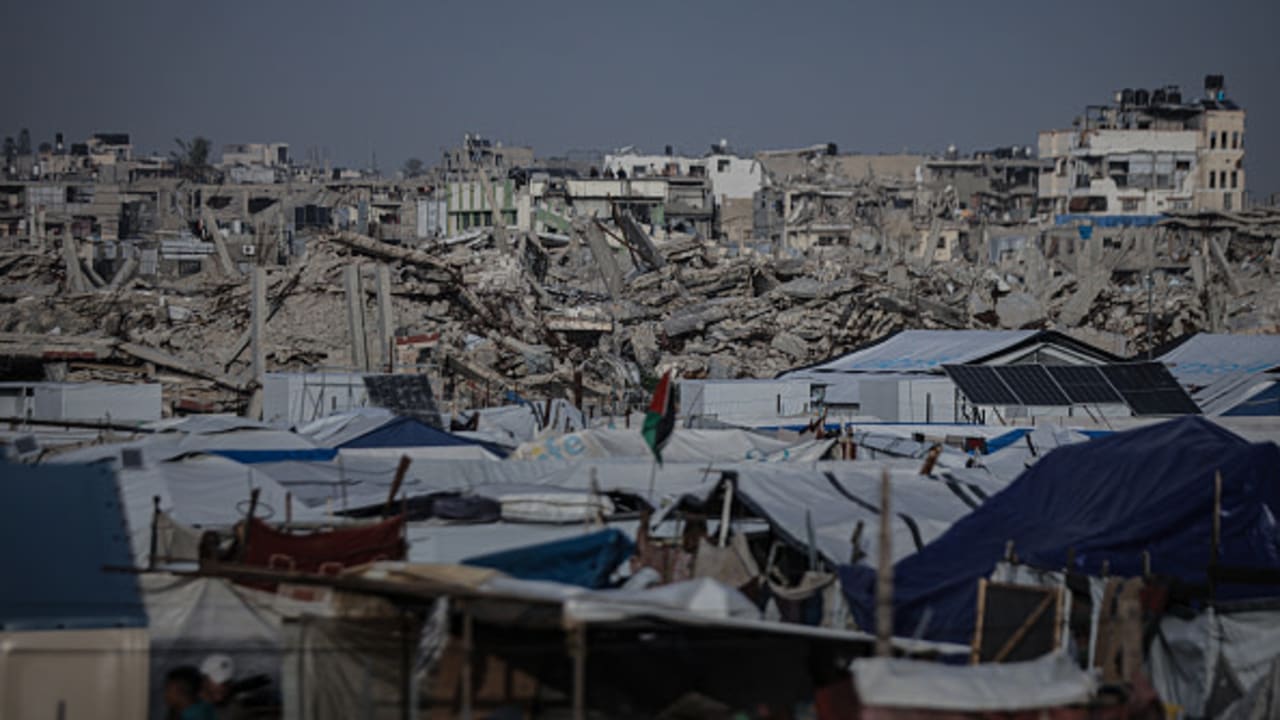
The White House is planning to host a meeting of its Board of Peace on February 19, Axios reported over the weekend. This is important because the US is trying to push forward the ceasefire in Gaza.
As recent Israeli airstrikes have shown, however, there are many challenges in Gaza. Hamas is still armed, and it is accused of continuing to plot attacks or cause chaos in Gaza.
The Board of Peace is supposed to support reconstruction, as well as being an international security force and ensuring the disarmament of Hamas. In addition, it has an executive board and a “high representative” for Gaza.
With so many moving parts, a meeting in mid-February is important. US President Donald Trump ratified the Board of Peace on January 22. The second phase of the Gaza plan began in January.
US envoy Steve Witkoff and Jared Kushner have been pushing for investment in Gaza, reconstruction, and other elements of the ceasefire to move forward. They were on the USS Abraham Lincoln aircraft carrier over the weekend as US-Iran tensions continue.
When the Board of Peace was ratified, the chief commissioner of the National Committee for the Administration of Gaza, Dr. Ali Sha’ath, said: “I want to start by thanking President Donald J. Trump and his administration for his intensive efforts to advance peace in the whole region… These efforts created the opportunity for a new future in Gaza, but what will really matter is what comes next.”

Shaath is supposed to be running the technical committee to help Gaza move toward peace in this phase. Nevertheless, it doesn’t seem like his committee has been allowed to do any real work in Gaza.
Israel appears to oppose the committee and any links it might have to the Palestinian Authority. In essence, this means Hamas remains in control of Gaza.
Officials in Jerusalem have said the PA will have no role in governance in Gaza. They have not said Hamas will have no role in governance, which appears to mean Hamas will remain.
On the other hand, another phenomenon in Gaza is also concerning. Reports that various militias in Gaza are harassing Gazans who seek to come and go from Rafah raise questions about the policy of having armed militias in Gaza.
“Four days after Rafah crossing reopened, Gaza residents [are] still disappointed,” Ynet reported. “Only about 20 patients have been allowed to leave Gaza out of some 22,000 requests, while just 75 people have returned after lengthy inspections, limited to one suitcase, a phone, and $600, amid reports of harassment by Abu Shabab militiamen.”
The frustration Gazans feel from long waits at the border is compounded by having to deal with what appears to be lawlessness in the areas between the border and the half of Gaza still controlled by Hamas, the report said.
“Adding to the frustration are reports of involvement by members of the Abu Shabab militia from Rafah, which is backed by Israel, in interrogating and detaining those returning to Gaza,” Ynet reported. “Palestinian media, particularly Hamas outlets, highlighted the account of Rutanah al-Rakab, who returned from Egypt this week.”
According to the report, she said: “After the inspections on the Palestinian side ended, militiamen arrived, declared that they were our brothers, and that they were fighting Hamas… They grabbed me and tried to hand me over to Israeli forces, but foreign officials operating at the crossing, apparently European monitors, prevented it.”
Some people said they were being interrogated by the militias and were even handcuffed and blindfolded, the report said. They also complained of theft by the militia.
The question now remains why Gazans are being given this stark choice of living under Hamas rule, which they have known since 2007, and the chaos of militias? If the people in Gaza feel the militias are a worse choice than Hamas, then they will gravitate back toward Hamas rule.
In addition, it’s not clear what laws the militias operate under to extrajudicially detain people. The Ynet reports about the armed militias raises many questions about what is happening in Gaza.
Most successful societies are not run by militias
Most successful societies are not run by militias. For instance, the fate of armed groups in Yemen and Syria illustrates how fragile these types of groups can be.
The same is true in Iraq, where the US backed what was called the “awakening” of various Sunni tribes in Anbar from 2006-2008. While initially successful, the tribal groups did not bring security in the long term.
In other contexts, successful states have done away with militias in favor of formal professional armies. George Washington and the Continental Congress, for instance, sought to professionalize the American Revolution after initial gains by militias near Boston in 1775.
After the War of Independence, Israel immediately got rid of the various armed groups that had been at the forefront of the Jewish underground.
The Hagana basically became the modern IDF, and the Irgun and Lehi (the Stern Group) were abolished as armed forces. This saved Israel from the kind of chaos and infighting that divided the Arab irregular fighters of 1947-1948.
Another challenge for Gaza is that the opening of the Rafah crossing, a key part of the second phase of the ceasefire, has had many hurdles.
“The first week of the partial reopening of the Rafah crossing between Gaza and Egypt was marked by confusion, and logistical hurdles, according to Palestinians attempting to cross and multiple sources who spoke to CNN on condition of anonymity,” CNN reported.
“The disorder resulted in far fewer Palestinians traversing the border between Egypt and Gaza than was expected, nearly two years after Israel seized and shut the crossing,” the report said. “When the partial reopening was announced last week, an Israeli security official told CNN that 150 Palestinians per day would be allowed to leave Gaza, while only 50 would be permitted to enter. But even that detail was unclear, as Egyptian state media reported that only 50 would be allowed to leave and the same number to enter.”
After Trump ratified the Board of Peace on January 22, the new high representative for Gaza, Nickolay Mladenov, said: “Who would’ve thought two years ago that we would be sitting here with this group of countries, with this leadership, giving the people of Gaza a new chance?… For too long, Gazans, Palestinians, and Israelis have lived with conflict, with death, with destruction. Now, the page turns.”
In addition, Witkoff said, “We have achieved a peace deal in Gaza. We have brought the hostages home… And maybe most importantly, we have created a sense of hope for what the future can bring in Gaza and all other places where the Board of Peace will operate. And I am so honored, Mr. President, to have worked on this on your behalf.”
The February meeting will be an important symbol, a month after the ratification, to get things moving forward. The hurdles of Rafah may have been worked out by then.
Questions remain about the role of the militias and whether the Gazans will have access to any healthcare or education that is not run by Hamas.
If the alternative to Hamas is only men with guns in armed militias, it’s unlikely the Gazans will choose that as a preferred way of life. This will essentially just create another cycle of the status quo of Hamas in power.
Over the years, some voices have argued that it is a good strategy for Jerusalem to divide Gaza from the West Bank by having Hamas in Gaza. After the October 7 massacre, it’s unclear if that strategy will continue.
So far, the status quo is that Hamas has reestablished its rule in half of Gaza.