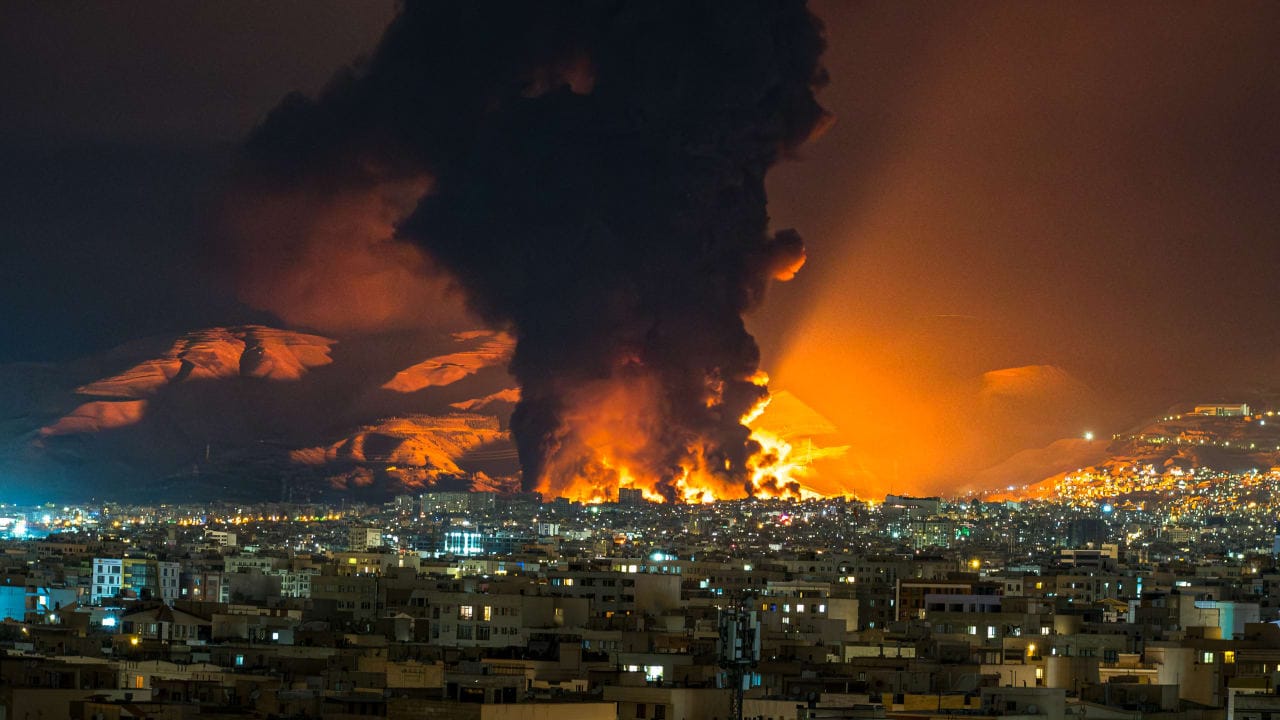
The Iran war has crossed the 10-day threshold, and US President Donald Trump has publicly mused about ending it sooner than his original “four to five weeks” estimate.
The US and Israel are still hitting the Islamic regime hard each day, but there are diminishing returns and many fewer bombs being dropped compared to the early days of the war.
To answer the question of when it should end, we need to list off what has been achieved, what might still be achieved by a slightly longer war, what is unlikely to be achieved given the maximum four- to five-week timeframe that is likely to shrink, what the costs are, and what costs are likely to increase the longer the war draws on.
IDF Chief of Staff Lt.-Gen. Eyal Zamir, during the June 2025 war with Iran, presented this analytical question to the security cabinet as a bell curve.
His bell curve graph showed the beginning of the operation, making each additional strike have an augmented and increased impact against the adversary, but after reaching a certain peak point, each additional strike would have diminishing returns as the most important targets had already been hit, or those targets that had not been hit became much harder to locate over time.

Did Israel reach that point a few days ago? Has it reached it now, and if not, when will it reach that point?
First, what has been achieved?
Ayatollah Ali Khamenei, along with the chief of the Islamic Revolutionary Guard Corps (IRGC), the chief of the Iranian military, and an additional 50-plus top Iranian officials, have been killed, mostly in the opening hours of the war on February 28.
Iran’s ballistic missile launches have dropped by about 90% from the first day of the war across the Middle East – including attacks on roughly a dozen Sunni countries – while the number of missiles fired at Israel has declined by roughly 75-90%, depending on the day.
Of Iran’s roughly 450-500 missile launchers, about 75% are now out of commission – roughly half destroyed outright and the other half rendered unusable by cave-ins or logistical damage caused by airstrikes.
Out of the Islamic Republic’s 2,500 missiles at the start of this war, over 1,000, likely between half and two-thirds, have been used or destroyed.
Larger segments of the supply chain for reestablishing and rebuilding damaged segments of the ballistic missile apparatus have been damaged as compared to June 2025, when that was a secondary goal to bombing the nuclear program.
Top headquarters and command and control centers for the IRGC, the Basij militia, the Iranian missile and drone force, the terror-spreading Quds Force, and the aerospace center relating to dual-use nuclear capabilities all over western Iran, Tehran, and certain other locations have been destroyed.
Some areas where the Iranians had made some modest nuclear program recoveries since June 2025 have been bombed.
Somewhere between 1,900 and multiple thousands of Islamic regime fighters have been killed.
All of these achievements are significant.
What do they mean in the broader context?

The June 2025 war’s main achievements, in order, were pushing back Iran’s nuclear program by two years, reducing its ballistic missile program by about half from 3,000 missiles and 400 launchers to under 1,500 missiles and around 200 launchers, eliminating the then IRGC and Iranian military chiefs and dozens of other top security officials, damaging more than 80% of Iranian air defenses, and making the regime appear more vulnerable domestically and globally.
By the eve of the current war, the Islamic regime had made almost no progress rebuilding its nuclear program, but it had nearly fully rebuilt its ballistic missile damage, had replaced most of its senior officials killed, and was in no real imminent danger of being toppled aside from outside intervention.
One twist on the nuclear issue is that Iran had and has a significant quantity of 60% enriched uranium buried under rubble at bombed nuclear sites at Isfahan and elsewhere, which it has no current access to and which the Mossad and CIA are monitoring.
Israel and the US would like to seize or eliminate that uranium, but it is viewed as impossible to do so using airstrikes. At the same time, even if Iran accessed that uranium, it could take two years to be able to use it for anything, given that so much of the rest of its enrichment and weapons programs was destroyed in June 2025.
Israel's main achievement - damaged the ballistic missile program
Coming back to the present, Israel hopes that its main achievement so far, whether the regime falls or not, is to have damaged the ballistic missile program far more deeply to put off that threat for years and make Iran think twice about rebuilding it, after apparently the June 2025 operation failed to convince them not to rebuild it.
This issue is a big question mark, especially after top Israeli officials have said that building new ballistic missile launchers is extremely easy.
As a plus, it has pushed off any minor nuclear progress Iran had made since June 2025, though that progress was so minor that it would not necessarily have justified the current war, whose timing was more connected to the ballistic missile issue for Israel and to domestic Iranian protests for the US.
How much have Israel and the US advanced the possibility of regime change?
In his 2021 book Empire of Terror, former senior US Defense Department intelligence official Mark Silinsky estimated that Iran’s military had around 400,000 fighters, that the IRGC had around 125,000, and that the Basij had between one and two million, of which 200,000 were hardcore members.
These numbers have likely fluctuated quite a bit, especially after the June 2025 war, but what is clear is that killing 1,900 to multiple thousands is a drop in the bucket.
Top Israeli officials hope that the mix of those actual deaths, along with the destruction of so many command centers and the killing of supreme leader Ayatollah Khamenei and all the top officials who replaced the top officials killed in June 2025, will be enough to weaken the regime in a broad and sustained way, such that the Iranian protesters will have a chance to finally overcome them.
The protesters, of course, would not be alone.
They would have foreign intelligence assistance.
The Mossad has hinted at various forms of assistance, and the CIA and American intelligence have been more overt about their intentions to assist.
There are also specific groups, like Kurdish-Iranians, who may be more capable on their own of taking over their specific area, weakening the veil of supremacy of the regime, even if they may not be able to topple it beyond their home province.
But no one really knows if and when top Iranian generals might defect against the regime or how or when even all of these new points in favor of regime change will cumulatively add up to enough to get over the top.
Most of the above-listed achievements seem to have been achieved in the first week. It is unclear exactly what has been achieved since the weekend, as the number of bombs dropped per day has shrunk substantially from 1,000 per day in the early days to half or a third of that now.
It is also unclear when many of the IDF and US messages about new achievements sound very similar to prior achievements: bombing more ballistic missiles, IRGC, and Basij sites.
If there is a list of sites that can be bombed over the coming days or week or two, which top Israeli and US officials see as concretely setting back Iran in the missile area by years and in regime stability in concrete and critical provinces where the regime still needs to be weakened to get close to the tipping point, then there could be a strong argument for continuing for additional days or even another week or two.
If the impact of striking some additional missile and regime sites is speculative and may not move the ultimate dial on the missile threat or regime change, then Israel and the US may already have crossed the threshold, falling downward in Zamir’s June 2025 bell curve.
Incidentally, if the US had decided to bomb the Fordow nuclear facility a few days earlier in June 2025, Zamir might have been happier ending the war at that point after around a week, versus extending to 12 days.
What are the downsides of continuing?
Some are clear and concrete, and some are speculative.
For Israel, it is being hit by ballistic missiles. Thirteen Israelis have been killed, and as of Sunday, 1,619 Israelis had been taken to the hospital, with 87 remaining hospitalized.
Just as important, thousands of Israelis’ homes have been made unlivable.
Each additional day of war, unless the IDF starts shooting down 100% of missiles, something it does not believe it can or will do for weeks or longer, means more wounded and maybe more dead.
In June 2025, several additional Israelis were harmed in the final days of the war.
In addition, millions of Israelis feel a sense of terror every day as they dash into their bomb shelters and safe rooms every time Iran fires, and the Islamic regime has still managed to fire double-digit missiles every day so far.
Schools and businesses across the country are still shut or on life support in some kind of temporary remote Zoom loop.
Israeli Sunni allies are also taking casualties and significant harm to their economies.
Seven American soldiers have been killed to date, with an unclear number wounded, and major harm has been done to American military facilities in the region. These harms could also deepen. All of that is concrete.
There is also antisemitism and the anti-Israel wave worldwide. To be sure, some antisemites and Israel-haters need no reason or event to jump off from. But no one really debates that when Israel goes to war, it also brings out some additional problems.
Of course, there were strong arguments that existential threats like Iran’s nuclear program and its ballistic missile program needed to be dealt with, regardless of the global antisemitism and anti-Israel impact.
But for how long?
If Iran’s regime will survive anyway, and the amount of time it will take to rebuild its ballistic missile program will not change much from a few more days or weeks of war, then taking these issues into account also makes sense.
There are other issues the US needs to take into account.
The war in the US is not popular, and the longer it goes, the less popular it becomes.
The negative impact on oil markets and overall world market stability is also increasing over time. Some economists say that if the current oil price crisis is not solved by ending the war within days or a week, the crisis will not be something that can be immediately shut down even once the war itself ends.
So whether top Israeli and US defense officials want to share more of their insights about the missile threat and regime change prospects with the public at this point or not, they already need to be taking a clear-eyed look on a daily basis at the costs versus the benefits of continuing.
If significant gains can still be had in these areas in the coming days or weeks or two, there could be justification for continuing.
If not, at some point, it could be time to take whatever wins have been secured and end the war so as to end the many increasing costs.
Of course, understanding some of these questions is an art as much as any science.
But extensions of the war based on speculation and hope, versus hard-nosed data and analysis, could ultimately undermine aspects of its initial strong successes.