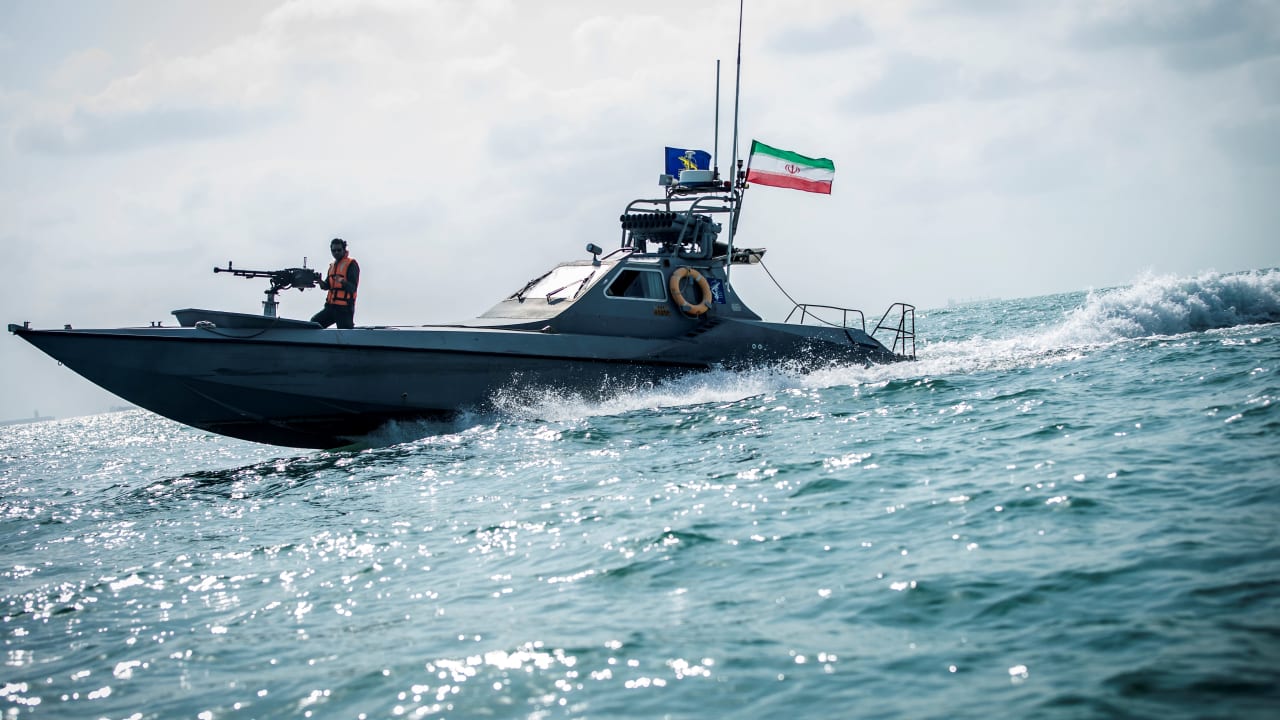
Iran’s latest move, days after it used drones to attack a ship off the coast of Oman, was apparently an attempt to send men to board and hijack a ship.
What is clear is that Iran’s goal is to spread chaos using unpredictable behavior. This policy applies not just in the areas around the Gulf, but throughout the Middle East.
Iran operates through a series of proxies and partners, from Yemen to Iraq, Syria and Lebanon. These groups have varying degrees of links to Iran, some of them are likely directly controlled by the Islamic Revolutionary Guard Corps. Others, like Hamas, are supported by Iran but probably do not take orders from Tehran.
Iran’s goal is to keep these groups armed and ready to support its activities, such that they can be operationalized or used as leverage and tools for Tehran’s regional project. This means that the Houthis in Yemen, fighting Saudi-backed Yemeni government forces, have been “put on steroids” by the Islamic Republic, armed with drones and ballistic missiles.
Iran provides know-how to help these groups build longer-range missiles. Hamas, for instance, increased the range of its rockets from several kilometers in the early 2000s to more than 250 km. in 2021.
The goal is to show that Iran has the opportunity, if it wants, to strike where it wants. This leaves regional countries that want trade and stability to wonder whether escalation is in their interest. Iran’s goal is not to defeat all these countries, but merely to increase the potential price that might be paid if there is a conflict. The mining of ships in May and June of 2019 was an example, as was the attack on Abqaiq in Saudi Arabia in September 2019, and other incidents over the last six months, such as several attacks on commercial ships.
The concept of “unpredictable Iran,” which often acts more like a mafia state than a normal country, is a policy choice. It is the same way Tehran uses pressure in the Vienna talks and nuclear negotiations. It boasts about uranium enrichment, regardless of whether it actually wants to detonate a nuclear device one day. It knows that the prospect of Iran acquiring nuclear weapons is enough to bring other countries to the table. No other state in the world ever used nuclear threshold status as a negotiating tactic.
These are games Iran is good at – and so far it has worked wonders for Tehran. In the past, Iran has also used kidnapping, hostage-taking and even detaining foreign sailors as a means to get what it wants and embarrass other countries, such as the US or UK.
This is calculated unpredictability, to make it appear that even though Iran has a weak navy, it can spread chaos across a thousand miles of open ocean and the Persian Gulf.