
When the legendary poet Judah Halevi plotted the Kuzari nearly 900 years ago, he imagined a restless Khazar king awakened by a dream in which an angel tells him: “Your intentions are desirable to the Creator, but your deeds are not acceptable.”
Unsatisfied with easy answers, the king summons priests, imams, and philosophers before finally embracing a rabbi’s simple confession: “We believe in the God of Abraham, Isaac, and Jacob, who brought Israel out of Egypt and spoke at Sinai.”
The literary device allowed Halevi to argue that serious ideas inevitably reshape politics.
Enter Argentina’s President Javier Milei, who touched down in Jerusalem on Monday. A self-designated “anarcho-capitalist,” Milei says that his weekly Torah studies with Rabbi Shimon Axel Wahnish, Buenos Aires’ ambassador in Jerusalem, offer him the moral compass missing in modern politics.
“What I saw in Judaism,” Milei said after a tear-filled visit to the Western Wall last year, “was the constant search for truth and spirituality, an endless journey of growth.”
Moments later, he added a line worthy of Halevi’s king: “Every minute of this trip is a message to the world. It represents something bigger than us.”
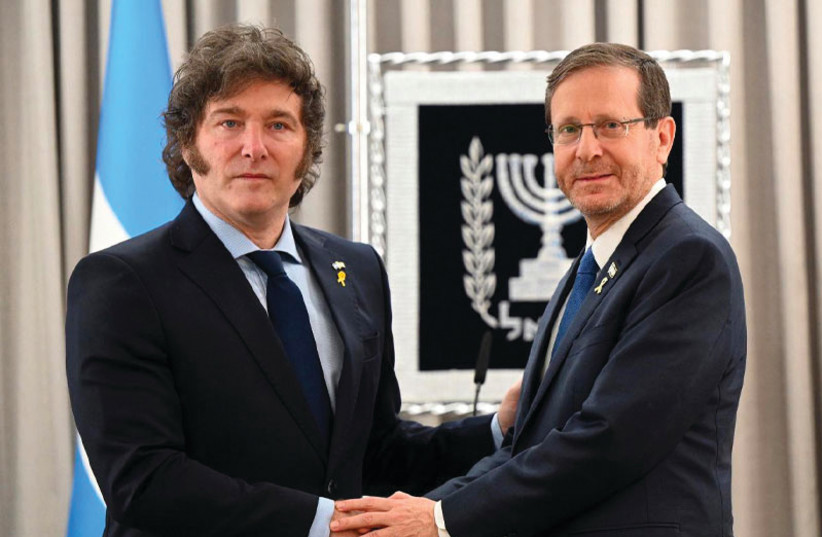
Those private convictions are now public policy. Buenos Aires has flipped decades of UN voting patterns, black-listed Hamas and Hezbollah, and promises to move its embassy to Jerusalem once the Gaza war allows.
Milei’s next stop on his current visit will be to the Chagall State Hall, where he will become the first non-Jewish recipient of the Genesis Prize, often dubbed the Jewish Nobel.
The Genesis Prize Foundation chose him, it says, for “unequivocal support of Israel” at a time when doing so carries a cost.
Halevi would have recognized the symmetry: An outsider welcomed into the Jewish story because his deeds, not just his intentions, align with its values.
Milei pitches 'Isaac Accords'
Milei’s ambitions extend further. He is pitching the concept of the “Isaac Accords,” a Latin American version of the Abraham Accords, which would begin with Paraguay and Ecuador and then expand to other regional democracies willing to sign security and innovation pacts with Israel.
A medieval king redirected alliances after a spiritual pivot; a modern president is attempting something similar, only this time, the map runs from Jerusalem to the Pampas.
Skeptics note that Argentina’s economy is in intensive care, and Milei’s own cabinet frets about overextension. Yet the rabbi-ambassador appears unfazed.
In my Friday column, Wahnish put it this way: “Our two countries aren’t merely partners – we’re brothers who share liberty and democracy.” Brothers, after all, organize their priorities differently from casual friends.
Will Milei formally enter the covenant? He says any conversion decision must wait for retirement, partly because Shabbat observance clashes with the presidency.
Even so, Israel has rarely seen a visiting head of state quote biblical precedent with such ease, or act on it so quickly.
“When good and evil are so clear,” he told reporters after the October 7 massacre, “you cannot stay neutral.”
The analogy is not perfect. The Khazar saga is half-legend, whereas Milei governs a messy democracy that counts its inflation in triple digits.
Still, Halevi’s point endures: Ideas, once taken seriously, reorder loyalties. Milei’s own journey, from chainsaw-waving populist to the Jewish world’s most outspoken gentile champion, shows that the distance from dream to deed can shrink fast when a leader decides, like the Kuzari king, that moral clarity outweighs convenience.
“If you wish to know God, love His creatures, for they are His handiwork and mirror His will,” Halevi wrote (the Kuzari, Book III, ch. 35).
This works perfectly with the way Milei and his government have been approaching Judaism and the only Jewish state.
For Israel, locked in an unforgiving news cycle, that clarity is no small gift. And for readers who wonder whether spiritual curiosity can still move the diplomatic needle, this week in Jerusalem supplies a timely footnote. Sometimes – even in 2025 – the rabbi still wins the debate.