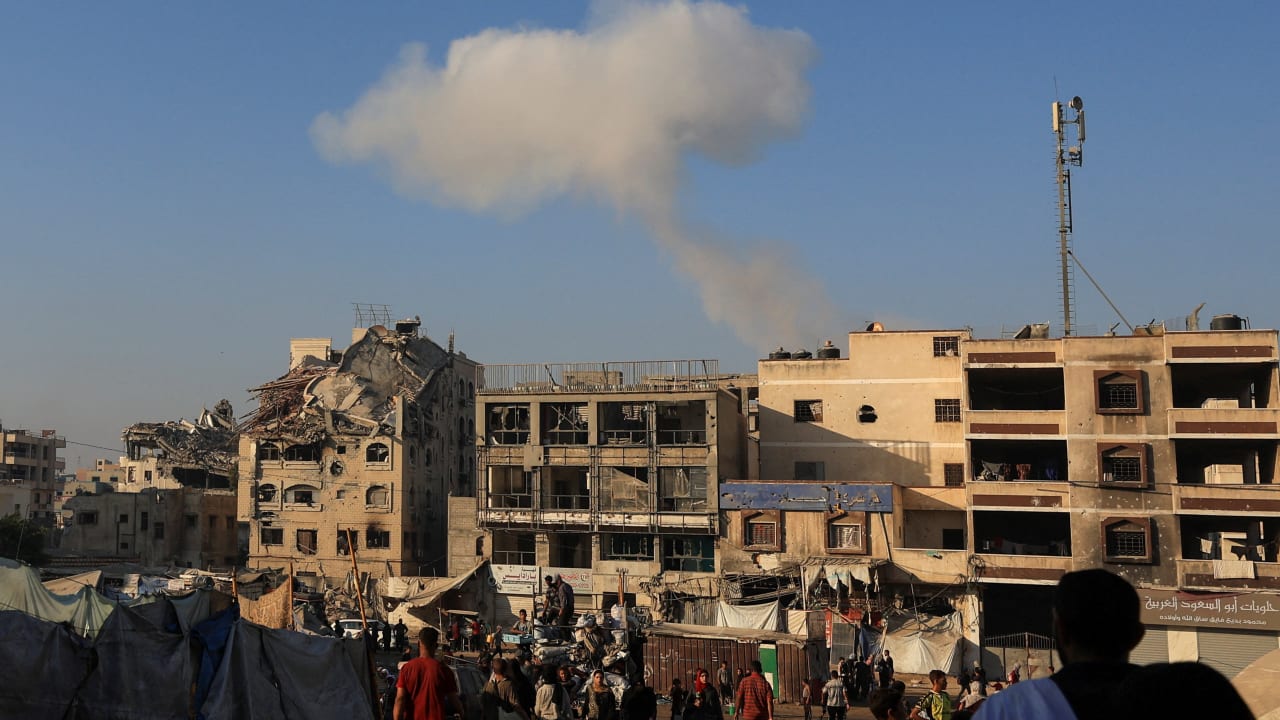
Imagine a society in which a child walks to school on a street named for a mass murderer, studies in a building honoring a terrorist ideologue, and spends afternoons in youth centers commemorating men famous for killing civilians. Imagine further that this child is taught – by state-sanctioned television – that the highest aspiration in life is death, preferably violent, preferably in the service of God.
This is not a dystopian thought experiment. It has been everyday life in Gaza.
Before October 7, a Palestinian child might have walked along Abu Jihad Street – named for the architect of a bus hijacking that killed 38 Israelis, including 13 children – before arriving at a school bearing the name of Hamas founder Ahmad Yassin.
After class, the same child could attend activities in a center honoring Abu Iyad, one of the planners of the Munich Olympics massacre.

On a popular Palestinian TV program, an adult host asks an 11-year-old girl if martyrdom is beautiful. “Very, very beautiful,” she replies. “Everyone yearns for shahada. What could be better than going to Paradise?”
This cultural environment did not emerge by accident.
Majority of Palestinians express support for Hamas before the October 7 massacre
And it helps explain a grim statistic often treated as impolite to mention. On October 7, polls showed that roughly 70 percent of Gazans and 80% of West Bank Palestinians expressed support for Hamas. For decades, scholars and policymakers have warned about the institutionalized radicalization embedded in Palestinian education, media, and civic life – a culture that prizes martyrdom over life and grievance over coexistence.
And for decades, those warnings have been met with a familiar response: denial, relativism, and money – lots of it. Over the past 10 years alone, billions of dollars – a large part from Europe – have flowed into Gaza, with few conditions and fewer consequences, helping sustain a system that glorifies death while promising peace.
Now, after October 7, the Middle East stands at a rare historical inflection point. Israel’s military and diplomatic gains have widened the opening created by the Abraham Accords: a chance to privilege pragmatism over ideology, realism over fantasy.
Gaza, too, sits before such a moment, if the world has the nerve to seize it. Reconstruction, however, cannot mean repeating the errors that led to ruin. Rebuilding Gaza without dismantling the ideology that destroyed it would be less an act of compassion than an exercise in willful blindness. Concrete poured atop radicalization is not reconstruction. It is preparation for the next war.
This brings us to a word that is endlessly invoked and rarely understood: “deradicalization.” Hamas’ disarmament is essential, but it is not sufficient. Weapons can be confiscated, but ideas require confrontation.
Deradicalization is not merely about convincing militants to lay down their arms. It is about dismantling the narratives, symbols, institutions, and incentives that normalize violence and sanctify hatred.
There is a useful distinction here. Deradicalization refers to the ideological retreat from extremist beliefs – something that can happen to individuals (as in the case of Mosab Hassan Yousef, author of The Green Prince and son of a Hamas founding member) or even groups (as with the IRA in late 1990s Ireland).
Counter-Radicalization, by contrast, is preventative, ensuring that extremist ideas fail to capture new generations. Gaza requires both. But above all, it requires societal change.
History offers a precedent that is often invoked and rarely absorbed. Post-war Germany did not abandon Nazism because it was gently persuaded to do so. It did so because Nazism was systematically uprooted. Symbols were removed, and textbooks were rewritten. Media was regulated, and former perpetrators were barred from power.
Accountability was imposed.
Denazification succeeded not because Germans were flattered, but because reality was enforced.
The lesson is uncomfortable but unavoidable: Radicalized societies do not heal through dialogue alone. They require structural reform. For Gaza, that means rewriting curricula that glorify jihad, renaming streets and institutions that honor terrorists, regulating media that incites violence, and permanently excluding Hamas from political authority. Without these steps, the “day after” will look disturbingly like the day before.
This transformation cannot be imposed solely from above. Palestinian civil society, both local and international, must play a role in building cultural immunity against extremism. That includes educational initiatives, exposure to alternative narratives, and yes, carefully structured encounters with the very people Hamas has spent decades demonizing, the Jews.
I say this not as an optimist by temperament, but as someone who has spent years speaking with former jihadists who abandoned ideologies they once embraced unto death. Change is possible. But it is never accidental.
The consequences of failure extend well beyond Gaza. Hamas has proved remarkably adept at exporting its worldview, fusing Islamist extremism with Western progressive rhetoric.
What began as the worst massacre of Jews since the Holocaust has metastasized into a global antisemitic movement, turbocharged by social media and absorbed by students who cannot locate Gaza on a map but chant slogans calling for Israel’s erasure. The spectacle borders on the surreal: LGBTQ activists chanting Hamas slogans and progressive students donning Hamas costumes in European capitals. In the name of liberation, they excuse misogyny, homophobia, honor killings, theocracy, and the murder of Jews, while congratulating themselves on their moral sophistication.
Western governments should recognize the boomerang effect. Funding radicalization abroad imports illiberalism at home. Some Arab states already understand this.
Morocco and the United Arab Emirates have concluded that the Muslim Brotherhood ideology is a threat not only to Israel or the West but also to their own societies. They have acted accordingly, by reforming textbooks, regulating religious discourse, producing media that promote coexistence, and appointing officials explicitly tasked with countering extremism.
Gaza deserves no less seriousness – and no more indulgence.
If the Abraham Accords demonstrated that peace in the Middle East is possible without illusions, then Gaza’s future depends on applying the same realism to Palestinian society itself.
Ideological disarmament is not collective punishment. It is a collective rescue. The window is open, but history will not keep it that way for long.
The writer is a German-Israeli strategic communications and counter-extremism expert and former government adviser. She holds a PhD from King’s College on deradicalization processes of former Islamist extremists and terrorists.