
The Western Wall is not the property of one stream, one sector, or one interpretation of Judaism.
It is the beating heart of the entire Jewish people – in Israel and in the Diaspora; religious and secular; Orthodox, Conservative, Reform, and traditional.
And yet, for many years, the holiest site for the Jewish people has effectively been administered as a separatist ultra-Orthodox courtyard, one that does not grant equal expression to women and does not recognize the legitimacy of other Jewish streams.
As Women of the Wall, we gather each month to pray the Rosh Hodesh service in the women’s section.
Some of us are wrapped in tallitot, some lay tefillin, and all of us seek to read from the Torah. Not in order to provoke, but to exercise a basic right: the right to pray according to our faith and custom at the holiest site of the Jewish people.
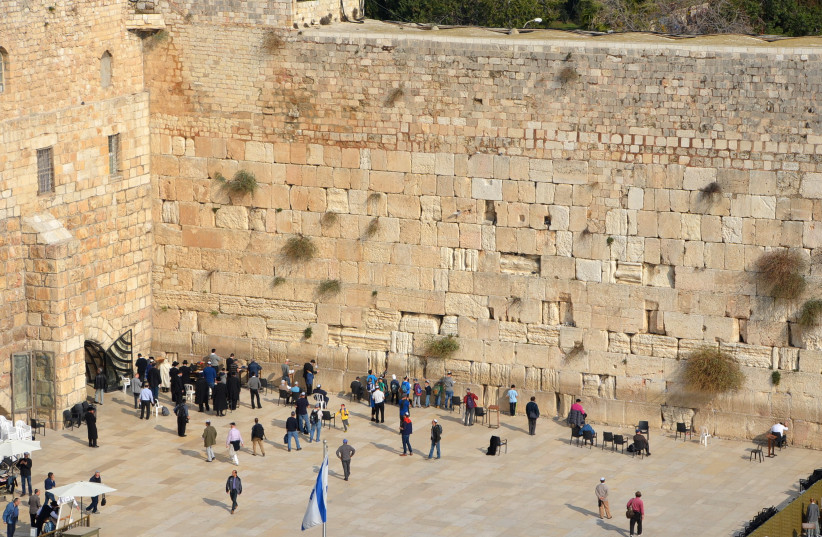
Time and again, we encounter attempts to restrict and constrain us – to prevent us from bringing a Torah scroll to the Wall or from reading from a Torah scroll already there – efforts to silence and exclude us.
Just days ago, on Rosh Hodesh Adar, the police detained me and the vice chair of Women of the Wall, Tami Gottlieb, for questioning following our reading from a Torah scroll at the entrance to the Wall.
This was after the Western Wall Heritage Foundation prevented us from bringing a Torah scroll into the plaza in order to read from it in the women’s section. The foundation even issued restraining orders barring both of us from the Old City for approximately two weeks.
This reality is not a decree of fate; it is the result of a political choice to leave the administration of the Wall in the hands of a body that represents a narrow and exclusive conception of Judaism.
In 2016, Israel’s government adopted a historic decision to approve the Western Wall Compromise, a complex but worthy agreement designed to establish a state-recognized, dignified, and egalitarian prayer space at Ezrat Yisrael, alongside a joint and representative governance mechanism.
The decision was advanced and approved by a government led by Prime Minister Benjamin Netanyahu, following prolonged negotiations with representatives of the various Jewish streams and the Jewish Agency, and with the tacit consent of the ultra-Orthodox parties.
Yet shortly thereafter, under political pressure, that same government reversed course and froze the very framework it had initiated and approved.
The cancellation of the Western Wall Compromise was not merely a political maneuver; it was a painful message to Diaspora Jewry and to millions of Jews who do not identify with a stringent Orthodox interpretation.
It deepened feelings of alienation and undermined the shared destiny between Israel and Jews around the world.
The Wall, which should serve as a symbol of unity, became an arena of dispute and a symbol of exclusion.
In recent days, Israel’s High Court of Justice issued another significant decision, reinforcing the state’s obligation to act with equality and fairness in regulating prayer at Ezrat Yisrael.
Over the years, the court has repeatedly clarified that freedom of religion and conscience, as well as the principle of equality, apply at the Western Wall plaza as well.
The state cannot evade its responsibility and leave Ezrat Yisrael inaccessible, unregulated, and improperly administered.
Ezrat Yisrael – the southern plaza adjacent to the Wall – can and must become an egalitarian, dignified, and properly regulated prayer space, officially recognized and granted equal status to the main plaza.
Its renovation and development are not a “favor” to one stream or another; they are the fulfillment of a national responsibility. The Western Wall is not a private shtiebel but a national site of unparalleled historical, religious, and symbolic significance.
Jewish people have had internal differing opinions, disputes
Religious pluralism is not a threat to Judaism; it is its living and renewing expression. Throughout the generations, the Jewish people have known disputes and diverse interpretations – and it is precisely this multiplicity of voices that has ensured our survival.
The exclusion of women, the disqualification of Jewish streams, and the insistence on exclusivity harm not only worshipers but the Wall itself and its meaning as a unifying symbol.
I call on the government of Israel to renew its commitment to the Western Wall Compromise, to implement its own decisions, and to respect the rulings of the court.
I call for the accelerated and dignified renovation of Ezrat Yisrael and for the establishment of a joint, transparent, and representative governance structure.
It is time for the Western Wall to be a home for every Jewish woman and every Jewish man – without fear, without exclusion, and without preconditions.
The Western Wall belongs to all of us. It is time we felt that way.
The writer is the executive director of Women of the Wall.