More than half of all Israelis disagree with their government's decision to boycott the Palestinians' new governing alliance, which doesn't explicitly recognize the Jewish state's right to exist, a poll showed on Monday.
Thirty-nine percent of the 517 people surveyed by the Dahaf Research Institute said Israel should talk with the new Palestinian government, made up of Hamas and Fatah. An additional 17 percent said their government should engage only Fatah Cabinet ministers. The poll had a margin of error of 4.3 percentage points.
US 'disturbed' by PA gov't platform
Meanwhile, Israel, which in recent months said it wanted to hold "political horizon" talks with Palestinian Authority Chairman Mahmoud Abbas, reversed gears on Sunday and declared that it would only talk to him about security or humanitarian issues.
The upshot of the cabinet resolution that defined Israeli policy toward the new PA government, a senior government source confirmed Sunday night, was that the "political horizon" idea that was meant to strengthen moderate Palestinians by showing what they had to gain by rejecting Hamas's extreme positions, was now no longer relevant.
By vote of 19 in favor and two abstentions, the cabinet passed a resolution saying that in light of the new PA government's platform, "Israel will continue to work with Mahmoud Abbas to advance issues of security and issues pertaining to improving the quality of living of the Palestinian population."

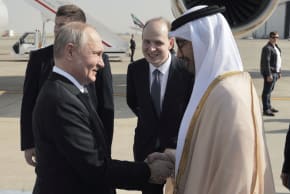
Prime Minister Ehud Olmert greets Palestinian Authority Chairman Mahmoud Abbas before a meeting at Olmert's official residence in Jerusalem.
Photo: AP [file] , AP
The resolution also stated Israel was now limited in what it could discuss with Abbas, as a result of the new PA government guidelines that see terrorism as a legitimate right, accept previous agreements with Israel only "in accordance with Palestinian interests" and call for any future agreement to be approved by the Palestinian National Council and the Palestinian Diaspora.
In other words, talking about security and humanitarian issues with Abbas is acceptable, but dealing with "political horizon" issues, or what a final agreement would look like, is not.
Labor ministers Ghaleb Majadle and Eitan Cabel cast the two abstentions.
Despite the lopsided victory for the resolution, the cabinet is far from united on how to approach the new reality created by the establishment of the PA unity government.
While both Prime Minister Ehud Olmert and Foreign Minister Tzipi Livni backed a complete boycott of the new government and all its members - regardless of whether they were members of Hamas or Fatah - a number of key ministers had different ideas.
Olmert told the cabinet it was impossible not to discern "a change for the worse in the Palestinian positions." This was apparent first and foremost, he said, in the clause recognizing as legitimate all means of "resistance."
Olmert, who met with Abbas a week ago and informed him that Israel would have no contact with a government that had this type of platform, told the cabinet that Abbas did not deliver on commitments he made to Olmert and leading international statesmen that there would be no unity government until kidnapped soldier Cpl. Gilad Schalit was released.
But with all the disappointment in Abbas, Olmert added, he would continue to meet with the PA chairman on security and humanitarian issues to keep the lines of communication open.
Israel, he said, expected the international community to maintain its policy of isolating the Palestinian government until it accepted the Quartet's three principles.
These three principles, as laid out in the cabinet resolution, were more far reaching than those that appeared in any Quartet statement over the last year. The cabinet resolution defined the principles as "recognition of Israel's right to exist, elimination of terror and the dismantling of terrorist infrastructure, and recognition of the agreements signed with Israel including the road map."
The principles, as articulated by the Quartet following the victory of Hamas in the Palestinian Legislative Council election in January 2006, said, "All members of a future Palestinian government must be committed to nonviolence, recognition of Israel and acceptance of previous agreements and obligations, including the road map."

While Sunday's cabinet resolution called for boycotting the PA government and all its ministers, Defense Minister Amir Peretz argued that not only should Israel not boycott non-Hamas members, but it should start talking to Abbas about final status issues, and in so doing leapfrog over the first stage of the road map that calls for the Palestinians to dismantle the terrorist infrastructure.
"On the one hand, we are facing an opposing side that is problematic," Peretz told the cabinet. "On the other hand, we need to ask ourselves if the diplomatic freeze is right for the long term."
Peretz said Israel was obligated, in light of the upcoming Arab League summit in Riyadh, to take a new initiative to present in the face of the Arab diplomatic proposal.
"Why not say that we are willing to enter into final status negotiations with Abbas," Peretz said. "If the prime minister presents matters in such an unequivocal matter, it will lead to a substantive debate in Riyadh."