The Olmert-Livni-Barak-Yishai government's liquidation sale of Israel's strategic assets opened officially this week. Iran's proxies have pounced on the merchandise.
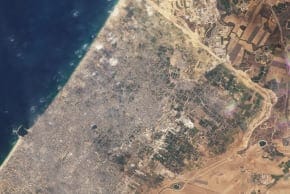
The first asset sold was the security of southern Israel. The Olmert-Livni-Barak-Yishai government's "cease-fire" with Hamas transferred all power to determine the fate of the residents of southern Israel to Iran's Palestinian proxy.
Under the "agreement," Hamas will refrain from attacking Sderot, Ashkelon, Netivot and surrounding kibbutzim for as long as it serves its interests. Since temporarily halting its attacks on southern Israel is the only thing that Hamas has agreed to do, it will use the lull in fighting to build up its arsenal and its military infrastructures in Gaza. When it has built up its forces sufficiently, or when its Iranian overlords give it the order, Hamas will again attack southern Israel. And when it reengages, it can be assumed that it will do so with a vastly expanded missile range. So under the guise of the "cease-fire," Hamas will place hundreds of thousands more Israelis at its mercy.

The Olmert-Livni-Barak-Yishai government's agreement with Hamas does more than sell out the security of the South. The agreement also divests Israel of its former ability to isolate Hamas diplomatically. Fatah's renewal of negotiations toward reconciling with Hamas is a direct consequence of Israel's actions. As these talks unfold, it is clear to all concerned that they will not lead to any sort of power sharing agreement between the two parties. Hamas today holds all the power in Palestinian society. Israel's acceptance of Hamas's power over the safety of Israeli citizens only amplified this fact. Fatah leader Mahmoud Abbas - who cannot even travel to Nablus without IDF protection - is not approaching Hamas as an equal, but as a supplicant.
Moreover, Israel's willingness to allow Gazans to enter Israel, and its acceptance of Hamas's control over the Rafah international terminal that separates Gaza from Egypt, constitutes de facto Israeli recognition of the Hamas regime in Gaza. And the direct consequence of Israel's diplomatic and strategic capitulation to Hamas is that no one in either the Arab world or the West today will agree to isolate or boycott Hamas.
But the Olmert-Livni-Barak-Yishai government apparently doesn't care. Israel's leaders actually don't want anyone to isolate or boycott Hamas anymore. The government's reported negotiations regarding the deployment of an all-Arab "peacekeeping" force in Gaza in a later phase of the "cease-fire" make clear that Israel is pushing for Hamas's international legitimization.
After all, unlike Israel, Hamas would never allow any government that doesn't recognize its legitimacy to deploy forces in its territory or along its borders. So any Arab force that deployed in Gaza or along Gaza's borders would have to recognize Hamas's regime. Beyond that, of course, Israel's advocacy of such a force indicates that the government has no interest in ever confronting Hamas militarily and is ready to tie the hands of any future Israeli government to do so since the presence of Arab forces in Gaza will render it much more difficult for Israel to defend itself. For if such a force is deployed, any future counter-terror operation in Gaza is liable to cause casualties among foreign Arab soldiers and so risk escalating the conflict to the level of regional war.

Israel's decision to embrace Hamas is so outrageous that even the US State Department apparently hasn't had a chance to get its bearings. Reacting to the news on Wednesday, State Department deputy spokesman Tom Casey said, "Saying you've got a loaded gun to my head but you're not going to fire today is far different from taking the gun down, locking it up, and saying you're not going to use it again." The agreement "hardly takes Hamas out of the terrorism business," Casey added.
The "cease-fire" with Hamas also has direct implications for Judea and Samaria. If Hamas holds its fire for six months, then Israel will be obliged to end its counter-terror operations in Judea and Samaria. That is, if Hamas keeps its powder dry until January, Israel will effectively enable it to assert its control over Judea and Samaria and so place Iran in control of the outskirts of Jerusalem, Kfar Saba, Afula and Netanya.
IF THE US was aghast at the Olmert-Livni-Barak-Yishai government's capitulation to Hamas, UN officials are aghast at its second asset drop. This week the government conducted its second round of negotiations toward the surrender of the Golan Heights to Syria. Speaking of the surrender talks to a group of Israeli diplomats, Terje Roed-Larsen, the UN Secretary General's Special Envoy for the implementation of UN Security Council Resolution 1559, condemned the move, arguing just by holding the negotiations, "Israel has given Syria a huge gift, without thus far receiving anything in exchange."
Larsen continued bitterly, "Syria is receiving legitimacy for free. Europe is courting the Syrians because of the negotiations with Israel, and they are no longer being asked to give anything in exchange."
Indeed, far from moderating their behavior, the Syrians seem only to have strengthened their already intimate ties with Iran since Israel initiated the surrender talks last month. Reacting to the second round of talks, Iran's Ambassador to Syria, Sayyed Ahmed Moussavi, told a German news agency that Iranian-Syrian ties have strengthened still further over the past four months. Moussavi, who also serves as a general in Iran's Revolutionary Guards and as a senior adviser to President Mahmoud Ahmadinejad, hinted that Iran is planning on sharing its nuclear arsenal with Syria. As he put it, "Islam taught us to pass on our knowledge and we can pass our [nuclear] experience to Syria if it wants it."
In its rush to obliterate Israel's defensive positions, the Olmert-Livni-Barak-Yishai government apparently doesn't care that Iran may well attack Israel with nuclear warheads launched from a post-withdrawal Golan Heights. What is most important to the government is to make Syria look good. And so, following the second round of negotiations with the Syrians, Olmert practically got down on his hands and knees to beg Assad to meet with him face to face when they visit Paris together next month. The two have been invited by French President Nicholas Sarkozy to participate in the launch of his Mediterranean Union initiative on July 13. Assad, no doubt enjoying the moment, rejected Olmert's pleas. As Larsen warned, Assad has no reason to pay for something he is already getting for free.