Experts at the IAEA are in agreement that Teheran has the ability to make a nuclear bomb and is on the way to developing a missile system able to carry an atomic warhead, according to a secret report seen by The Associated Press on Thursday.

Iranian President Mahmoud Ahmadinejad tours the Natanz uranium enrichment facility.
Photo: AP [file]
The document drafted by senior officials at the UN's International Atomic Energy Agency is the clearest indication yet that the agency's leaders share Washington's views on Iran's weapon-making capabilities. It appears to be the so-called "secret annex" on Teheran's nuclear program that Washington says is being withheld by the IAEA's chief.
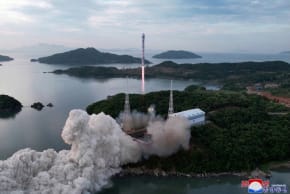
According to the document, the Islamic republic has "sufficient information" to build a bomb. Iran is likely to "overcome problems" on developing a delivery system, according to the report.
However, the IAEA denied the AP report. "With respect to a recent media report, the IAEA reiterates that it has no concrete proof that there is or has been a nuclear weapons program in Iran," the statement said.
Coincidentally on Thursday, US President Barack Obama shelved a Bush-era plan for an Eastern European missile defense shield that has been a major irritant in relations with Russia. A redesigned defensive system would be cheaper and more effective against any threat from Iranian missiles, the president said.
Anticipating criticism from the Right that he was weakening America's security, Obama said repeatedly that his decision would provide more protection, not less.
"It is more comprehensive than the previous program, it deploys capabilities that are proven and cost-effective, and it sustains and builds upon our commitment to protect the US homeland," Obama said in a statement released by the White House.
With the announcement, Washington scrapped what had become a politically troublesome plan, one the Defense Department now says was ill-suited to the true threat from Iran. In its place would be a system the Pentagon contends would accomplish the original goal and more.
US Defense Secretary Robert Gates said Iran's changing capabilities had driven the decision, but he acknowledged that the replacement system would probably allay some of Russia's concerns.

The plan for a European shield was a darling of the Bush administration, which reached deals to install 10 interceptors in Poland and a radar system in the Czech Republic, both Eastern European nations at Russia's doorstep and once under Soviet sway. Moscow argued vehemently that the system would undermine the nuclear deterrent of its vast arsenal.
"Its concerns about our previous missile defense programs were entirely unfounded," Obama said, speaking of Russia.
In Jerusalem, meanwhile, one assessment of the move was that it would significantly improve US-Russian ties and could be part of a US trade-off with Russia, whereby Moscow might now be more willing to impose stiff sanctions on Iran to get it to stop its nuclear program.
"Obama made a huge gesture to the Russians, and now they owe him, and what they owe him could be something having to [do] with Iran," one senior government source said.
The announcement came on the eve of two important meetings in the US that will deal with the Iranian nuclear issue: the G-20 meeting in Pittsburgh of the leaders of the world's leading economies, and the UN General Assembly meeting in New York. The possibility of imposing sanctions on Iran will be discussed at both forums.
Russian President Dmitry Medvedev will be attending both meetings. On Tuesday, he seemed to hint at a possible policy reversal on the Iran-sanction issues, saying that while sanctions were not very effective on the whole, "sometimes you have to embark on sanctions, and they can be right."

Until now, Moscow, along with Beijing, has been very reluctant to impose significant sanctions on Teheran, saying it doubted their effectiveness. In fact, last week both Russian Prime Minister Vladimir Putin and Foreign Minister Sergei Lavrov expressed opposition to sanctions. Medvedev's comment indicated, however, that there might be a softening of the Russian position, and its timing so close to Obama's announcement led to speculation that the two things might be related to removal of the missile shield.
The expectation in Israel, officials said, was that the US would deploy additional missile defense systems in the area to help defend against the Iranian threat.
The different options will come up in talks Defense Minister Ehud Barak will hold in Washington next week. Barak, officials said, was scheduled to leave on Sunday night for the US for meetings with Gates and National Security Adviser James Jones.
"Missile defense will feature prominently on Barak's agenda during his talks with Gates," one official said. "We understand from the Americans that Israel is going to be part of the missile defense shield that they are creating in the face of Iran."
The IAF's Air Defense Division will hold a joint drill, called Juniper Cobra, with the US military's European Command and the US Missile Defense Agency next month, in what is being described as the largest joint exercise ever held by the countries. They will test three different ballistic missile defense systems.
Officials said it was possible that the US would decide to leave some systems in Israel following the drill, to bolster Israeli defenses in the face of Iran. One possibility under discussion is that Aegis ships, which carry SM3 missile interceptors, will be deployed in the Mediterranean and Red seas.
Obama phoned Czech Prime Minister Jan Fischer on Wednesday night and Polish Prime Minister Donald Tusk on Thursday morning to alert them to his decision. It was not clear whether Washington also informed Russia.
In Moscow, Medvedev called the decision a "responsible move."
It was also unclear whether any part of the future system would be hosted by those nations, which agreed to handle the Bush-planned shield at considerable cost in public opinion and to their relations with Russia. Gates said they might, and said he hoped Poland would still approve a broad military cooperation agreement with the United States.