Archaeologists unearth medieval convent’s heating system during renovations in Switzerland
Gnadental convent was built outside Basel's city wall for Franciscans around 1231, later becoming a temporary home for several orders.
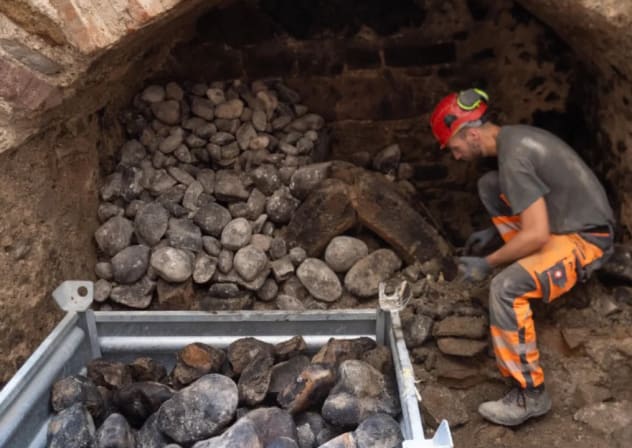
Gnadental convent was built outside Basel's city wall for Franciscans around 1231, later becoming a temporary home for several orders.


The stele has since been moved to the Inspectorate’s headquarters to undergo initial restoration work so that it can be studied in depth.

The vast majority of material was lost after a 2025 murder. All that remains is a small amount of dust collected from the floor and a few samples preserved by the Jones family.

Located on Arran’s west coast, Machrie Moor is a peat moorland where a large collection of Neolithic and Bronze Age archaeological finds, dating back to between 3,500 BCE to 1,500 BCE.

For decades, scholars have wondered if Qumran’s 364-day year calender had ever been used in practice or if it served only as a theoretical framework.

The site, believed to have likely served as a focus for religious gatherings, bears extensive evidence of feasting and large-scale gatherings.

The lead curse tablet found in the Netherlands was discovered by a team of Dutch archaeologists in a pit beneath the town hall square of the Roman military settlement of Coriovallum.

The discovery helps “highlight the cultural diversity witnessed by the Egyptian oases throughout different historical periods," said Egyptian Tourism and Antiquities Minister Sherif Fathy.

The ruins of the ancient settlement of Huqoq, which reached its peak during the Roman-Byzantine period, sits in the heart of the Amiad Forest in an open space near a spring of the same name.

The temple dates back to Egypt’s 26th Dynasty, the last native dynasty of ancient Egypt before the Persian conquest in 525 BCE.

The Italian state spent €15 million on a series of celebrated frescoes found in the central hall of the tomb, which were painted between 340 and 320 BCE.
