
August 6, 2023, marks 78 years since the US Army dropped an atomic bomb on the Japanese city of Hiroshima in World War II.
The nuclear weapon itself was dubbed the "Little Boy" and was the culmination of the scientific research of the Manhattan Project, led by Jewish scientist J. Robbert Oppenheimer and featuring other scientific luminaries such as Niles Bohr and Albert Einstein.
Its use marked the first-ever use of nuclear weapons in war and against a civilian population and is credited by many as changing the way war and diplomacy is carried out in the modern era.
Oppenheimer's legacy: What is an atomic bomb and how was it made?
An atomic bomb is, in its simplest form, a bomb that utilizes the process of nuclear fission, the splitting of then nucleus of an atom into two other nuclei, for the purpose of creating a massive and powerful explosion.
Despite the relatively small size of the bomb, it is capable of creating massive explosions, greater than any bomb ever made until that point.
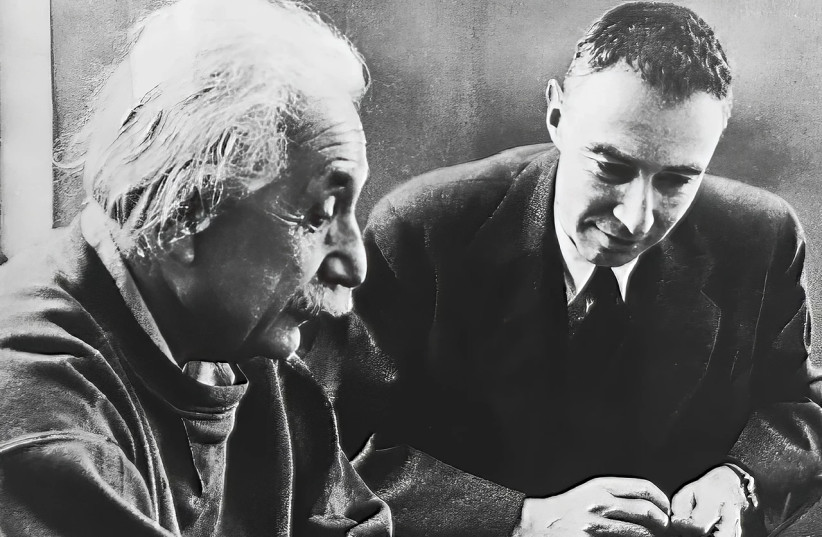
Several scientists around the world had been working towards this goal, with the first to succeed being Oppenheimer, Einstein, and the rest of the Manhattan Project team.
Developed under the administration of then-US president Franklin Delano Roosevelt, the project was finished and the bombing was carried out under the administration of then-president Harry S. Truman as a means of ending the war.
The first nuclear weapon was tested on July 16, 1945, in New Mexico in what became known as the Trinity nuclear test. Less than a month later, the first atomic bomb would be dropped on Hiroshima.
The Trinity test prompted Oppenheimer to recall a phrase from the Bhagavad Gita, a portion of the Hindu epic poem the Mahabharata, "Now I am become Death, the destroyer of worlds."
Ultimately, the bomb was dropped by the Boeing B-29 bomber Enola Gay on the city, striking the city with an unprecedentedly powerful 15 kilotons of TNT. The destruction was widespread in the city with tens of thousands of people dead as a result.
It was later estimated that some 146,000 people in Hiroshima died.
The war in Europe had already ended in May with the surrender of Nazi Germany, and the US had made great strides against Japan in the Pacific theater, but an invasion of the Japanese mainland was considered too costly, with the Japanese having already an intense defensive operation to counter a land invasion. As such, the nuclear bomb was seen as a way to avoid further Allied casualties.
The decision to use a nuclear weapon was not one Truman took lightly and insisted that the target not be Tokyo but instead Hiroshima, a city of considerable industrial and military significance because he insisted the target be a military target, as noted in Truman's diary.
<strong>Before and after the Hiroshima bomb drop</strong><br><br>However, archive footage shows pre-bomb Hiroshima as a bustling, thriving city of trilby-topped gentlemen boarding trams, ladies dressed in elegant kimonos, and uniformed schoolchildren walking beneath cherry blossoms overhanging shopping streets.
After the blast, rubble and contorted metal stretch almost uninterruptedly to the horizon. Electricity poles and bare trees accompany the dotted handful of windowless buildings which appear to have withstood the impossible.
The destruction wrought by the dropping of the atomic bomb sparked criticism from Oppenheimer, who would just 11 days later write a letter to the then-US secretary of war calling for the banning of nuclear weapons – the start of an anti-nuclear bomb stance that would see him face backlash from the US government.
The bombing followed the issuing of the Potsdam Declaration on July 26, which saw the US demand Japan surrender, and the refusal to do so would result in "the inevitable and complete destruction of the Japanese armed forces and just as inevitably the utter devastation of the Japanese homeland."