“Ani meshuga” (“I’m crazy”) is a common motivational chant used to pump up IDF soldiers.
It works as a call-and-response chant. The commander shouts, “Mi meshuga” (“Who is crazy?”), and the soldiers shout back, “ani meshuga” (“I’m crazy”) – shorthand for something deeper: I’m unbreakable, I’ll do what needs to be done, I can push past normal limits, I’m willing to run toward what others would run away from.
This week, a clip of a variation of this ritual in the haredi (ultra-Orthodox) Hasmonean Brigade went viral. Instead of “Who is crazy,” the commander – his face blurred, sidelocks flowing – shouted with the same rhythm and passion as the original, “A little more Torah, a little more Torah.” His soldiers echoed it back. Then came, “Another page of Gemara, another page of Gemara.”
It was a striking – and positive – cultural translation: haredi soldiers taking something quintessentially IDF and recasting it in their own idiom.
On Tuesday, the IDF took a step that helps explain why that moment mattered. By formally issuing new protocols regulating the service conditions of haredi soldiers, the army signaled that it wants to make this kind of adaptation not just possible but institutionalized.

That signal comes as the debate over haredi enlistment reaches fever pitch.
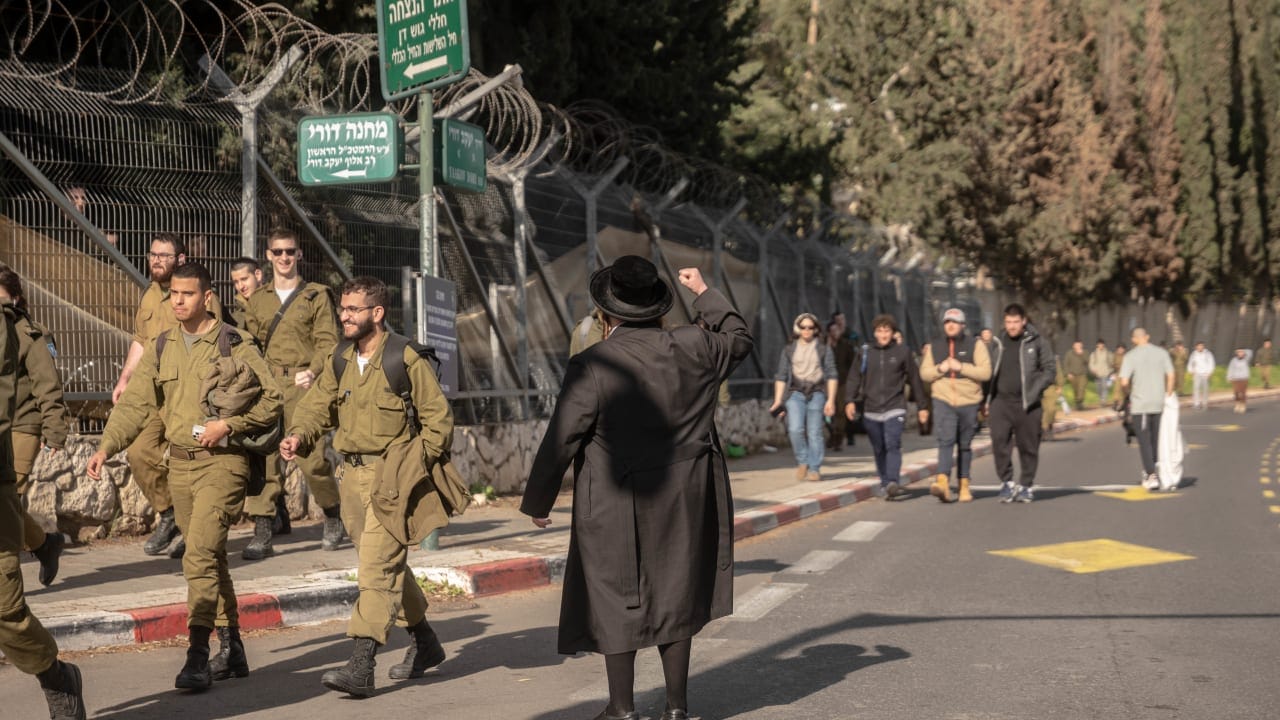
On Wednesday, as Knesset legislation on the matter continued to dominate the national agenda, dozens of haredim from the “we will die rather than enlist” wing of the community blocked streets in Tel Aviv and Jerusalem. Against that backdrop, the IDF’s move is best understood not as a cultural gesture but as a strategic one: an effort to make military service workable for those haredim who are willing – or at least open – to serving.
“Comfortable” here does not mean physical comfort – plush bases or gourmet food. It means the ability to live a full haredi lifestyle while in uniform: fixed time for prayer and Torah study, separate kitchens adhering to the strictest kashrut standards, and a sex-segregated environment.
At its core, the army is trying to neutralize what has become the central haredi argument against enlistment – voiced not only by rabbinic leaders but also by parents of haredi youth: that conscripts who enter the IDF as haredi will emerge as something else.
Israeli society's great equalizer
For generations, the IDF has been seen as Israeli society’s great equalizer – its melting pot. In the non-haredi world, that has long been one of its strengths. But it is also precisely what haredi leaders fear the most.
They don’t want that integration; they want insulation. They seek to preserve a way of life defined by separation from the broader culture and fear that the army, by its very nature, dissolves those boundaries.
By issuing these protocols, the IDF is effectively saying something new: integration need not mean assimilation. Walls can be erected inside the army if that is what it takes. Separate, male-only, haredi-only frameworks can be created in which soldiers serve without abandoning their religious identity.
The new protocols apply to haredi men who enlist through three designated tracks. They guarantee time for prayer, strict kosher food, and allow soldiers to declare allegiance to the IDF rather than swear an oath. They also establish a rabbinical oversight mechanism.
The significance of this move lies less in its details than in what it reveals about the army’s evolving priorities. Facing an acute manpower shortage, the IDF has concluded that if it wants haredim to enlist – now framed as an existential issue – accommodation is required.
Just as the haredim need to realize that in a post-October 7 reality they must serve, so too the army needs to realize that it must make that service compatible with their way of life.
In practical terms, this amounts to something close to a separate army within the army – separate in the sense that certain bases, or at least one track that includes the Hasmonean Brigade, will be off-limits to women.
Does this align with the expectations of a Western, liberal, egalitarian society? No. But the more pressing question is whether it aligns with the needs of a country that urgently requires more soldiers to guard its borders. On that score, the answer is yes.
This tension is not unique to Israel. Militaries around the world are wrestling with the question of whether they are primarily fighting forces or social laboratories. Are they meant to shape society’s values or simply defend it?
The role of women in the IDF
In Israel, this debate has long played out around the role of women in the IDF. For years, the push for expanded roles for women was framed as both a military and a societal imperative, rooted in the belief that integration in the army would lead to equality outside it. The IDF was seen not just as a fighting force but also as an educator, an absorber, and a unifying institution.
But it is also, ultimately, a fighting force. Its primary mission is to defend the country and win wars. And to do that, it needs manpower. If expanding that manpower requires compromising – in limited frameworks – on ideals such as full egalitarianism across every unit, the army is signaling that it is prepared to make that trade-off.
If Hasmonean bases are off-limits to female soldiers or if female instructors do not train male haredi soldiers that may clash with Israel’s egalitarian ethos. But the army is saying such measures are necessary to bring more haredim into uniform – and that the country urgently needs them there.
A slow societal shift expected
Still, no one should harbor illusions. These guidelines will not lead to mass haredi enlistment. They will not persuade the ideological hardcore. What they can do is make service viable for those who are already defying their rabbis and political leaders by enlisting. And as more soldiers enter the army as haredim and leave it the same way, the argument that the two are incompatible may gradually weaken.
Societal changes of this magnitude are slow. Haredi integration into the army requires legislation, real sanctions against draft dodgers, and accommodation. In that sense, these protocols mark a positive development. But they will not be without complications.
Just as the army needs haredi soldiers, it also needs women soldiers – who, too, deserve to feel comfortable in their military environment. Women are not a marginal presence in today’s IDF; they serve across combat, intelligence, technology, and command, and any policy shift must ensure that their standing is not harmed.
And these protocols apply only to haredim. That inevitably raises the next set of questions. What about religious-Zionist soldiers and those in the hesder framework who also seek stricter standards of observance?
Should women serve in tank crews alongside religious-Zionist men? Should yeshiva students be compelled to attend performances featuring female singers? Fifteen years ago, such questions sparked a major uproar – even drawing the attention of then-US secretary of state Hillary Clinton, who reportedly compared refusals to hear female singers to practices in Iran.
These questions will not disappear. The new protocols do not resolve them; they merely push them forward. But if they are approached with goodwill – and with a shared understanding that enabling as many Israelis as possible to serve is now a national necessity – workable solutions can be found.
With these new protocols, the IDF is opting for pragmatism over purity. It won’t please everybody. But under the circumstances and given the stakes, it is a common-sense approach.