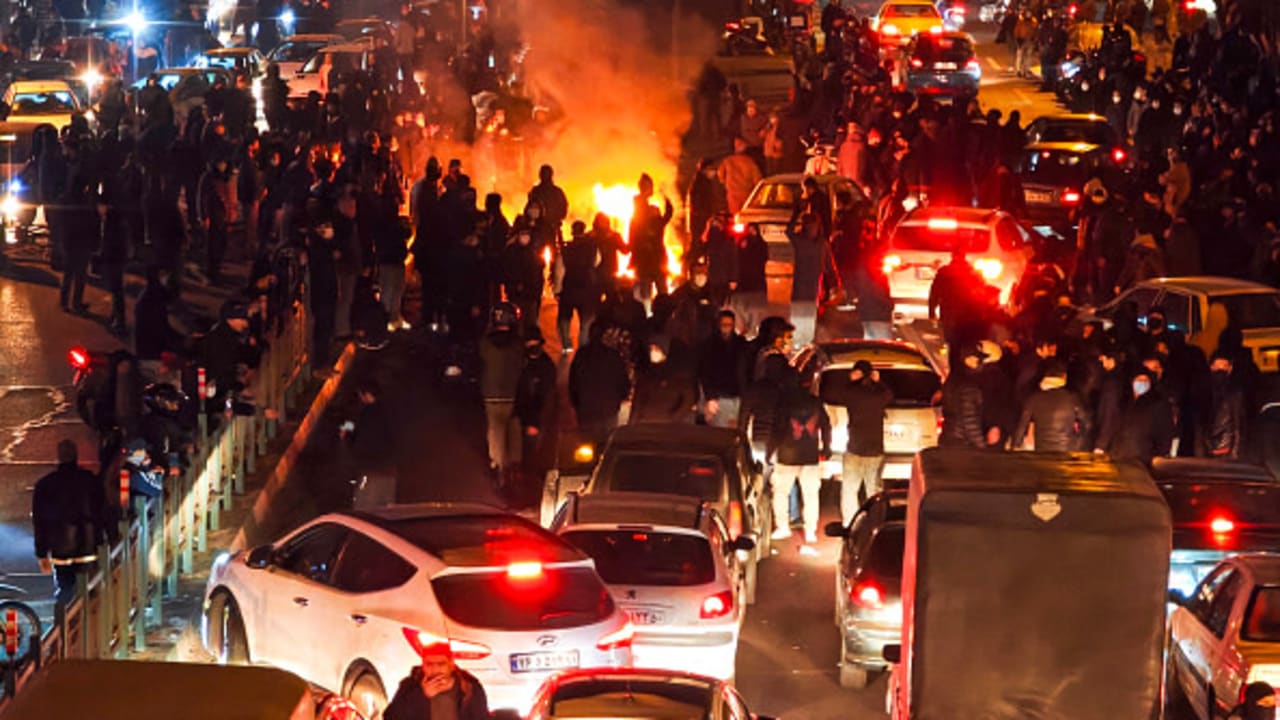
New accounts from Iran appear to increasingly indicate that Iranian-backed militias in Iraq may be helping Iran’s regime suppress protests in Iran.
In the past, these groups, called Hashd al-Shaabi or Popular Mobilization Forces, have suppressed protests in Iran.
In past years, there have also been claims that Iraqi militias entered Iran to help the Islamic Revolutionary Guards Corps (IRGC) suppress protests.
Tahmineh Dehbozorgi, an attorney, posted on X that “I just spoke to a friend in Iran who just got back online. He said the Islamic Republic hired terrorist militias – Hashd al-Shaabi and Fatemiyoun Division – professional killers shooting people indiscriminately in the streets and in front of their homes. The death toll is far higher than 20,000. Body bags everywhere. Families can’t even bury their dead. Now they’re bracing for the next wave of executions.”
Academic Dr. Kylie Moore-Gilbert noted on X that “Iraqi Shia ‘popular mobilisation forces’ and an Afghan division trained by Iran to fight in Syria, respectively.

An overlooked aspect of the Islamic Republic’s Axis of Resistance strategy so far has been the role these proxies could play in securing the Iranian regime itself from domestic ‘threats’ inside the country (ie, training foreign proxies to defend the regime from the democratic aspirations of its own people).”
CNN reported on January 15 that “Iraqi militiamen have crossed into Iran over the past weeks to help Tehran suppress ongoing protests, according to a European military source and an Iraqi security source familiar with the matter.
The Iraqi security source said nearly 5,000 fighters from powerful Iraqi militias entered Iran from two border crossings in southern Iraq: the Shaib border crossing in Maysan province and the Zurbatiya border crossing in Wasit province.”
Iran International has also reported on foreign fighters coming to Iran. “According to the information, Afghanistan’s Fatemiyoun Brigade, Pakistan’s Zainebiyoun Brigade and Iraq’s Popular Mobilization Forces carried out a significant part of the killings,” a report on January 17 noted.
It is difficult to verify these reports. The PMF is a group of militias in Iraq that was formed in 2014 to help Iraq fight ISIS. They were formed after a fatwa by Ayatollah Ali Sisteni, a Iraqi Shia cleric. Some of the militias were based on previous pro-Iranian groups that existed in Iraq, such as the Badr Organization and Kataib Hezbollah.
These groups have links to the IRGC. For instance, Kataib Hezbollah leader Abu Mahdi al-Muhandis was a close associate of Quds Force IRGC commander Qasem Soleimani.
They were both killed by a US drone strike in 2020. Many of these Iranian-backed Iraqis have links to Iran from the 1980s, when they backed Iran in the Iran-Iraq war. Many of them are also designated terrorists by the US.
For instance, the group Asaib Ahl al Haq and Harakat Hezbollah al-Nujaba are both members of the PMF and are also terrorist groups. There have been increasing calls to disarm the groups in Iraq. However, since 2018, they have also received salaries from the Iraqi government as paramilitary forces.
Iranian-backed Iraqi terrorist groups
They are an attempt to create a kind of IRGC in Iraq. The groups serve Iran’s interests, and it’s plausible some may have gone to Iran to help in the crackdown. They are Arabic-speaking Sunnis, so they won’t easily be able to operate everywhere in Iran.
The Iranians also recruited via the IRGC, Shi’ites from Afghanistan and Pakistan. These men were recruited to fight in Syria. However, when the Assad regime fell, the Fatemiyoun and Zainebiyoun had to leave Iraq, and they are stuck in Iran.
It’s possible Iran has used them to suppress protesters, and because they are foreigners, they have no allegiance to the average Iranian and likely don’t mind harming them. Nevertheless, the full story about Iran using these foreign groups still requires additional investigation to prove their role.