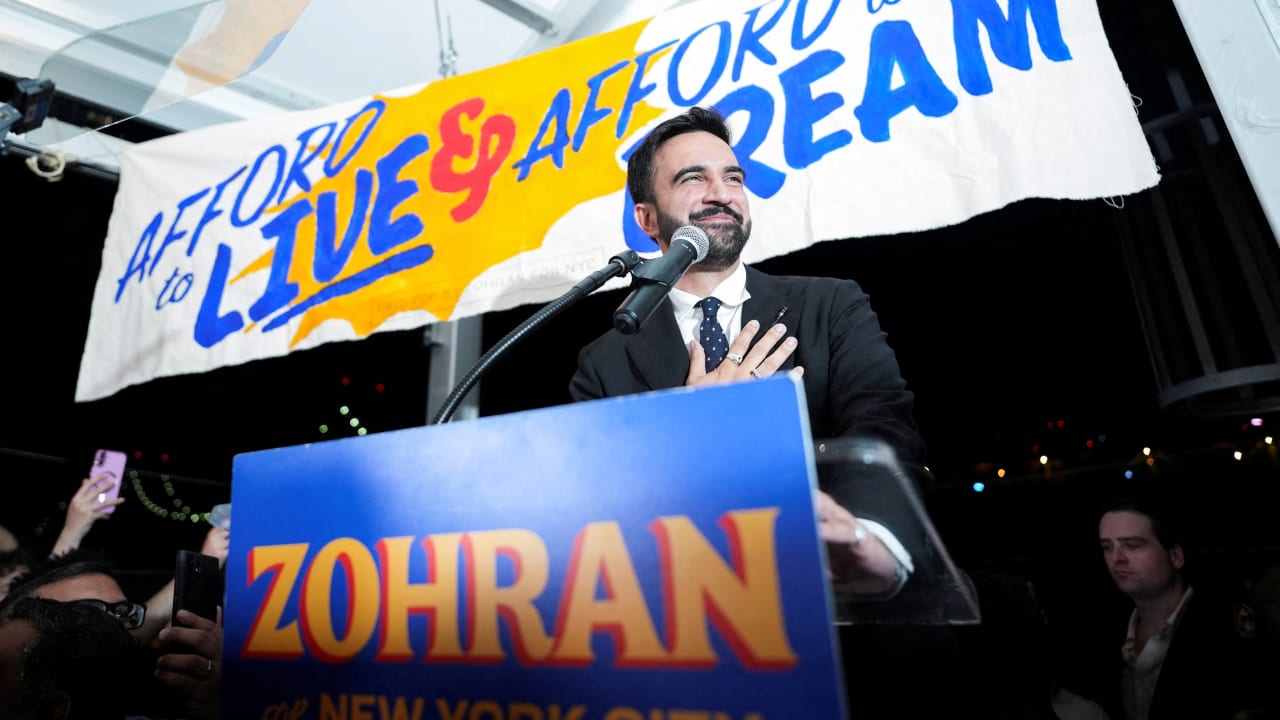
For many, the victory of Zohran Mamdani in the Democratic primary for NYC mayor shook their senses. How, in the city with the largest Jewish population outside of Israel, could an outspoken anti-Zionist who calls Israel an apartheid state win an election?
Especially striking is that his victory came because of a plurality he won in parts of Brooklyn and Manhattan that have a large Jewish population. Any way you slice it, a lot of Jews voted for a man who would arrest Prime Minister Benjamin Netanyahu if he came to New York.
Yet, if you look at the data, this isn’t a surprise at all. At the Jerusalem Center for Security and Foreign Affairs, where we have been researching Jewish-American and American public opinion for years, a clear trend emerged. Liberal Americans, including liberal Jewish-Americans, have abandoned reflexive backing of Israel, in its place supporting a slate of values associated with progressive positions.
The environment, immigration, human rights, and opposition to what they see as a dangerously authoritarian president tops the list. They also claim to strongly oppose antisemitism, and here is where the issue gets quite clouded.
Progressives, including soon-to-potentially-become mayor Mamdani, are against, even vigorously, antisemitism. They say it repeatedly. But they do not see being anti-Israel as being antisemitic, and they take every opportunity they can to separate the two. Their anti-Israel stance is not simply “being critical of the current government” in Israel. They are against the concept of Israel itself – what we would call “anti-Zionism.”

They see support for a state that is by definition “Jewish” as inconsistent with their value system of equality for all, and against “nationalism.” In their eyes, there is nothing irrational or inconsistent with being an “anti-Zionist” and wanting to fight antisemitism, even if one holds “Jewish values” dear.
In 2020, our research has found a solid minority of Jews who see identification with Israel as problematic. That minority expresses sentiment that Israel committed war crimes in Gaza, that Palestinians deserve the same sympathy that Israeli does and that when it comes to voting, they would prefer candidates like Rashida Tlaib or Ilhan Omar over a “moderate Republican.”
This minority of about 25-30% of Jews seems to be the ones attracted to Mamdani and no doubt helped secure his victory.
Nuanced link between anti-Zionism and antisemitism
There is no doubt that anti-Zionism and antisemitism are close blood relatives. But the fact that so many do not see this relationship requires us to take another look at always equating the two. Among Jewish-Americans, it is apparent that many self-defined liberal or progressive Jews disagree with the linkage.
In the more Orthodox Jewish population, there are more than half a million haredi (ultra-Orthodox) Jews for whom “Zionist” is derogatory word. This population is very much “pro” the Jews of Israel, but they also avoid any association or identification with the “Zionist” foundations of the state.
In other research we have conducted, the link between anti-Zionism and antisemitic behavior is clear. If you see an antisemite, the likelihood is that you are also looking at an anti-Zionist.
There are also some people, much fewer, who do not like Jews, but are “pro-Israel.” Yet, for many liberal and progressive Americans whose political home is in the Democratic party, this link does not apply.
On an ideological and philosophical level, they strongly reject antisemitism, but in practice see no contradiction between that stance and rejecting what they see as Zionism. We found people who were genuinely against Jew-hatred, but also genuinely against what they see in Israel. Many of these people do not understand why all Jews do not feel the same way.
These people’s view of Zionism is incorrect, full of misinformation, falsehoods, and blatant ignorance. But being stupid is not the same as being antisemitic. When the public statements of Israeli and Jewish leaders insist on linking anti-Zionist and antisemitic behavior, they are conflating two very related ideas that do not always meet in the minds of others.
They also are unnecessarily snubbing a group of people and creating an ideological barrier between understanding what Zionism is and understanding how non-antisemitic anti-Israel people see it.
The support that so many decent, idealistic but naive and misinformed people had for Mamdani is a wake-up call for those charged with presenting Israel’s case to Americans. Yes, many antisemites voted and supported Mamdani, but many of his supporters are not antisemitic.
The language of “anti-Zionism is antisemitism” may work when we sit around our tables and bemoan what we see in the streets, and now the polling booths of America; but we all need to find a way to translate that into a strategy that speaks to people who are clueless to what we are saying.
Anti-Zionists may think they are not antisemites, but don’t understand that the anti-Israel behavior that results from anti-Zionism leads to actions that create and fan Jew-hatred and deny self-determination for the Jewish people.
It is time to learn to speak in a language that the ideologically confused understand. Calling them antisemites is not part of that.
The writer, who holds a PhD, is a clinical psychologist and a fellow at the Jerusalem Center for Security and Foreign Affairs specializing in political psychology.