
Even as the ink dried on the ceasefire agreement, Iran’s Supreme Leader Ayatollah Ali Khamenei made his first public appearance since the war and stood before the world with a message of defiance. He made it clear that this war is not over.
While Israel mourns its dead and searches for a path to recovery, Iran is already preparing for the next phase, openly pledging to continue arming and funding its proxies across the region. Yet it is Israel, not Iran, that now faces growing calls for disarmament – from the very institutions that claim to stand for peace and human rights. That contrast is not only stark; it is dangerous.
UN condemns Israel strikes on Iran
Under the radar, a group of the UN’s most prominent human rights experts issued a statement calling on states to “stop the supply of arms to Israel,” describing it as a “first step toward returning to peace and stability in the region.” It may seem like just another diplomatic statement – but it isn’t.
Issued at a moment perceived by many as an existential threat, when the world was still debating whether to support or criticize Israel’s decision to attack Iran’s nuclear sites, the statement reflects a deeper shift in international discourse – one where Israel appears to be steadily losing its legitimacy to exist.
The UN condemned Israel for striking Iranian targets – without acknowledging that Iran has exported terror across the region for decades and openly calls for Israel’s destruction. It made only passing mention of Israeli civilians under fire. It ignored Iran’s proxy network operating from Gaza, Lebanon, Syria, and Yemen. And it erased Iran’s central role in enabling the October 7 massacre and in a painful war that has not ended since.
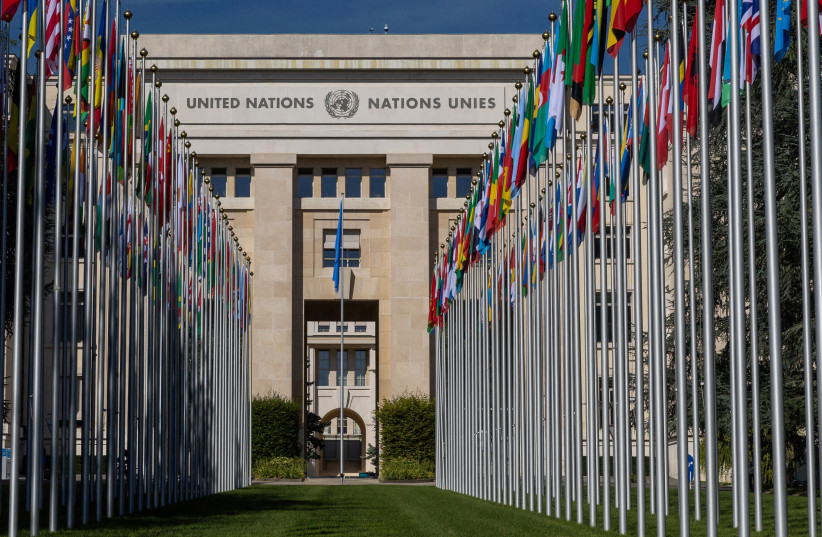
Some may dismiss the UN statement as symbolic or peripheral. But that would be a dangerous mistake. Left unchallenged, it risks shaping a new international consensus. That such a declaration could be issued during an existential crisis is not just misguided – it is, in effect, a call to dismantle the conditions of Israel’s survival.
I have spent my life believing in the promise of the human rights community – imperfect though it may be – as a force capable of restraining the worst impulses of power. That human rights could serve as a shield for the vulnerable. That the memory of our people’s genocide, of persecution and atrocity, could be transformed into enduring principles and democratic values.
Human rights have become weaponized
The shifts we are witnessing in the human rights discourse are not abstract, and they are not just about Israel. They reflect a deeper crisis. When institutions that claim to uphold universal values cannot call out a regime that propagates terror, represses its own population, and systematically denies women’s basic rights – something essential is broken.
If we allow human rights to become a language that is wielded as political weapons rather than moral shields – we will lose the system itself.
What we are witnessing is not merely bias. It is the quiet institutionalization of radical Islam and antisemitism, cloaked in the language of human rights.
To call for the disarmament of Israel at one of the most vulnerable moments in its modern history – when our citizens are still reeling from trauma, when our hostages remain in Gaza, and when Jews are being attacked in cities around the world – is not a call for peace. It is a dangerous fiction, one that erodes the very foundations of human rights.
As Kofi Annan warned in 2004: “The rise of antisemitism anywhere is a threat to people everywhere…. It is therefore rightly said that the United Nations emerged from the ashes of the Holocaust. And a human rights agenda that fails to address antisemitism denies its own history.”
Today, we find ourselves confronting a truth we never imagined we would have to say aloud: that the values we believed in – and to which we have devoted our lives – are now being weaponized against us.
The questions we must ask ourselves now are: What does this mean for the future of humanity? And if this is the path the international system is taking, what future will our children inherit?
The writer is an expert in international law and human rights and a recipient of the 2024 Israel Prize. She is the founder and chair of the Civil Commission on October 7 Crimes by Hamas against Women and Children, teaches at Reichman University, and is a senior fellow at the Shalom Hartman Institute in Jerusalem.