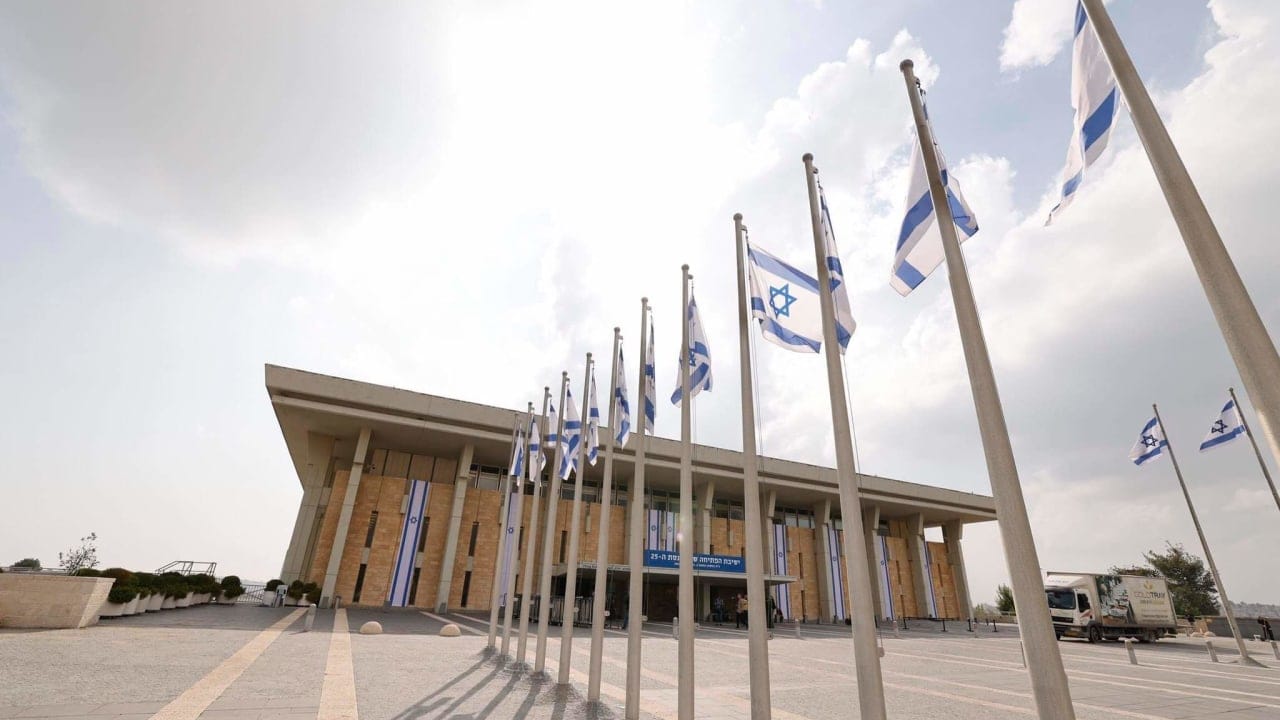
In a rare departure from the current era of polarization, the Knesset is hosting the first meeting of a caucus born of cross-partisan cooperation: the “Caucus for Changing the Electoral System and Advancing Primaries on Election Day,” initiated by Members of Knesset Eitan Ginzburg (Blue and White), Eli Dalal (Likud), and Ohad Tal (Religious Zionism).
“Primaries on Election Day,” as termed by the members of the caucus, is more precisely termed a “semi-open ballot.” This is an electoral system that allows voters to choose not only a party list but also specific candidates. In Israel’s multi-party parliamentary system, Israelis vote only for a political party on Election Day – and in most cases, they do not have any say over the people for whom they would vote to represent them in Knesset.
In this system, each party builds a list of candidates to run on their party list; candidates higher on the list are more likely to have a seat in Knesset, as a party is allocated a number of seats proportionate to its share of the national vote.
So, how would this alternative model of a semi-open ballot system work? The ballot slip for each party list would include the names and order of its candidates (or at least some of them). A voter who wishes to do so could mark the names of several candidates he or she would like to see in the Knesset. When the party votes are counted, the personal votes for candidates will also be tallied. A candidate who receives a substantial number of personal votes could move up to a higher spot on the list.
This is a significant reform, and a much-needed one. It addresses one of the central flaws of Israeli politics: the excessive distance, indeed a real disconnect, between voters and their elected representatives.

The new system would enable voters to participate in politics in a fuller and more precise way, by choosing not only a list as a “package deal,” but also specific candidates within it. It would also dramatically affect the accountability and sense of responsibility of members of Knesset toward the public. MKs would know that on Election Day, each of them must stand personally before hundreds of thousands, even millions, of their party’s voters, with their experience and record to answer for.
This stands in sharp contrast to the current situation, in which an MK’s political future depends primarily on the dominant actor within the party – whether it be a single leader, a party-arranging committee, the party central committee, or primary voters.
Moreover, by shifting part of the weight from the party list as a whole to individual candidates within it, the system is likely to incentivize parties to place higher-quality and more representative candidates on their lists.
Semi-open list system is a more common democratic system
The reform is also justified and logical from a comparative perspective. In almost all established democracies, voters can express support for individual candidates and not only for party lists. In fact, the semi-open list system is the most common electoral model among developed democracies, and is used in countries such as the Netherlands, Belgium, Sweden, Austria, Iceland, the Czech Republic, Slovenia, and others.
In the few democracies where, as in Israel, voters can choose only among party lists (such as Spain, Portugal, Costa Rica, Norway), there are at least electoral districts, unlike in Israel, so citizens vote specifically for representatives of their geographic area. Israel’s system is therefore the most extreme in this respect: it has no personal component, no regional component, and therefore a very tenuous link between voter and elected official.
As noted, the proposal enjoys support across the political spectrum. The caucus was established by MKs from the Center (Blue and White), Likud (Right), and Religious Zionism (far-Right), and a related bill has also been introduced in the current Knesset by a representative of Yesh Atid. The proposal has also garnered backing in civil society from a wide range of organizations, including the Israel Democracy Institute, the Kohelet Policy Forum, the Movement for Quality Government in Israel, Israel 2050, and the Fourth Quarter.
It is important to note that electoral reform made so close to elections (i.e., in an election year) should generally be avoided. Therefore, even if the reform is advanced during the current Knesset term, it should enter into force only ahead of the next Knesset elections (which are scheduled to take place in 2030).
To be sure, there are differences among the specific proposals advanced by each MK and organization, for example, regarding whether the new system would be mandatory for all parties or only for those that choose to adopt it. But the direction is clear: Israel’s electoral system ought to be reformed to include a personal component, one that strengthens voters’ influence and enhances the accountability and responsibility of those elected to serve them.
The writer is the head of the Israel Democracy Institute’s Political Reform Program.