Jerusalem archaeology
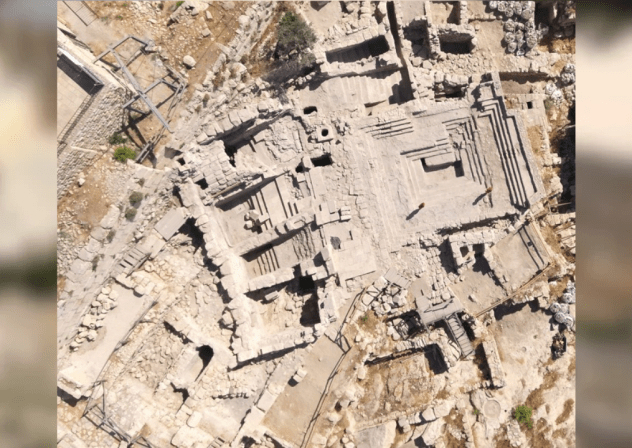
Massive newly-unearthed complex may shed light on how Jewish pilgrims prepared to enter the Temple
The discovery was made during five seasons of excavations, directed by Prof. Uzi Leibner and Prof. Orit Peleg-Barkat of the Hebrew University of Jerusalem’s Institute of Archaeology.

Border Police discover Second Temple-period burial cave during operations in eastern Jerusalem

First Temple-era figurine mold unearthed in Jerusalem's 'most significant excavation' in decades

Days before Tisha B'Av: Charred wooden beams from First Temple’s destruction unearthed in Jerusalem
Was literacy important in the biblical Kingdom of Judah? Expert offers answers
Questions related to literacy in ancient times are not an exclusive prerogative of academic studies on the Israelites.

'Jerusalem Through the Ages': What archaeology reveals about the history of Jerusalem - review
This is both positive and a challenge for readers; it’s dense, meticulous, and sometimes overwhelming.

Largest ever Second Temple era quarry discovered in Har Hotzvim Hi-Tech Park, Jerusalem
Archaeologists excavated 3,500 square meters of earth in one section of the massive quarry.

When Britain’s King George V ‘met’ the founder of its most famous beer, on walls in Jerusalem
These walls continue to talk to us and reveal Jerusalem’s history."

Rare 2,550-year-old silver coin from Persian era uncovered in Jerusalem area
Dr. Robert Kool: “The rare find contributes information concerning the way trade was carried out."

Grapevine: A well-deserved tribute
Movers and shakers in Israeli society.

Earliest systematic weapons production dating back 7,000 years found in Israel
The findings show the mass production of slingstones from the Southern Levant dating back to the Early Chalcolithic period (c. 5800–4500 BCE),

Ancient aqueduct from time of Roman occupation discovered in Jerusalem
The excavation efforts also led to the discovery of a coin from 67/68 CE, during the first Jewish revolt against the Roman occupying forces.

Israel unearths ancient Greek tomb, rare bronze mirror in Jerusalem
The burial cave is rare evidence of the Hellenistic period in the Jerusalem area. It was discovered on a rocky slope not far from Kibbutz Ramat Raḥel.

Steps where Jesus said to heal a blind man unearthed in Jerusalem
The discovery was made by archaeologists during excavation work on the Pool of Siloam. Approximately eight steps were unearthed.
