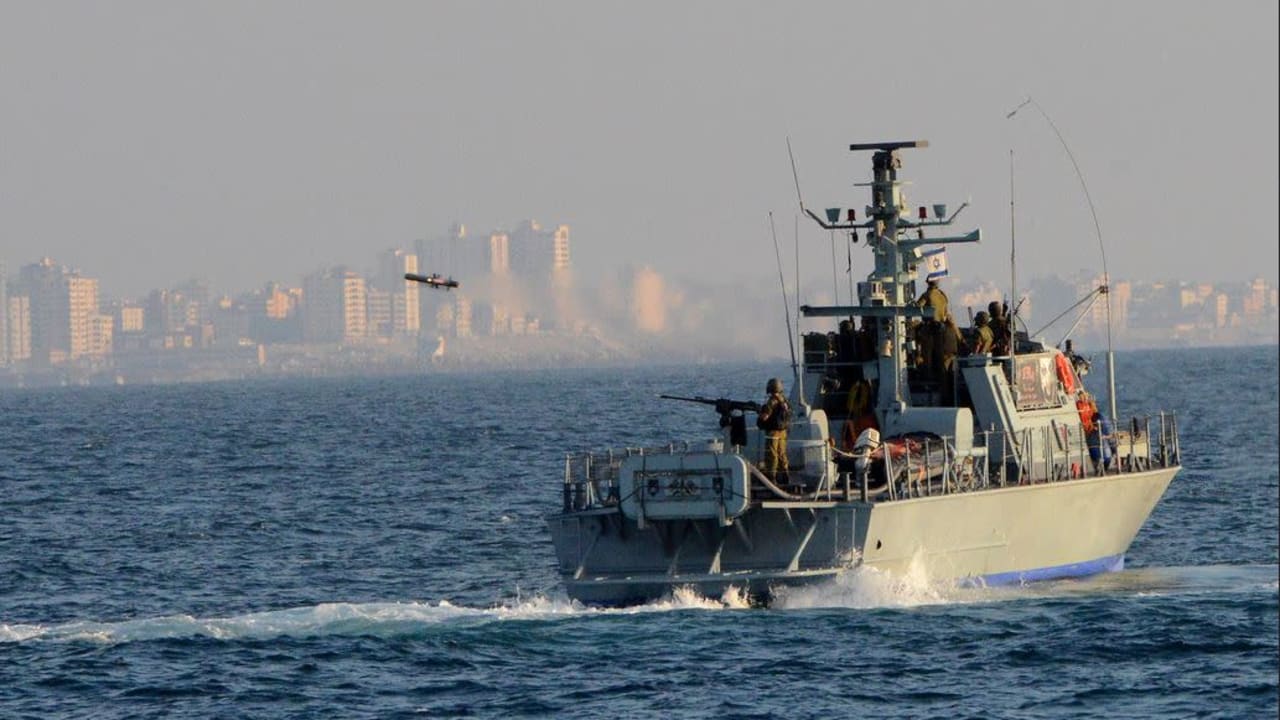
Last year, Israel took delivery of its first Sa’ar 6 Corvette. This new ship and the subsequent class of ships based on it are supposed to help protect Israel’s Exclusive Economic Zone.
An oil spill that began in early February and has decimated Israel’s coastline now brings into the spotlight questions about protecting the EEZ and monitoring potential naval threats. This includes ships that appear like commercial or civilian ships but may threaten Israel.
Israel’s Environmental Protection Ministry has called the oil spill a type of ecological terrorism. If it is terrorism, then it means national security focus needs to prevent future spills like this and other threats.
This took on added importance during the Second Lebanon War and with the development of natural gas platforms and a new gas forum in the East Mediterranean, as well as a potential pipeline to Cyprus and Greece. Some tensions have also been heating up across the Mediterranean.
Israel’s Environmental Protection Ministry says the ship “went dark again before entering Israel's economic waters. Between February 1st and 2nd, the ship polluted Israel's economic waters while in motion and with its equipment turned off. When it reached Syrian territory, it once again turned on its devices. Between February 3 and 14, the tanker unloaded all the crude oil it was carrying onto other vessels.”
Israel naval doctrine has shifted to focus on defending the EEZ. For instance, it needs to defend the Tamar field off Gaza and Leviathan off Haifa, as well as the liquified natural gas port and the Karish-Tanin field, which is around 80-100 km. off the coast. New naval technology includes better detection systems, such as optics, electronic warfare and multi-mission radar that can detect threats up to 200 km. away.
ONE OF the questions that the Emerald affair raises is the importance of tracking all the ships that may enter the EEZ, especially ships that are linked to Iran and that may have been off Iran and then come into waters off the coast of Israel.
Although ships may appear civilian or commercial in nature, a ship that can spill oil can also spill other things or offload threats. Iran, for instance, has been mining ships in the Gulf of Oman. It has in the past trafficked missile technology to Gaza.
Regardless of whether the IDF or Mossad were involved this time, the timeline of the ship and its entrance into and exit from Israel’s EEZ, while turning off its transponder, leads to questions about whether the ship should have been more closely monitored. Had that been done, the oil spill would have been detected earlier.
While it’s unclear if the spill was intentional and whether that constituted ecological terrorism, the next incident may be more grave or come from a different direction.
Israel’s concerns over the need to protect the EEZ are clear in the drive to outfit the Sa’ar 6. In addition, The Jewish state has impressive surveillance assets, from satellites to UAVs. Some of Israel’s UAVs are tasked for naval missions when they have been sold or leased to other countries. These maritime missions, whether for Heron or Hermes or other UAVs, are well suited to track vessels.
In addition, Israel’s Elbit Systems has combined a UAV with an unmanned naval vessel, providing unique capabilities for using ships teamed with UAVs. There is a lot of potential in this technology.
The use of UAVs for maritime missions is increasing. At Italy’s Sigonella Naval Air Station, NATO is supposed to be deploying a Global Hawk derivative.