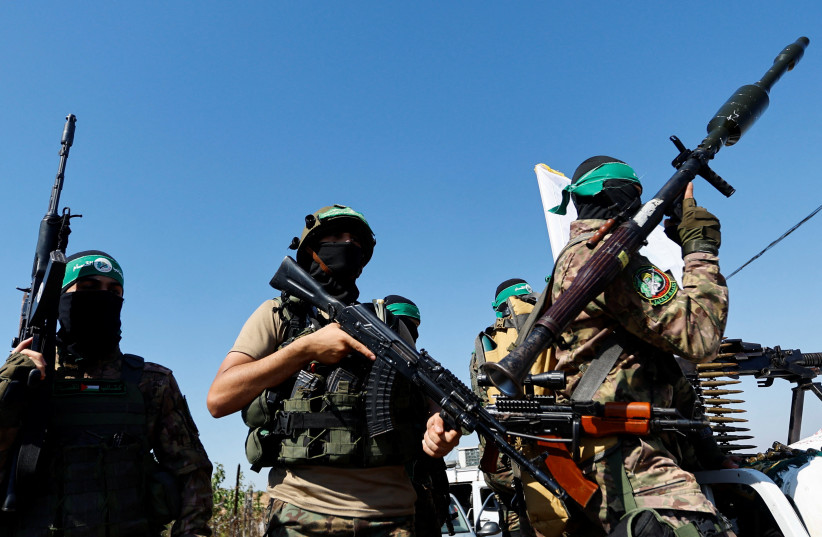
It is important to remember that many regional powers are financing this Hamas campaign, and they certainly would not want to see their investment go down the drain. In order to invest so many millions of dollars, they must be convinced that it has a chance of subduing the enemy, which at the moment is Israel; but in the future, these will be other democratic countries.
Hamas, as every Israeli knows, will not be satisfied with anything that is not a total annihilation of the Zionist entity. So why are they “wasting their assets” in a battle that will not achieve a decisive victory but just some damage to their enemy?
What is their combat doctrine, and what do they want to achieve by massacring children, raping women, kidnapping elderly citizens, and launching 100 rockets a day toward empty fields and some population concentrations? Many are still trying to understand the logic behind this tactic from a military point of view. Understanding the broader context of this campaign could hint to what might happen in the upcoming campaign with Hezbollah.
If you want to defeat an enemy, you have to identify its most critical asset and try to damage it. So, what is the most essential asset of democracies? It is not free speech as people think. In terms of totalitarian regimes, this is precisely the Achilles heel of democracies. From their point of view, given enough time, personal freedoms can accelerate the collapse of democracies. So, what is the most crucial asset that gives democracies a comparative advantage over any other non-democratic system of governance?
They found that the alliance between democratic citizenship, their army, and their government is the most vital asset that ultimately results in democratic supremacy on the battlefield and gives democratic countries a scientific, cultural, and technological advantage that overwhelms non-democratic cultures.
In a democracy, citizens feel that their government works for their safety, happiness, and well-being. The election mechanism is a means to ensure that the elected will continue to work for them. This contrasts with non-democratic countries, where citizens do not expect much from their governors, who mainly exist to ensure their own survival. In most non-democratic regimes, the citizens groan under the burden of the army and its politicians. How, then, do you dismantle or at least cause a lot of damage to the unsigned treaty among these three parties? Non-democratic regimes believe that long-term shocks to this foundation can bring about the collapse of a democracy. To this end, they developed a multi-layered combat doctrine to break this link between the democratic citizen and his state’s institutions. Hamas and its allies have found that in order to shake the trust that democratic citizens have with his leaders and military commanders, they need them to start doubting the ability and good intentions of their leaders and soldiers. They need to cast doubts in the hearts of Israeli citizens that their leaders are not succeeding, despite all efforts and budgets they are pouring into their army to stop the trickling of 100 rockets a day.
As far as Hamas leaders understand, the longer they prolong the time in which they can continue to send 100 rockets a day, the more they will destroy the trust that the Israelis have in their army and leaders, and they will demand to stop the fighting because it doesn’t bring the decisive victory they claim to achieve. If Hamas leaders succeed, despite the many losses their population suffers, in continuing to fire rockets, they are sure that Israelis will resent their leaders and army, and thus over time the long-awaited rift will form that will limit the technological and economic advantages of Israel as a democracy, and it will only be a matter of time until it will be defeated. ■
The writer is a futurist and full professor at Bar-Ilan University’s Faculty of Education, where he heads the Graduate Program in Information and Communication Technology and the Virtual Reality Lab.