Archaeology
Oldest copy of Homer’s Odyssey in book form joins Christopher Nolan's film press tour
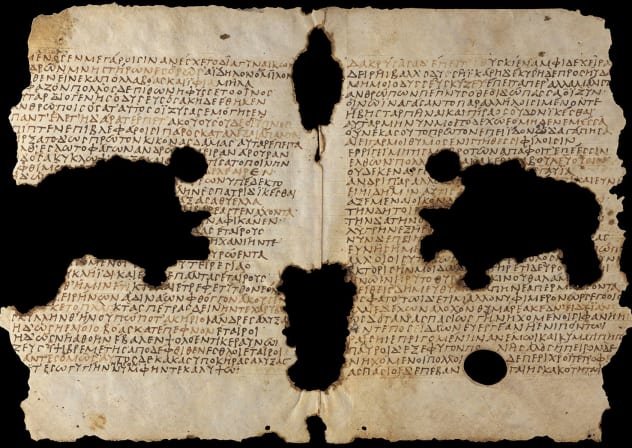
The Manchester Odyssey dates back to the third century BCE in Egypt, around the time scrolls went out of fashion and “bound” books became more popular.

‘Weaponization of cultural heritage’: Israel accuses PA of exploiting UNESCO in bid for Sebastia

Days before Tisha B'Av: Charred wooden beams from First Temple’s destruction unearthed in Jerusalem

Ancient humans precisely navigated northern Israel to find right stones for tools, study suggests
Central-Eastern Europe's oldest Neanderthal group identified by DNA taken from teeth - study
Notably, three of the teeth - two belonging to children and one to an adult - taken from different sediment layers within the cave, all shared identical mitochondrial DNA.

Knesset advances in first reading bill to form Israeli antiquities authority in West Bank
Should the bill pass, it would shift responsibility currently belonging to the Defense Ministry to the Heritage Ministry.

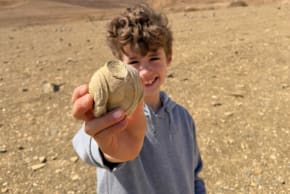
Eight-year-old boy visiting Ramon Crater finds over 1,700-year-old statue fragment hidden in rocks
“I was looking for special things on the ground that I could show in class,” Wolynitz shared. “ Suddenly, I noticed an interesting stone with stripes lying on the ground, and picked it up.”
Wooden platform older than Stonehenge found hidden beneath man-made island in Scotland
The analysis found that the crannog started out as a circular wooden platform, measuring at around 23 meters across, and topped with brushwood.

Scientists find traces of rare 'imperial' Tyrian purple dye found in Roman infant burials in York
Tyrian’s costly nature comes from the difficulty of its creation - made in a process similar to that of tekhelet, the blue dye traditionally used in Judaism to color strings of the tzizit.
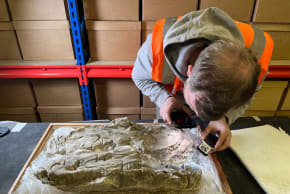
US repatriates over 300 artifacts to Italy, including ancient Roman funerary stone found by FBI
Among the most significant items unveiled at the ceremony were a marble head of Alexander the Great dating to the first century CE, which was stolen from a Rome museum in 1960.

Collection of Greek, Roman, Byzantine artifacts discovered in neighborhood of Egypt’s Alexandria
Professor Ibrahim Mustafa, head of the archaeological mission and director of the Central District, stated that initial restoration work for the artifacts has already started.

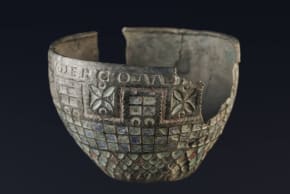
Nearly 2,000-year-old 'souvenir cup' found in Spain names Hadrian's Wall's eastern forts - study
The cup is decorated with red, green, turquoise, and blue enamel, all arranged in geometric patterns, including fish scales and tower motifs that are believed to represent the wall itself.
World's oldest plague mass grave found beneath Roman racetrack in Jordan - study
According to the study, the grave predates the Black Death burial pits from medieval Europe by approximately 800 years.

Mummy CT scan reveal ancient Egyptian might've suffered from osteoperosis
The discovery comes as part of an ongoing study using CT scans to order to analyze the remains of six different mummies, the oldest of which dates back approximately 2,300 year.
