Mars
Japan launches uncrewed space mission to become first to gather samples from Mars' moon Phobos
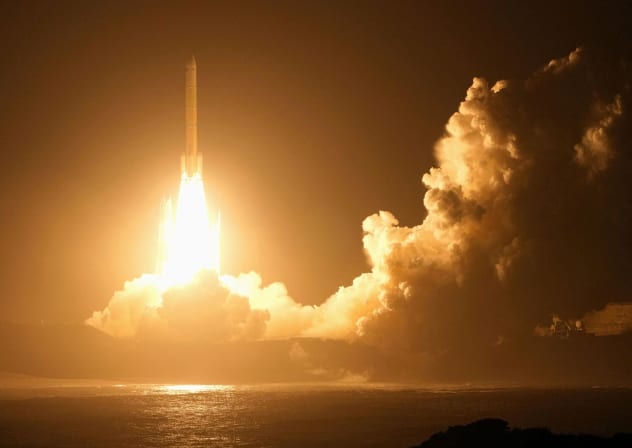
The Japan Aerospace Exploration Agency's Martian Moons eXploration spacecraft lifted off aboard an H3 rocket before dawn from the Tanegashima Space Center in southwestern Japan.

Jordan joins Artemis Accords, int'l principles for exploring Moon, Mars, space, NASA says
Water on Mars? Scientists discover 'bathtub ring' which may reveal contours of ancient ocean

Artemis II astronauts return to Earth after historic crewed mission to the Moon
Can humans survive on Mars?
The medical advances that will change people’s lives

Mars' speed of sound is different than Earth's - study
The SuperCam microphone on the Perseverance has allowed the sounds of Mars to be heard properly, revealing new discoveries.

Can rainbows form on Mars? NASA scientist explains why not
Though Mars has some similar weather features to Earth, factors at play make forming a rainbow impossible on the Red Planet.

Are microbes, methane behind Mars's carbon cycle? Study investigates
Scientists present three possible explanations for what seems to be a very unusual carbon cycle on the red planet. But all three have issues and are unlike anything we have on Earth.
How did Earth, Mars form? Study affirms inner solar system collisions
Earth and Mars were largely formed through planetary embryos made of gathered material and gases in the inner solar system.

Mars may have had water for a very short time, study finds
It is possible water may have existed in the Arabia Terra region, but if it had, it could only have been for a very short period of time.

Mars Curiosity rover captures rare and stunning panorama
The Mars Curiosity rover was dispatched onto the fourth planet from the sun – and closest to Earth – on November 26th, 2011.
AMADEE-20: Israel-based Mars analog mission ends after 3 weeks
The mission was the latest Mars analog mission launched by the Austrian Space Forum (OeWF), held in partnership with the Israel Space Agency (ISA) and the D-MARS habitat.

What does Mars sound like? NASA's Perseverance sends back audio
Because Mars is, as far as we know, uninhabited, and its atmosphere is very thin, the sounds would seem rather dull, but they have provided new understanding of the Martian atmosphere.
'Astronauts' simulate Mars environment in Israel’s Mitzpe Ramon
The mission will run 20 experiments and test methods for searching for signs of life on the Red Planet before it ends on October 31.
