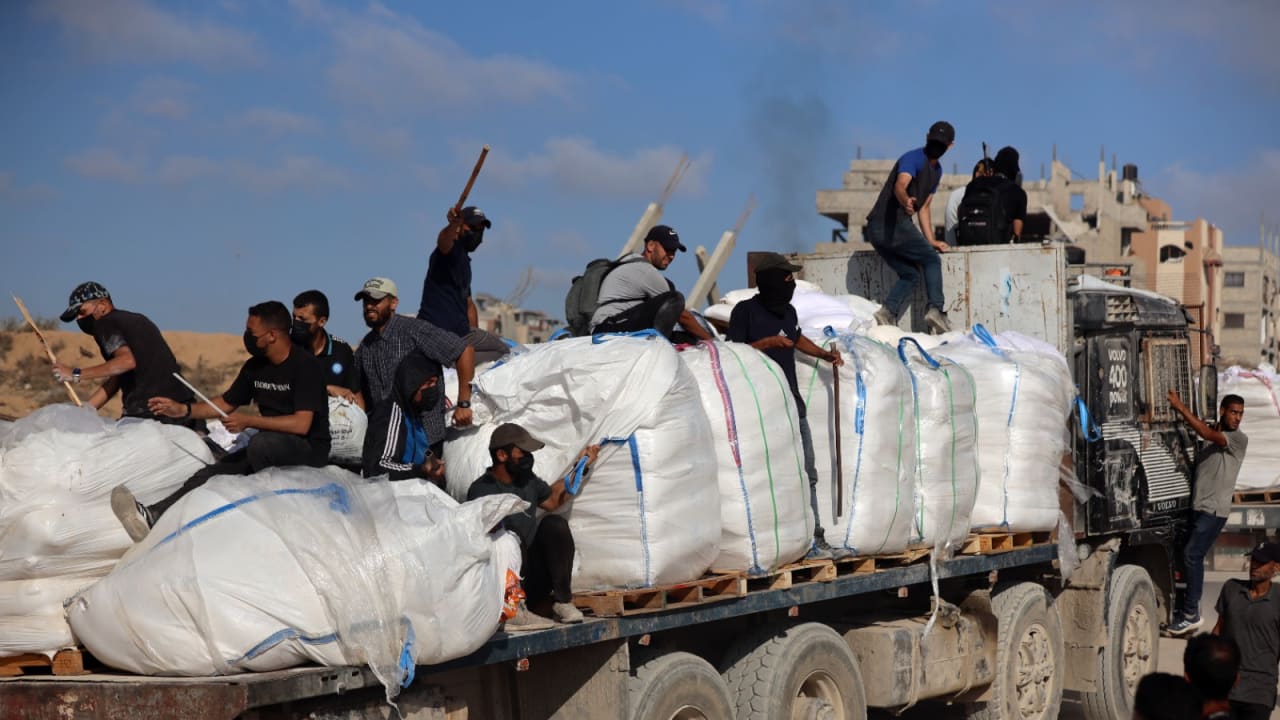
The annual cost of feeding the 2 million residents of the Gaza Strip is estimated at 3.4 billion shekels, Professor Elise Brezis , Chair of the Israeli Macroeconomics Forum and a faculty member at Bar-Ilan University, told N12 on Sunday.
Brezis argued that the current figures being circulated about Gaza's food needs are inaccurate, as they are viewed through a Western lens.
"It's like asking someone living in Mea She'arim how much it costs them to live and then giving them the figure for Tel Aviv," Brezis says. In her opinion, the cost of food in Gaza should be compared to countries such as Burkina Faso and Congo, not European nations.
"You can't compare the cost of living in Gaza to a country where people dine at restaurants, buy groceries at supermarkets, and purchase shoes. The lifestyle in Gaza is more akin to that of Africa," she continues. Brezis argued that when comparing Gaza to countries like Burundi, the cost of feeding Gaza’s population drops to 2 billion shekels.
"If you keep throwing European food at them from planes, it will clearly cost more, but that would be a mistake," Brezis explained. She points to wartime African countries where locals survive by growing their own food as a more accurate comparison.

In an interview with Professor Brezis, N12 attempted to estimate the economic cost of an Israeli occupation of Gaza. Despite recent focus on food supply issues, Brezis stressed that this represented the least expensive aspect of the process. "The real reason we won't be able to survive [in a situation of control over Gaza] is the price inside the country: 350,000 reserve soldiers. This was feasible in the early days after October 7. We’re two years after that now," she said.
“If we're talking about two weeks or a month, we might somehow survive that. But if we’re talking about a year, we can't afford it. The security costs would rise to 50 billion shekels per year,” she estimated. These figures also include the costs of recruiting reserves and armaments.
Additionally, she highlighted the long-term economic impact of massive reserve mobilization: “They aren’t working, they aren’t learning. These are the young people who represent the next generation of our human capital. The problem isn't how much Gaza will cost us, it’s how much the war will cost us.”
Brezis noted that even after occupying the strip, security expenses will remain high. "The military will manage the strip. It will stay the same. You won't send a tax clerk; you’ll send a soldier."
Additional factors increase incurred cost of Israeli occupation in Gaza
Other estimates point to similar costs. A study by Ofer Guterman from the Institute for National Security Studies (INSS), published last April, suggested that maintaining a military occupation of Gaza could cost 25-30 billion shekels annually.
Approximately 20 billion of this would go towards military operations, including reserve days. The additional 5-10 billion shekels would be allocated to running a civil administration mechanism and providing minimal civil services to Gaza's residents.
Guterman noted that prior to Israel's 2005 disengagement, a significant portion of the funding for civil administration came from the profits and taxes generated by Gaza's economy. However, in the current situation of destruction in Gaza, this source of income is no longer available, significantly raising the cost for Israel.
“You need a bureaucratic system, and that has a price,” Brezis said. “In the '70s and '80s, Israel placed civil servants there because it wasn’t dangerous. Today, they’ll place military personnel as civil servants, so we won’t be able to reduce much from the reserve mobilization.”
As someone whose research focuses on development, Brezis also offered suggestions for severing the link between Hamas and Gaza’s population. The key, she asserted, lies in addressing the high percentage of youth in Gaza, an issue she refers to as the "youth bulge."
"Development and demographic studies show that in places where the fertility rate exceeds four children per woman and youth constitute 30%-50% of the population, the likelihood of war is 80%. In contrast, in countries with a fertility rate of two children per woman and youth making up 20%, the likelihood of war drops to 5%-8%," she explained. "If we don't address this, how can we discuss Gaza? There, over 40% of the population is youth, and this helps explain why Hamas took control."
According to Brezis , this age group is particularly vulnerable. "Hormones are raging," she noted, making young people in Gaza susceptible to recruitment by groups like Hamas or other terror or criminal organizations. She argued that Israel must address the population growth rate in Gaza to solve the attraction of such groups.
A policy that encourages reducing birth rates, she suggested, is what helped Japan make an economic leap after World War II, and also helped Qatar reduce its birth rate from seven children per woman in the 1950s to fewer than two today.
"The UN deliberately avoided addressing the population growth rate, silencing groups that called for it," she accused.
The solution, she argued, lies in limiting state aid to families with fewer children. "In every country with more than four children per family, there is a 'Hamasland,'" she concludes.